Joint USAF/NOAA Report of Solar and Geophysical Activity
SDF Number 249 Issued at 2200Z on 05 Sep 2012

IA.  Analysis of Solar Active Regions and Activity from  04/2100Z
to 05/2100Z:  Solar activity was low. Region 1564 (S14E01 -
Esi/beta-gamma) produced occasional C-class flares including a C6 at
05/0347Z and a C7/Sn at 05/0806Z, neither of which were associated
with significant radio emission. Region 1564 showed gradual spot and
penumbral decay during the period, but retained a beta-gamma
configuration due to polarity mixing in the vicinity of its
intermediate spots. Region 1560 (N04W58 - Eai/beta-gamma-delta)
showed minor spot loss in its trailer portion during the period. It
retained a delta within its intermediate spots, but the delta
appeared to be dissipating. The remaining spotted region were
unremarkable. No new regions were numbered. No Earth-directed CME
activity occurred during the period.

IB.  Solar Activity Forecast:  Solar activity is expected to be low
through the period (06 - 08 September) with a chance for an isolated
M-class flare during days 1 - 2.

IIA.  Geophysical Activity Summary 04/2100Z to 05/2100Z:
Geomagnetic field activity ranged from quiet to major storm levels
with a brief period of severe storm levels at high latitudes. An
interplanetary shock passed the ACE spacecraft at 04/2203Z
indicating the arrival of the CMEs observed on 02 September. Field
activity increased to major storm levels during 05/0000 - 0300Z
following the shock, then decreased to minor storm levels during
05/0300 - 0600Z. A further decrease to active levels occurred during
05/0300 - 0900Z. Quiet to unsettled levels occurred during the rest
of the period with active to minor storm levels detected at high
latitudes.

IIB.  Geophysical Activity Forecast:  Geomagnetic field activity is
expected to be at quiet to unsettled levels through the period (06 -
08 September) with a chance for active levels on day 1 due to
possible weak coronal hole high-speed stream effects.

III.  Event Probabilities 06 Sep-08 Sep
Class M    25/25/20
Class X    01/01/01
Proton     01/01/01
PCAF       green
Solar Panel kits Survival kits Latest Solar Flare Activity Solar flare storm
Showing posts with label Wind Storm. Show all posts
Showing posts with label Wind Storm. Show all posts
Wednesday, September 05, 2012
latest solar flare activity sept 5 2012

Saturday, May 05, 2012
Report of Latest Solar Wind Storm Activity May 5 2012
Two M-Class Flares / Sunspot 1476
Solar activity increased to moderate levels thanks to newly numbered Sunspot 1476. This new region rotated into view off the northeast limb and has so far produced a pair of M-Class flares. The latest event was an M1.3 at 23:01 UTC Saturday evening. solar activity is again increasing.
Solar activity increased to moderate levels thanks to newly numbered Sunspot 1476. This new region rotated into view off the northeast limb and has so far produced a pair of M-Class flares. The latest event was an M1.3 at 23:01 UTC Saturday evening. solar activity is again increasing.

Solar Update
Solar activity increased somewhat due to the new sunspot rotating into view off the northeast limb. This region should be numbered 1476 on Saturday. There will be a chance for an M-Class event. All other regions have been fairly quiet with the exception of a C2.0 flare around Sunspot 1471 in the southern hemisphere.
Solar activity increased somewhat due to the new sunspot rotating into view off the northeast limb. This region should be numbered 1476 on Saturday. There will be a chance for an M-Class event. All other regions have been fairly quiet with the exception of a C2.0 flare around Sunspot 1471 in the southern hemisphere.
Updated May 05 2200 UTC

Joint USAF/NOAA Report of Solar and Geophysical Activity
SDF Number 126 Issued at 2200Z on 05 May 2012

IA.  Analysis of Solar Active Regions and Activity from  04/2100Z
to 05/2100Z:  Solar activity was at moderate levels. New Region 1476
(N09E67) produced several C-class flares along with an M1/Sn at
05/1329Z. The regions proximity to the limb makes spot
classification difficult, however, it is currently considered a
Dko-beta type group. Region 1469 (S26W77) continues to produce low
level C-class activity as it rotates around the west limb. A model
run was completed after the forecast was issued yesterday to include
the CME observed off the southwest limb yesterday. It was determined
that the CME has a slight Earth-directed component. A second CME,
first visible in STEREO A COR2 imagery at 05/0309Z, appeared to be
associated with a C1 flare from Region 1469 observed at 04/2350Z.
Although both CMEs have a weak Earth-directed component, neither are
expected to cause significant geomagnetic activity. A third CME
associated with a C2/Sf flare from Region 1470 (S15W31) observed at
05/0639Z, first became visible in SDO AIA imagery at approximately
05/0600Z. Due to the source location, it is probable that the CME is
Earth-directed and a model run is currently in progress to determine
geoeffectiveness.

IB.  Solar Activity Forecast:  Solar activity is expected to be low
with a chance for M-class flares for the next three days (06-08
May).

IIA.  Geophysical Activity Summary 04/2100Z to 05/2100Z:
The geomagnetic field was quiet during the past 24 hours.

IIB.  Geophysical Activity Forecast:  The geomagnetic field is
expected to be quiet on day one (06 May). Quiet to unsettled
conditions are possible on days two and three (07-08 May) due to
weak effects from the CMEs observed on 04 May.
Tuesday, March 06, 2012
Latest Solar Flare Activity: March 2012
Latest Solar Flare Activity: latest news of Solar Flare Activity March 2012:
Big sunspot AR1429 has unleashed another major flare. This one is the strongest yet, an X5-class eruption on March 7th at 00:28 UT. NASA's Solar Dynamics Observatory recorded the extreme UV flash:

Big sunspot AR1429 has unleashed another major flare. This one is the strongest yet, an X5-class eruption on March 7th at 00:28 UT. NASA's Solar Dynamics Observatory recorded the extreme UV flash:
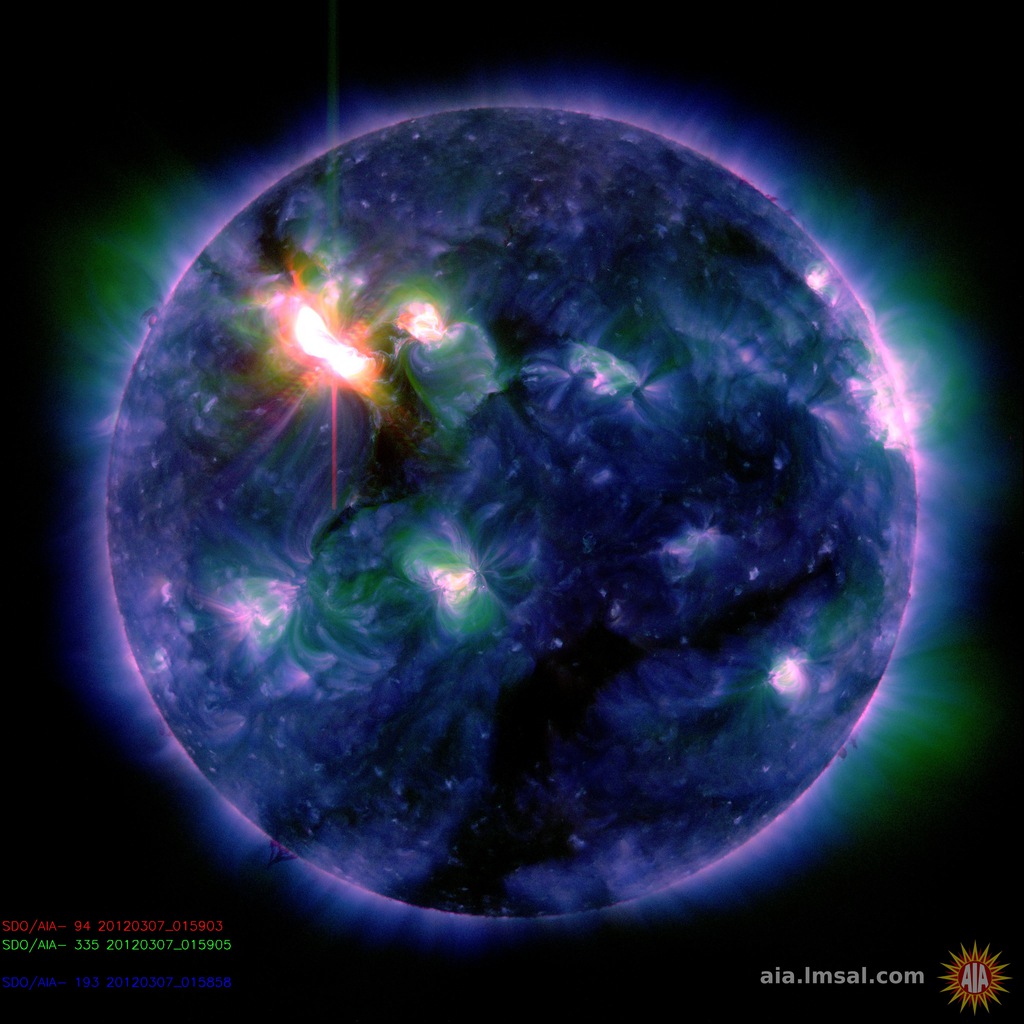
This eruption hurled a bright CME into space. First-look data from STEREO-B are not sufficient to determine if the cloud is heading for Earth. Our best guess is "probably, yes, but not directly toward Earth." A glancing blow to our planet's magnetosphere is possible on March 8th or 9th. Stay tuned for updates
latest news of Solar Flare Activity March 2012
Big sunspot AR1429 has unleashed another major flare. This one is the strongest yet, an X5-class eruption on March 7th at 00:28 UT. NASA's Solar Dynamics Observatory recorded the extreme UV flash:
This eruption hurled a bright CME into space. First-look data from STEREO-B are not sufficient to determine if the cloud is heading for Earth. Our best guess is "probably, yes, but not directly toward Earth." A glancing blow to our planet's magnetosphere is possible on March 8th or 9th. Stay tuned for updates
Tuesday, February 28, 2012
latest Solar and Geophysical Activity
Joint USAF/NOAA Report of Solar and Geophysical Activity
SDF Number 059 Issued at 2200Z on 28 Feb 2012
IA. Analysis of Solar Active Regions and Activity from 27/2100Z
to 28/2100Z: Solar activity was very low during the past 24 hours.
IB. Solar Activity Forecast: Solar activity is expected to be very
low for the next three days (29 Feb - 02 Mar) with just a slight
chance for an isolated C-class flare.
IIA. Geophysical Activity Summary 27/2100Z to 28/2100Z:
The geomagnetic field ranged from quiet to active levels with a
period of minor storm levels at some observatories during the local
nighttime hours. Quiet conditions prevailed from the beginning of
the period until about 07Z when a substorm interval began and
continued through about 09Z. The planetary activity reached active
levels but several individual stations attained minor storm levels
during the disturbance. Activity promptly returned to predominantly
quiet levels after the substorm and remained quiet for the rest of
the period. The disturbance was preceded by about two hours of
southward interplanetary magnetic field (IMF) seen at the ACE
spacecraft (0510-0702Z, with maximum southward deflection of -11
nT). The IMF was otherwise predominantly northwards during the
interval. ACE data also indicated a solar sector boundary crossing
at about 1534Z. The greater than 10 MeV protons observed by GOES
returned to background levels late on the 27th and remained there
through the end of the period.
IIB. Geophysical Activity Forecast: The geomagnetic field is
expected to be quiet for the first two days (29 Feb - 01 Mar). A
slight increase to quiet to unsettled levels is expected on the
third day (02 Mar) due to a small but well positioned coronal hole.
SDF Number 059 Issued at 2200Z on 28 Feb 2012
IA. Analysis of Solar Active Regions and Activity from 27/2100Z
to 28/2100Z: Solar activity was very low during the past 24 hours.
IB. Solar Activity Forecast: Solar activity is expected to be very
low for the next three days (29 Feb - 02 Mar) with just a slight
chance for an isolated C-class flare.
IIA. Geophysical Activity Summary 27/2100Z to 28/2100Z:
The geomagnetic field ranged from quiet to active levels with a
period of minor storm levels at some observatories during the local
nighttime hours. Quiet conditions prevailed from the beginning of
the period until about 07Z when a substorm interval began and
continued through about 09Z. The planetary activity reached active
levels but several individual stations attained minor storm levels
during the disturbance. Activity promptly returned to predominantly
quiet levels after the substorm and remained quiet for the rest of
the period. The disturbance was preceded by about two hours of
southward interplanetary magnetic field (IMF) seen at the ACE
spacecraft (0510-0702Z, with maximum southward deflection of -11
nT). The IMF was otherwise predominantly northwards during the
interval. ACE data also indicated a solar sector boundary crossing
at about 1534Z. The greater than 10 MeV protons observed by GOES
returned to background levels late on the 27th and remained there
through the end of the period.
IIB. Geophysical Activity Forecast: The geomagnetic field is
expected to be quiet for the first two days (29 Feb - 01 Mar). A
slight increase to quiet to unsettled levels is expected on the
third day (02 Mar) due to a small but well positioned coronal hole.
Sunday, February 26, 2012
Latest Solar Flares Feb 2012
Joint USAF/NOAA Report of Solar and Geophysical Activity
SDF Number 056 Issued at 2200Z on 25 Feb 2012
IA. Analysis of Solar Active Regions and Activity from 24/2100Z
to 25/2100Z: Solar activity was very low. Umbral separation was
... observed in Region 1422 (N15W78). Slight decay was observed in the
trailing spots of Region 1424 (N08E52). The rest of the spot groups
were relatively quiet and stable. A filament eruption on the SE
limb was observed in SDO/AIA 304 imagery beginning at 24/1911Z. A
corresponding CME off the SE limb was observed in LASCO C2 imagery
beginning at 24/1948Z. The CME is not expected to be geoeffective.
IB. Solar Activity Forecast: Solar activity is expected to be very
low with a chance for C-class activity for the next three days (26 -
28 February).
IIA. Geophysical Activity Summary 24/2100Z to 25/2100Z:
The geomagnetic field was at quiet to unsettled levels. Isolated
major storm conditions were observed at high latitudes (College)
during the periods ending at 25/1200Z and 25/1500Z. A greater than
10 MeV proton enhancement began at approximately 25/0330Z and
reached a maximum of 3 pfu at 25/1830Z and continued to be enhanced
by the end of the reporting period. The event did not reach event
threshold and likely originated from a backside event.
IIB. Geophysical Activity Forecast: The geomagnetic field is
expected to be mostly quiet on day 1 (26 February). Early on day 2
(27 February), unsettled to active conditions are expected with
minor storm periods possible due to the expected arrival of the 24
February CME. Conditions are expected to calm to quiet to unsettled
levels with active periods possible by day 3 (28 February).
III. Event Probabilities 26 Feb-28 Feb
Class M 01/01/01
Class X 01/01/01
Proton 01/01/01
PCAF green
IV. Penticton 10.7 cm Flux
Observed 25 Feb 108
Predicted 26 Feb-28 Feb 100/100/100
90 Day Mean 25 Feb 129
V. Geomagnetic A Indices
Observed Afr/Ap 24 Feb 006/004
Estimated Afr/Ap 25 Feb 004/006
Predicted Afr/Ap 26 Feb-28 Feb 004/005-011/015-010/010
VI. Geomagnetic Activity Probabilities 26 Feb-28 Feb
A. Middle Latitudes
Active 05/25/20
Minor storm 01/10/05
Major-severe storm 01/01/01
B. High Latitudes
Active 15/30/25
Minor storm 10/25/20
Major-severe storm 05/15/10
SDF Number 056 Issued at 2200Z on 25 Feb 2012
IA. Analysis of Solar Active Regions and Activity from 24/2100Z
to 25/2100Z: Solar activity was very low. Umbral separation was
... observed in Region 1422 (N15W78). Slight decay was observed in the
trailing spots of Region 1424 (N08E52). The rest of the spot groups
were relatively quiet and stable. A filament eruption on the SE
limb was observed in SDO/AIA 304 imagery beginning at 24/1911Z. A
corresponding CME off the SE limb was observed in LASCO C2 imagery
beginning at 24/1948Z. The CME is not expected to be geoeffective.
IB. Solar Activity Forecast: Solar activity is expected to be very
low with a chance for C-class activity for the next three days (26 -
28 February).
IIA. Geophysical Activity Summary 24/2100Z to 25/2100Z:
The geomagnetic field was at quiet to unsettled levels. Isolated
major storm conditions were observed at high latitudes (College)
during the periods ending at 25/1200Z and 25/1500Z. A greater than
10 MeV proton enhancement began at approximately 25/0330Z and
reached a maximum of 3 pfu at 25/1830Z and continued to be enhanced
by the end of the reporting period. The event did not reach event
threshold and likely originated from a backside event.
IIB. Geophysical Activity Forecast: The geomagnetic field is
expected to be mostly quiet on day 1 (26 February). Early on day 2
(27 February), unsettled to active conditions are expected with
minor storm periods possible due to the expected arrival of the 24
February CME. Conditions are expected to calm to quiet to unsettled
levels with active periods possible by day 3 (28 February).
III. Event Probabilities 26 Feb-28 Feb
Class M 01/01/01
Class X 01/01/01
Proton 01/01/01
PCAF green
IV. Penticton 10.7 cm Flux
Observed 25 Feb 108
Predicted 26 Feb-28 Feb 100/100/100
90 Day Mean 25 Feb 129
V. Geomagnetic A Indices
Observed Afr/Ap 24 Feb 006/004
Estimated Afr/Ap 25 Feb 004/006
Predicted Afr/Ap 26 Feb-28 Feb 004/005-011/015-010/010
VI. Geomagnetic Activity Probabilities 26 Feb-28 Feb
A. Middle Latitudes
Active 05/25/20
Minor storm 01/10/05
Major-severe storm 01/01/01
B. High Latitudes
Active 15/30/25
Minor storm 10/25/20
Major-severe storm 05/15/10
Subscribe to:
Posts (Atom)