Showing posts with label current solar. Show all posts

Tuesday, October 15, 2013

Current Solar Flare Activity oct 15 2013

Updated 10/16/2013 @ 00:05 UTC
Impulsive M-Flare
Sunspot 1865 produced an impulsive M1.3 solar flare at 23:36 UTC Tuesday evening. Impulsive flares are not generally known to produce large coronal mass ejections, however I will provide further updates if necessary. Continue to monitor this region for further flare activity. Image below by SDO using the 094 angstroms channel.


Solar Activity

.24 hr Summary...
Solar activity was at moderate levels. Region 1865
(S21W21,Dao/beta-gamma-delta) produced M1 flares at 15/0838 UTC and
15/2336 UTC. An associated coronal mass ejection (CME) subsequently
occurred from the 15/0838 UTC flare. The event appeared narrow and off
plane from an earthward trajectory. The filament related CME from around
15/00 UTC was also determined unlikely to be a geoeffective transient.
Region 1865 maintained an east/west inversion line running through the
adjoined leader spots as well as a beta-gamma-delta configuration.
Region 1861 (S10W45, Dho/beta) showed slight growth in its intermediate
spots and was responsible for multiple C-class flares. A new region
(1872) was numbered near S15E67, and appeared to be  magnetically simple
and inactive.

.Forecast...
Solar activity is expected to be low with a chance for an M-class (R1-R2
Minor to Moderate) flare for the forecast period.  The most likely
regions for M-class flare activity continue to be Regions 1861 and 1865.

Energetic Particle

.24 hr Summary...
The greater than 2 MeV electron flux at geosynchronous orbit was at
normal to moderate levels.  The greater than 10 MeV proton flux at
geosynchronous orbit was at background levels.

.Forecast...
The greater than 2 MeV electron flux at geosynchronous orbit is expected
to be at normal to moderate levels for the forecast period (16-18 Oct). 
The greater than 10 MeV proton flux at geosynchronous orbit is expected
to remain at background levels.

Solar Wind

.24 hr Summary...
Solar wind parameters continued to indicate the influence of a coronal
hole high-speed stream (CH HSS). Speed ranged from 460 to 575 km/s
during the period. IMF total field decreased from a high around 12 nT
early in the period to lows of around 2 nT during the latter half of the
period. Intermittent incidences of negative Bz occurred throughout the
period.

.Forecast...
Enhanced solar wind speed and IMF variability are expected to persist
for the next three days (16-18 Oct) from combined effects of residual CH
HSS and the anticipated arrival of the CME from 13 Oct late on day one
(16 Oct).

Geospace

.24 hr Summary...
The geomagnetic field was at quiet to active levels due to CH HSS and
possible weak CME effects.

.Forecast...
The geomagnetic field is expected to be at quiet to active levels for
day one (16 Oct) due to residual CH HSS conditions early before the
anticipated arrival of the weak CME from 13 October late on day one.
Quiet to active conditions are expected to persist on day 2 (17
Oct).  By day three (18 Oct), conditions are expected to decrease to
mostly quiet levels with unsettled periods as CH HSS and CME effects
wane.


Friday, August 23, 2013

latest solar flare activity august 23 2013

Analysis of Solar Active Regions and latest solar flare activity august 23 2013from 22/2100Z to
23/2100Z: Solar activity has been at low levels for the past 24 hours.
The largest solar event of the period was a C1 event observed at
22/2207Z from Region 1828 (N14E26). There are currently 9 numbered
sunspot regions on the disk.
 
 IB.  Solar Activity Forecast: Solar activity is expected to be low with
a slight chance for an M-class flare on day one (24 Aug) and expected to
be low on days two and three (25 Aug, 26 Aug).


IIA.  Geophysical Activity Summary 22/2100Z to 23/2100Z: The geomagnetic
field has been at quiet to active levels for the past 24 hours. Solar
wind speed, as measured by the ACE spacecraft, reached a peak speed of
593 km/s at 22/2215Z. Total IMF reached 7 nT at 22/2100Z. The maximum
southward component of Bz reached -5 nT at 22/2205Z. Electrons greater
than 2 MeV at geosynchronous orbit reached a peak level of 1857 pfu.

IIB.  Geophysical Activity Forecast: The geomagnetic field is expected
to be at unsettled to minor storm levels on day one (24 Aug), quiet to
minor storm levels on day two (25 Aug) and quiet to unsettled levels on
day three (26 Aug). 
 
Solar activity was low.  Region 1820 (S12W73, Cao/beta) produced a C1 at
23/1557 UTC, which was the largest event of the period.  Region 1830
(S05W64, Dao/beta) showed minor growth while the other regions on the
disk were either stable or decaying.  A narrow coronal mass ejection
(CME) from Region 1820 was observed on LASCO C2 coronagraph imagery at
23/0048 UTC, but was not Earth-directed.

.Forecast...
Solar activity is expected to be low with a slight chance for M-class
flares on day one (24 Aug).  Solar activity is expected to be low for
days two and three (25 - 26 Aug).

Energetic Particle

.24 hr Summary...
The greater than 2 MeV electron flux at geosynchronous orbit was at
normal to high levels, reaching a maximum value of 1,860 pfu at 23/1710
UTC.  The greater than 10 MeV proton flux at geosynchronous orbit was at
background levels.

.Forecast...
The greater than 2 MeV electron flux at geosynchronous orbit is expected
to be at normal to high levels for the next three days (24 - 26 Aug). 
The greater than 10 MeV proton flux at geosynchronous orbit is expected
to remain at background levels for the next three days (24 - 26 Aug).

Solar Wind

.24 hr Summary...
Solar wind parameters, measured at ACE, were indicative of waning
coronal hole high speed stream (CH HSS) influence.  Solar wind speed
steadily decreased from initial values near 560 km/s to end-of-period
values near 475 km/s.  The total field strength ranged from 6 nT to 2 nT
while the Bz component ranged from +4 nT to -5 nT.  The phi angle
remained in a predominately positive (away) sector throughout the
period.

.Forecast...
Solar wind speed is expected to increase on day one (24 Aug) and remain
enhanced for days two and three (25 - 26 Aug) with arrival of the 21 Aug
CME and onset of a CH HSS late on day three.

Geospace

.24 hr Summary...
The geomagnetic field was at quiet to active levels.

.Forecast...
With arrival of the 21 Aug CME, the geomagnetic field is expected to be
at unsettled to G1 (Minor) geomagnetic storm levels on day one (24 Aug),
decreasing to quiet to G1 (Minor) geomagnetic storm levels on day two
(25 Aug).  Predominately quiet to unsettled conditions are expected on
day three (26 Aug) with waning CME effects and the onset of a CH HSS.

Monday, November 12, 2012

Solar Flares Solar activity 11 12 2012

Several M-Class Solar Flares Solar activity picked up in a hurry with the emergence of Sunspot 1613 located in the southern hemisphere. A solar flare reaching M2.0 was detected at 23:28 UTC late monday, followed by an impulsive M6.0 event at 02:04 UTC early Tuesday morning

CME Impact
The ACE Spacecraft detected an interplanetary shock at 22:20 UTC Monday evening. Almost an hour later, A geomagnetic sudden impulse was detected by the ground based magnetometer located in Boulder, Colorado (16 nT @ 23:16 UTC). This signalled the passage of the Coronal Mass Ejection past Earth.
The impact has been fairly minor thus far. The Solar Wind is between 400 and 500 km/s and the Bz component of the interplanetary magnetic field (IMF) is currently pointed North. The Kp index (4) is currently just below the G1 Geomagnetic Storm threshold. Should the Bz tip south for long durations, this could help intensify geomagnetic activity at high latitudes. Skywatchers at very high latitudes should be alert for Aurora.
ALERT: Geomagnetic K-index of 4
Threshold Reached: 2012 Nov 13 0103 UTC
Synoptic Period: 0000-0300 UTC
Active Warning: Yes
WARNING: SUMMARY: Geomagnetic Sudden Impulse
Observed: 2012 Nov 12 2316 UTC
Deviation: 16 nT
Station: Boulder


Prepared jointly by the U.S. Dept. of Commerce, NOAA,
Space Weather Prediction Center and the U.S. Air Force.
Updated 2012 Nov 12 2200 UTC

Joint USAF/NOAA Solar Geophysical Activity Report and Forecast
SDF Number 317 Issued at 2200Z on 12 Nov 2012


IA.  Analysis of Solar Active Regions and Activity from 11/2100Z to
12/2100Z: Solar activity has been at low levels for the past 24 hours.
The largest solar event of the period was a C2 event observed at
12/1022Z from Region 1610 (S22W10). There are currently 8 numbered
sunspot regions on the disk.

IB.  Solar Activity Forecast: Solar activity is expected to be at low to
moderate levels on days one, two, and three (13 Nov, 14 Nov, 15 Nov).


IIA.  Geophysical Activity Summary 11/2100Z to 12/2100Z: The geomagnetic
field has been at quiet levels for the past 24 hours. Solar wind speed,
as measured by the ACE spacecraft, reached a peak speed of 362 km/s at
12/0605Z. Total IMF reached 12 nT at 12/0724Z. The maximum southward
component of Bz reached -8.1 nT at 12/1934Z.

IIB.  Geophysical Activity Forecast: The geomagnetic field is expected
to be at mostly active with a chance for minor storm levels early on day
one (13 Nov) due to the arrival of the CMEs from 09/1524Z and 10/0539Z.
Activity is expected to decrease to generally unsettled levels on day 2
(14 Nov) as CME effects subside. On day 3 (15 Nov) conditions are
expected to return to mostly quiet levels.


III.  Event probabilities 13 Nov-15 Nov
Class M    35/35/35
Class X    05/05/05
Proton     01/01/01
PCAF       green


IV.  Penticton 10.7 cm Flux
Observed           12 Nov 144
Predicted   13 Nov-15 Nov 145/145/150
90 Day Mean        12 Nov 118


V.  Geomagnetic A Indices
Observed Afr/Ap 11 Nov  002/002
Estimated Afr/Ap 12 Nov  005/008
Predicted Afr/Ap 13 Nov-15 Nov  013/015-007/010-006/005


VI.  Geomagnetic Activity Probabilities 13 Nov-15 Nov
A.  Middle Latitudes
Active                35/20/05
Minor Storm           25/05/01
Major-severe storm    05/01/01
B.  High Latitudes
Active                30/20/15
Minor Storm           25/30/10
Major-severe storm    05/25/05
Solar Flares Solar activity 11 12 2012

Wednesday, September 05, 2012

latest solar flare activity sept 5 2012


Joint USAF/NOAA Report of Solar and Geophysical Activity
SDF Number 249 Issued at 2200Z on 05 Sep 2012

IA.  Analysis of Solar Active Regions and Activity from  04/2100Z
to 05/2100Z:  Solar activity was low. Region 1564 (S14E01 -
Esi/beta-gamma) produced occasional C-class flares including a C6 at
05/0347Z and a C7/Sn at 05/0806Z, neither of which were associated
with significant radio emission. Region 1564 showed gradual spot and
penumbral decay during the period, but retained a beta-gamma
configuration due to polarity mixing in the vicinity of its
intermediate spots. Region 1560 (N04W58 - Eai/beta-gamma-delta)
showed minor spot loss in its trailer portion during the period. It
retained a delta within its intermediate spots, but the delta
appeared to be dissipating. The remaining spotted region were
unremarkable. No new regions were numbered. No Earth-directed CME
activity occurred during the period.

IB.  Solar Activity Forecast:  Solar activity is expected to be low
through the period (06 - 08 September) with a chance for an isolated
M-class flare during days 1 - 2.

IIA.  Geophysical Activity Summary 04/2100Z to 05/2100Z:
Geomagnetic field activity ranged from quiet to major storm levels
with a brief period of severe storm levels at high latitudes. An
interplanetary shock passed the ACE spacecraft at 04/2203Z
indicating the arrival of the CMEs observed on 02 September. Field
activity increased to major storm levels during 05/0000 - 0300Z
following the shock, then decreased to minor storm levels during
05/0300 - 0600Z. A further decrease to active levels occurred during
05/0300 - 0900Z. Quiet to unsettled levels occurred during the rest
of the period with active to minor storm levels detected at high
latitudes.

IIB.  Geophysical Activity Forecast:  Geomagnetic field activity is
expected to be at quiet to unsettled levels through the period (06 -
08 September) with a chance for active levels on day 1 due to
possible weak coronal hole high-speed stream effects.

III.  Event Probabilities 06 Sep-08 Sep
Class M    25/25/20
Class X    01/01/01
Proton     01/01/01
PCAF       green

Wednesday, July 04, 2012

latest Solar flare storm and Geophysical Activity july 04 2012

M4.7 + M4.6 Flares
The 4th of July fireworks continue. A moderate solar flare reaching M4.6 peaked at 22:09 UTC Wednesday evening. The source was active Sunspot 1515. Moderate to Strong solar flares are now taking place frequently and there is now an increased chance for a major X-Class solar flare within the next 24-48 hours. Below is an updated list of today's solar flare events.


UPDATE: An impulsive solar flare reaching M4.7 was just detected at 03:36 UTC Thursday morning.

M4.7 @ 03:36 UTC - (Sunspot 1515)
M2.2 @ 02:42 UTC - (Sunspot 1515)
M2.4 @ 01:10 UTC - (Sunspot 1515)
M4.6 @ 22:09 UTC - (Sunspot 1515)
M1.8 @ 16:39 UTC - (Sunspot 1513) "Earth directed CME possible"
M2.3 @ 12:24 UTC - (Sunspot 1515)
M5.3 @ 09:55 UTC - (Sunspot 1515) "Non Earth directed CME generated"

Updated 7/4/2012 @ 23:10 UTC
Sunspot 1513 Erupts
Yet another M-Class flare, however this time it was centered around Sunspot 1513 in the northern hemisphere. The latest event measured M1.8 @ 16:39 UTC. A nice eruption is captured by SDO below.

Wednesday, June 13, 2012

latest Solar flare and Geophysical Activity june13 2012


Joint USAF/NOAA Report of Solar and Geophysical Activity
SDF Number 164 Issued at 2200Z on 12 Jun 2012

IA.  Analysis of Solar Active Regions and Activity from  11/2100Z
to 12/2100Z:  Solar activity was low.  Regions 1506 (N11E38), 1504
(S17E28), and 1507 (S27E02) were the most active regions on the
disk.  Each region was responsible for multiple C-flares during the
period.  The largest of these came from Region 1506 which produced a
C2 flare at 12/0315Z.  All three of these regions have shown signs
of growth.  There were no Earth-directed CMEs observed during the
period.

IB.  Solar Activity Forecast:  Solar activity is expected to be low
to moderate.  There is a chance for an isolated M-class event from
Region 1504.

IIA.  Geophysical Activity Summary 11/2100Z to 12/2100Z:
The geomagnetic field ranged from quiet to minor storm levels.  Minor
storm levels were reached from 11/2100Z to 12/0300Z.  This was
followed by an active period from 12/0300Z to 12/0600Z.  Solar wind
observations indicated a sustained interval of negative Bz from
11/1500Z to 12/0200Z with peak values around -10nT.  In addition,
the data indicated a solar sector boundary crossing starting late on
the 11th.

IIB.  Geophysical Activity Forecast:  Geomagnetic activity is
expected to be quiet to unsettled on day 1 (June 13).  Quiet levels
are expected for 14-15 June.

Tuesday, March 06, 2012

Latest Solar Flare Activity: March 2012

Latest Solar Flare Activity: latest news of Solar Flare Activity March 2012:

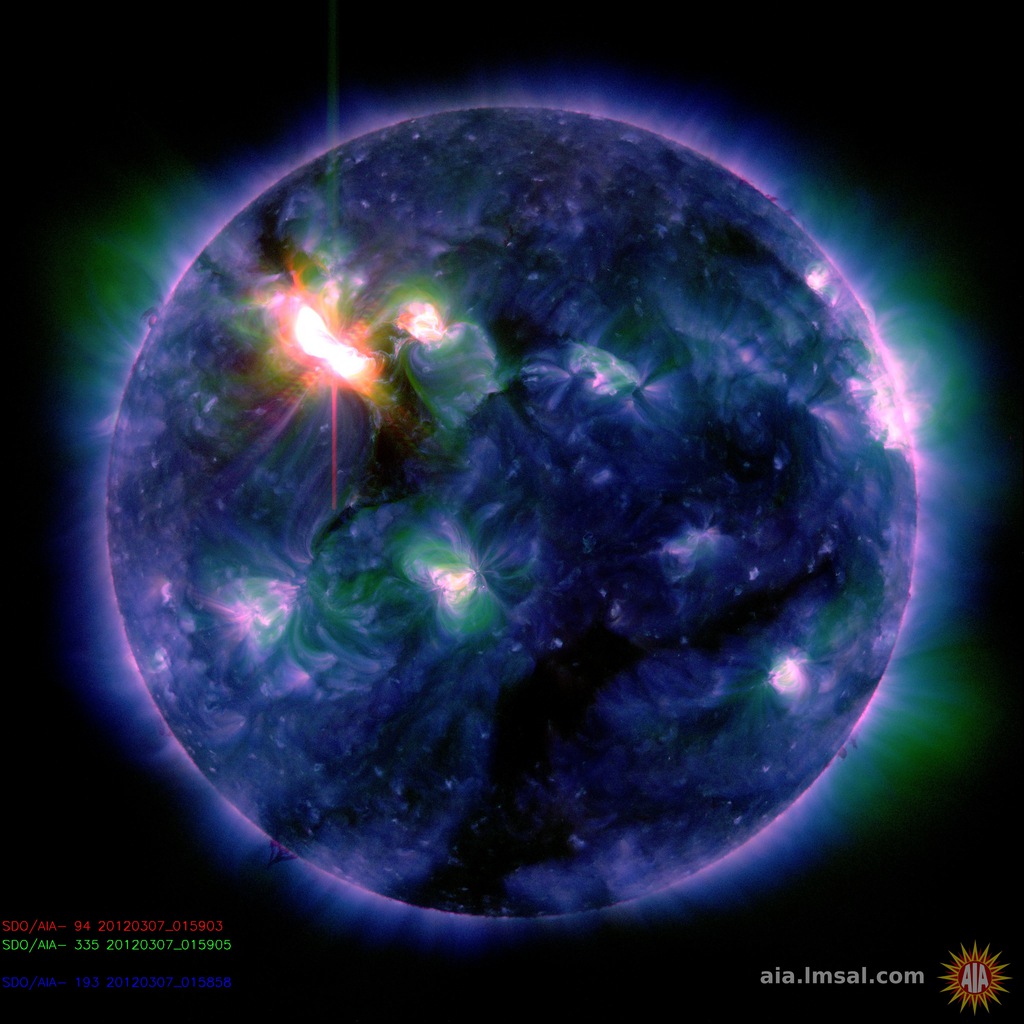
Big sunspot AR1429 has unleashed another major flare. This one is the strongest yet, an X5-class eruption on March 7th at 00:28 UT. NASA's Solar Dynamics Observatory recorded the extreme UV flash:
This eruption hurled a bright CME into space. First-look data from STEREO-B are not sufficient to determine if the cloud is heading for Earth. Our best guess is "probably, yes, but not directly toward Earth." A glancing blow to our planet's magnetosphere is possible on March 8th or 9th. Stay tuned for updates

latest news of Solar Flare Activity March 2012

Big sunspot AR1429 has unleashed another major flare. This one is the strongest yet, an X5-class eruption on March 7th at 00:28 UT. NASA's Solar Dynamics Observatory recorded the extreme UV flash:
This eruption hurled a bright CME into space. First-look data from STEREO-B are not sufficient to determine if the cloud is heading for Earth. Our best guess is "probably, yes, but not directly toward Earth." A glancing blow to our planet's magnetosphere is possible on March 8th or 9th. Stay tuned for updates

Thursday, March 01, 2012

Report of Solar flare Activity

Prepared jointly by the U.S. Dept. of Commerce, NOAA,
Space Weather Prediction Center and the U.S. Air Force.

Updated Mar 01 2200 UTC

Joint USAF/NOAA Report of Solar and Geophysical Activity
SDF Number 061 Issued at 2200Z on 01 Mar 2012

IA.  Analysis of Solar Active Regions and Activity from  29/2100Z
to 01/2100Z:  Solar activity has been low. There was one C-class
flare duing the past 24 hours, a C3/1f from Region 1423 (N17W21) at
01/1526Z. New Region 1427 (N15W01) was numbered today. A CME was
observed at 29/1824Z (using LASCO C2) from the north polar region of
the sun, however it is not expected to be geoeffective.

IB.  Solar Activity Forecast:  Solar activity is expected to be very
low to low.

IIA.  Geophysical Activity Summary 29/2100Z to 01/2100Z:
The geomagnetic field has been quiet to active with isolated storm
periods at high latitudes. The elevated activity appears to be
related to a solar sector boundary crossing.

IIB.  Geophysical Activity Forecast:  The geomagnetic field is
expected to be quiet to unsettled for the first and second days
(02-03 Mar) due to a small yet well positioned coronal hole.  A
return to quiet levels is expected on the third day (04 Mar).

III.  Event Probabilities 02 Mar-04 Mar
Class M    01/01/01
Class X    01/01/01
Proton     01/01/01
PCAF       green

latest Report of Solar flare and Geophysical Activity

Latest Report of Solar flare and Geophysical Activity
Joint USAF/NOAA Report of Solar and Geophysical Activity
SDF Number 060 Issued at 2200Z on 29 Feb 2012

IA. Analysis of Solar Active Regions and Activity from 28/2100Z
to 29/2100Z: Solar activity has been very low for the past 24 hours.
A series of CMEs were observed over the west limb at 29/0125Z,
29/0924Z, and 29/1212Z. Stereo-A imagery confirm the source regions
were behind the west limb and none of these are expected to be
geoeffective.

IB. Solar Activity Forecast: Solar activity is expected to be very
low.

IIA. Geophysical Activity Summary 28/2100Z to 29/2100Z:
The geomagnetic field has been mostly quiet.

IIB. Geophysical Activity Forecast: The geomagnetic field is
expected to be quiet for the first day (01 Mar). A slight increase
to quiet to unsettled levels is expected on the second day (02 Mar)
due to a small coronal hole. Quiet levels are expected on the third
day (03 Mar).

Solar Update / New Record

Solar activity continues on at very low levels.There is currently no chance for strong solar flares. A new sunspot is trying to form to the east of sunspot 1423 and is pictured below.

Despite the lack of Sunspots, February 29th will mark the 199th day in a row with an official visible Sunspot counted by SWPC Space Weather Operations (SWO). This is a new record for Cycle 24 and beats the previous record of 198 days set on August 13, 2011.

Tuesday, February 28, 2012

latest Solar and Geophysical Activity

Joint USAF/NOAA Report of Solar and Geophysical Activity
SDF Number 059 Issued at 2200Z on 28 Feb 2012

IA. Analysis of Solar Active Regions and Activity from 27/2100Z
to 28/2100Z: Solar activity was very low during the past 24 hours.

IB. Solar Activity Forecast: Solar activity is expected to be very
low for the next three days (29 Feb - 02 Mar) with just a slight
chance for an isolated C-class flare.

IIA. Geophysical Activity Summary 27/2100Z to 28/2100Z:
The geomagnetic field ranged from quiet to active levels with a
period of minor storm levels at some observatories during the local
nighttime hours. Quiet conditions prevailed from the beginning of
the period until about 07Z when a substorm interval began and
continued through about 09Z. The planetary activity reached active
levels but several individual stations attained minor storm levels
during the disturbance. Activity promptly returned to predominantly
quiet levels after the substorm and remained quiet for the rest of
the period. The disturbance was preceded by about two hours of
southward interplanetary magnetic field (IMF) seen at the ACE
spacecraft (0510-0702Z, with maximum southward deflection of -11
nT). The IMF was otherwise predominantly northwards during the
interval. ACE data also indicated a solar sector boundary crossing
at about 1534Z. The greater than 10 MeV protons observed by GOES
returned to background levels late on the 27th and remained there
through the end of the period.

IIB. Geophysical Activity Forecast: The geomagnetic field is
expected to be quiet for the first two days (29 Feb - 01 Mar). A
slight increase to quiet to unsettled levels is expected on the
third day (02 Mar) due to a small but well positioned coronal hole.

Sunday, February 26, 2012

Latest Solar Flares Feb 2012

Joint USAF/NOAA Report of Solar and Geophysical Activity
SDF Number 056 Issued at 2200Z on 25 Feb 2012

IA. Analysis of Solar Active Regions and Activity from 24/2100Z
to 25/2100Z: Solar activity was very low. Umbral separation was
... observed in Region 1422 (N15W78). Slight decay was observed in the
trailing spots of Region 1424 (N08E52). The rest of the spot groups
were relatively quiet and stable. A filament eruption on the SE
limb was observed in SDO/AIA 304 imagery beginning at 24/1911Z. A
corresponding CME off the SE limb was observed in LASCO C2 imagery
beginning at 24/1948Z. The CME is not expected to be geoeffective.

IB. Solar Activity Forecast: Solar activity is expected to be very
low with a chance for C-class activity for the next three days (26 -
28 February).

IIA. Geophysical Activity Summary 24/2100Z to 25/2100Z:
The geomagnetic field was at quiet to unsettled levels. Isolated
major storm conditions were observed at high latitudes (College)
during the periods ending at 25/1200Z and 25/1500Z. A greater than
10 MeV proton enhancement began at approximately 25/0330Z and
reached a maximum of 3 pfu at 25/1830Z and continued to be enhanced
by the end of the reporting period. The event did not reach event
threshold and likely originated from a backside event.

IIB. Geophysical Activity Forecast: The geomagnetic field is
expected to be mostly quiet on day 1 (26 February). Early on day 2
(27 February), unsettled to active conditions are expected with
minor storm periods possible due to the expected arrival of the 24
February CME. Conditions are expected to calm to quiet to unsettled
levels with active periods possible by day 3 (28 February).

III. Event Probabilities 26 Feb-28 Feb
Class M 01/01/01
Class X 01/01/01
Proton 01/01/01
PCAF green

IV. Penticton 10.7 cm Flux
Observed 25 Feb 108
Predicted 26 Feb-28 Feb 100/100/100
90 Day Mean 25 Feb 129

V. Geomagnetic A Indices
Observed Afr/Ap 24 Feb 006/004
Estimated Afr/Ap 25 Feb 004/006
Predicted Afr/Ap 26 Feb-28 Feb 004/005-011/015-010/010

VI. Geomagnetic Activity Probabilities 26 Feb-28 Feb
A. Middle Latitudes
Active 05/25/20
Minor storm 01/10/05
Major-severe storm 01/01/01
B. High Latitudes
Active 15/30/25
Minor storm 10/25/20
Major-severe storm 05/15/10