Showing posts with label solar wind. Show all posts

Monday, February 24, 2014

Solar Active Regions and Activity feb 23 2014

Activity again reached moderate levels due to a low level M-Flare (M1.2) at 11:17 UTC Monday morning. Most flare activity, including the M1.2 flare, is being centered around former region 1967 which is now returning into view off the east limb. A dark core belonging to the long lasting active region is now visible in the latest imagery. It appears that 1967 is in an advanced state of decay and may no longer be a large threat for strong X-Class solar flares. We will have a better look at the entire region within the next 24 hours. Elsewhere, sunspot duo 1981-1982 remains stable as it transits the center of the visible disk. All other regions, including region 1987, remain quiet. There will continue to be a chance for an isolated M-Class event with regions 1981-1982 and returning region 1967 being the likely source. 

Analysis of Solar Active Regions and Activity from 23/2100Z to
24/2100Z: Solar activity has been at moderate levels for the past 24
hours. The largest solar event of the period was a M1 event observed at
24/1205Z. There are currently 5 numbered sunspot regions on the disk.
IB.  Solar Activity Forecast: Solar activity is likely to be moderate
with a slight chance for an X-class flare on days one, two, and three
(25 Feb, 26 Feb, 27 Feb).

IIA.  Geophysical Activity Summary 23/2100Z to 24/2100Z: The geomagnetic
field has been at quiet to active levels for the past 24 hours. Solar
wind speed, as measured by the ACE spacecraft, reached a peak speed of
589 km/s at 24/0550Z. Total IMF reached 9 nT at 23/2224Z. The maximum
southward component of Bz reached -3 nT at 23/2101Z.
IIB.  Geophysical Activity Forecast: The geomagnetic field is expected
to be at quiet to unsettled levels on days one and three (25 Feb, 27
Feb) and quiet levels on day two (26 Feb).

III.  Event probabilities 25 Feb-27 Feb
Class M    60/60/60
Class X    10/10/10
Proton     01/01/01
PCAF       green

IV.  Penticton 10.7 cm Flux
Observed           24 Feb 171
Predicted   25 Feb-27 Feb 175/180/180
90 Day Mean        24 Feb 157

V.  Geomagnetic A Indices
Observed Afr/Ap 23 Feb  012/017
Estimated Afr/Ap 24 Feb  008/007
Predicted Afr/Ap 25 Feb-27 Feb  009/008-006/005-007/007

VI.  Geomagnetic Activity Probabilities 25 Feb-27 Feb
A.  Middle Latitudes
Active                10/05/15
Minor Storm           01/01/05
Major-severe storm    01/01/01
B.  High Latitudes
Active                15/15/15
Minor Storm           20/15/25
Major-severe storm    20/05/25

Tuesday, January 07, 2014

Major Solar Flare activity - jan 7 2014

  Major Solar Flare Detected + CME
A major solar flare measuring X1.2 was detected on Tuesday afternoon peaking at 18:30 UTC. The source of the eruption was region 1943, with interaction between sunspot 1944. Because the flare appears to be long in duration, a coronal mass ejection is possible (see below). The blast site is in a great geoeffective position for Earth directed eruptions. Attached image by the Solar Dyanamics Observatory (SDO) below, captures a "wave" of plasma racing away from the blast site.


Prepared jointly by the U.S. Dept. of Commerce, NOAA,
Space Weather Prediction Center and the U.S. Air Force.
UPDATED 2014 Jan 07 1230 UTC

.24 hr Summary...
Solar activity reached high levels during the past 24 hours. Region 1944
(S09E06, Fkc/beta-gamma-delta) remained the largest, most complex spot
group on the visible disk and produced the largest flare of the period,
a M7/2b flare at 07/1013 UTC. The flare had an associated 10 cm
Castelli-U radio burst with a peak flux of 409 sfu. This region
continued to exhibit growth, mainly in its leader spots, and produced
several low-level C-class flares throughout the period. Region 1946
(N09E01, Dac/beta-gamma) was the second largest region on the visible
disk and produced the second largest flare of the period, a M1/1n flare
at 07/0353 UTC. It showed signs of consolidation in the trailer spots as
well as separation between the intermediate and trailer spots, and was
responsible for additional low-level C-class flares. The remaining five
spot groups on the visible disk were either stable or showed signs of
decay. Analysis of any coronal mass ejection activity associated with
either the M1 or the M7 flare will be conducted as imagery becomes
available.
   
.Forecast...
Solar activity is expected to remain at moderate levels (R1-Minor to
R2-Moderate) for the next three days (07-09 Jan) with a chance for
X-class (R3-Strong) flares from active Regions 1944 and 1946.  

ALERT: Type II Radio Emission
Begin Time: 2014 Jan 07 1817 UTC
Estimated Velocity: 1064 km/s
Description: Type II emissions occur in association with eruptions on the sun and typically indicate a coronal mass ejection is associated with a flare event.
Updated 01/07/2014 @ 15:30 UTC
CME Sweeps Past Earth
The ACE Spacecraft detected a solar wind increase to above 400km/s at 14:25 UTC. A geomagnetic sudden impulse measuring 7 nT was detected by the Boulder, Colorado magnetometer at 15:15 UTC. This signals the passage of an expected coronal mass ejection (CME) past our planet. The initial impact appears to be weak.

Friday, June 08, 2012

Latest solar flare storm news June 8 2012

Prepared jointly by the U.S. Dept. of Commerce, NOAA,
Space Weather Prediction Center and the U.S. Air Force.

Updated Jun 07 2200 UTC

Joint USAF/NOAA Report of Solar and Geophysical Activity
SDF Number 159 Issued at 2200Z on 07 Jun 2012

IA. Analysis of Solar Active Regions and Activity from 06/2100Z
to 07/2100Z: Solar activity was low. Several C-class flares were
observed over the past 24 hours. The largest was a C9/2n flare
observed at 07/1543Z from Region 1499 (N15W09). This region
produced five other low level C-class flares during the period.
Region 1494 (S18W19) grew slightly and was also responsible for five
low level C-class flares during the period. These regions were
classied as Cai and Dso type groups, respectively, both with
beta-gamma magnetic characteristics. Region 1497 (S21W44) decreased
in areal extent since yesterday, but remained the largest region on
the disk and was classified as a Dai type group with beta magnetic
characteristics.

IB. Solar Activity Forecast: Solar activity is expected to be low
with a chance for isolated M-class activity.

IIA. Geophysical Activity Summary 06/2100Z to 07/2100Z:
The geomagnetic field began at unsettled to active levels, decreasing
to quiet levels for the remainder of the period. The solar wind
speed at the ACE spacecraft decreased from 700 to 600 km/s over the
past 24 hours. The Bz component of the interplanetary magnetic
field ranged between +/- 4nT while the total field remained around 4
nT. The greater than 2 MeV electron flux at geosynchronous orbit was
at high levels throughout the period.

IIB. Geophysical Activity Forecast: The geomagnetic field is
expected to begin the forecast period at unsettled levels with a
chance for active conditons on day one (08 June) as coronal effects
wane and a weak CME from 05 June arrives. Quiet conditions are
expected on day two (09 June) followed by a return to unsettled
conditions with a chance for active periods on day three (10 June)
with the potential arrival of a CME from 06 June.

Tuesday, March 06, 2012

Latest Solar Flare Activity: March 2012

Latest Solar Flare Activity: latest news of Solar Flare Activity March 2012:

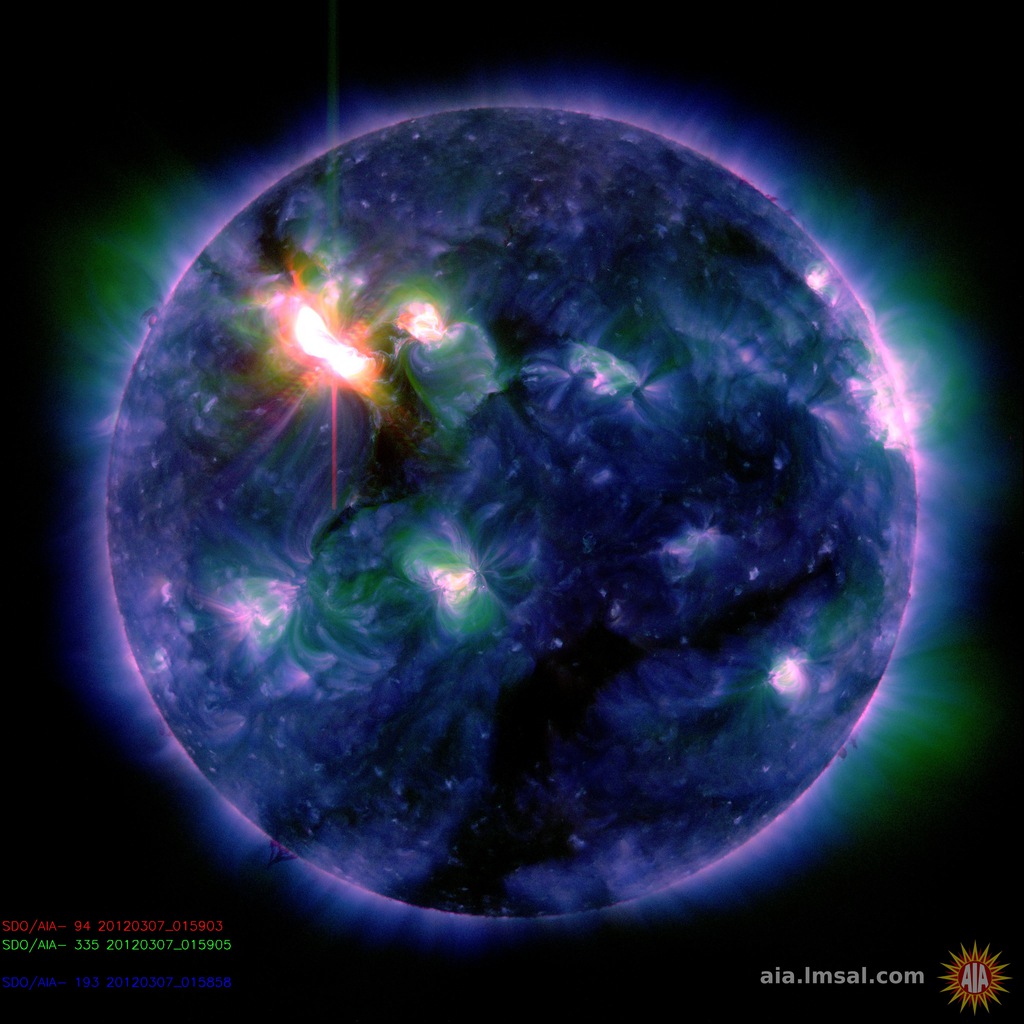
Big sunspot AR1429 has unleashed another major flare. This one is the strongest yet, an X5-class eruption on March 7th at 00:28 UT. NASA's Solar Dynamics Observatory recorded the extreme UV flash:
This eruption hurled a bright CME into space. First-look data from STEREO-B are not sufficient to determine if the cloud is heading for Earth. Our best guess is "probably, yes, but not directly toward Earth." A glancing blow to our planet's magnetosphere is possible on March 8th or 9th. Stay tuned for updates

latest news of Solar Flare Activity March 2012

Big sunspot AR1429 has unleashed another major flare. This one is the strongest yet, an X5-class eruption on March 7th at 00:28 UT. NASA's Solar Dynamics Observatory recorded the extreme UV flash:
This eruption hurled a bright CME into space. First-look data from STEREO-B are not sufficient to determine if the cloud is heading for Earth. Our best guess is "probably, yes, but not directly toward Earth." A glancing blow to our planet's magnetosphere is possible on March 8th or 9th. Stay tuned for updates

Thursday, March 01, 2012

Report of Solar flare Activity

Prepared jointly by the U.S. Dept. of Commerce, NOAA,
Space Weather Prediction Center and the U.S. Air Force.

Updated Mar 01 2200 UTC

Joint USAF/NOAA Report of Solar and Geophysical Activity
SDF Number 061 Issued at 2200Z on 01 Mar 2012

IA.  Analysis of Solar Active Regions and Activity from  29/2100Z
to 01/2100Z:  Solar activity has been low. There was one C-class
flare duing the past 24 hours, a C3/1f from Region 1423 (N17W21) at
01/1526Z. New Region 1427 (N15W01) was numbered today. A CME was
observed at 29/1824Z (using LASCO C2) from the north polar region of
the sun, however it is not expected to be geoeffective.

IB.  Solar Activity Forecast:  Solar activity is expected to be very
low to low.

IIA.  Geophysical Activity Summary 29/2100Z to 01/2100Z:
The geomagnetic field has been quiet to active with isolated storm
periods at high latitudes. The elevated activity appears to be
related to a solar sector boundary crossing.

IIB.  Geophysical Activity Forecast:  The geomagnetic field is
expected to be quiet to unsettled for the first and second days
(02-03 Mar) due to a small yet well positioned coronal hole.  A
return to quiet levels is expected on the third day (04 Mar).

III.  Event Probabilities 02 Mar-04 Mar
Class M    01/01/01
Class X    01/01/01
Proton     01/01/01
PCAF       green

latest Report of Solar flare and Geophysical Activity

Latest Report of Solar flare and Geophysical Activity
Joint USAF/NOAA Report of Solar and Geophysical Activity
SDF Number 060 Issued at 2200Z on 29 Feb 2012

IA. Analysis of Solar Active Regions and Activity from 28/2100Z
to 29/2100Z: Solar activity has been very low for the past 24 hours.
A series of CMEs were observed over the west limb at 29/0125Z,
29/0924Z, and 29/1212Z. Stereo-A imagery confirm the source regions
were behind the west limb and none of these are expected to be
geoeffective.

IB. Solar Activity Forecast: Solar activity is expected to be very
low.

IIA. Geophysical Activity Summary 28/2100Z to 29/2100Z:
The geomagnetic field has been mostly quiet.

IIB. Geophysical Activity Forecast: The geomagnetic field is
expected to be quiet for the first day (01 Mar). A slight increase
to quiet to unsettled levels is expected on the second day (02 Mar)
due to a small coronal hole. Quiet levels are expected on the third
day (03 Mar).

Solar Update / New Record

Solar activity continues on at very low levels.There is currently no chance for strong solar flares. A new sunspot is trying to form to the east of sunspot 1423 and is pictured below.

Despite the lack of Sunspots, February 29th will mark the 199th day in a row with an official visible Sunspot counted by SWPC Space Weather Operations (SWO). This is a new record for Cycle 24 and beats the previous record of 198 days set on August 13, 2011.

Tuesday, February 28, 2012

latest Solar and Geophysical Activity

Joint USAF/NOAA Report of Solar and Geophysical Activity
SDF Number 059 Issued at 2200Z on 28 Feb 2012

IA. Analysis of Solar Active Regions and Activity from 27/2100Z
to 28/2100Z: Solar activity was very low during the past 24 hours.

IB. Solar Activity Forecast: Solar activity is expected to be very
low for the next three days (29 Feb - 02 Mar) with just a slight
chance for an isolated C-class flare.

IIA. Geophysical Activity Summary 27/2100Z to 28/2100Z:
The geomagnetic field ranged from quiet to active levels with a
period of minor storm levels at some observatories during the local
nighttime hours. Quiet conditions prevailed from the beginning of
the period until about 07Z when a substorm interval began and
continued through about 09Z. The planetary activity reached active
levels but several individual stations attained minor storm levels
during the disturbance. Activity promptly returned to predominantly
quiet levels after the substorm and remained quiet for the rest of
the period. The disturbance was preceded by about two hours of
southward interplanetary magnetic field (IMF) seen at the ACE
spacecraft (0510-0702Z, with maximum southward deflection of -11
nT). The IMF was otherwise predominantly northwards during the
interval. ACE data also indicated a solar sector boundary crossing
at about 1534Z. The greater than 10 MeV protons observed by GOES
returned to background levels late on the 27th and remained there
through the end of the period.

IIB. Geophysical Activity Forecast: The geomagnetic field is
expected to be quiet for the first two days (29 Feb - 01 Mar). A
slight increase to quiet to unsettled levels is expected on the
third day (02 Mar) due to a small but well positioned coronal hole.

Sunday, February 26, 2012

Latest Solar Flares Feb 2012

Joint USAF/NOAA Report of Solar and Geophysical Activity
SDF Number 056 Issued at 2200Z on 25 Feb 2012

IA. Analysis of Solar Active Regions and Activity from 24/2100Z
to 25/2100Z: Solar activity was very low. Umbral separation was
... observed in Region 1422 (N15W78). Slight decay was observed in the
trailing spots of Region 1424 (N08E52). The rest of the spot groups
were relatively quiet and stable. A filament eruption on the SE
limb was observed in SDO/AIA 304 imagery beginning at 24/1911Z. A
corresponding CME off the SE limb was observed in LASCO C2 imagery
beginning at 24/1948Z. The CME is not expected to be geoeffective.

IB. Solar Activity Forecast: Solar activity is expected to be very
low with a chance for C-class activity for the next three days (26 -
28 February).

IIA. Geophysical Activity Summary 24/2100Z to 25/2100Z:
The geomagnetic field was at quiet to unsettled levels. Isolated
major storm conditions were observed at high latitudes (College)
during the periods ending at 25/1200Z and 25/1500Z. A greater than
10 MeV proton enhancement began at approximately 25/0330Z and
reached a maximum of 3 pfu at 25/1830Z and continued to be enhanced
by the end of the reporting period. The event did not reach event
threshold and likely originated from a backside event.

IIB. Geophysical Activity Forecast: The geomagnetic field is
expected to be mostly quiet on day 1 (26 February). Early on day 2
(27 February), unsettled to active conditions are expected with
minor storm periods possible due to the expected arrival of the 24
February CME. Conditions are expected to calm to quiet to unsettled
levels with active periods possible by day 3 (28 February).

III. Event Probabilities 26 Feb-28 Feb
Class M 01/01/01
Class X 01/01/01
Proton 01/01/01
PCAF green

IV. Penticton 10.7 cm Flux
Observed 25 Feb 108
Predicted 26 Feb-28 Feb 100/100/100
90 Day Mean 25 Feb 129

V. Geomagnetic A Indices
Observed Afr/Ap 24 Feb 006/004
Estimated Afr/Ap 25 Feb 004/006
Predicted Afr/Ap 26 Feb-28 Feb 004/005-011/015-010/010

VI. Geomagnetic Activity Probabilities 26 Feb-28 Feb
A. Middle Latitudes
Active 05/25/20
Minor storm 01/10/05
Major-severe storm 01/01/01
B. High Latitudes
Active 15/30/25
Minor storm 10/25/20
Major-severe storm 05/15/10

Thursday, February 09, 2012

Solar and Geophysical Activity 08 Feb 2012

Updated Feb 08 2200 UTC

Joint USAF/NOAA Report of Solar and Geophysical Activity
SDF Number 039 Issued at 2200Z on 08 Feb 2012

IA.  Analysis of Solar Active Regions and Activity from  07/2100Z
to 08/2100Z:  Solar activity was low. Region 1410 (N16W90) produced a
slow rise and fall, limb event, C7 x-ray flare at 07/2216Z.

IB.  Solar Activity Forecast:  Solar activity is expected to be very
low to low for the next 3 days (09-11 February).

IIA.  Geophysical Activity Summary 07/2100Z to 08/2100Z:
The geomagnetic field was mostly unsettled over the period due to
elevated ambient solar wind speeds and periods of southward Bz.

IIB.  Geophysical Activity Forecast:  The geomagnetic field is
expected to be mostly quiet to unsettled with isolated active
periods for days 1-2 (09-10 February) due to coronal hole effects.
Conditions should return to mostly quiet levels on day 3 (11
February).

Wednesday, February 08, 2012

Solar and Geophysical Activity Forecast

Updated Feb 08 2200 UTC

Joint USAF/NOAA Report of Solar and Geophysical Activity
SDF Number 039 Issued at 2200Z on 08 Feb 2012

IA.  Analysis of Solar Active Regions and Activity from  07/2100Z
to 08/2100Z:  Solar activity was low. Region 1410 (N16W90) produced a
slow rise and fall, limb event, C7 x-ray flare at 07/2216Z.

IB.  Solar Activity Forecast:  Solar activity is expected to be very
low to low for the next 3 days (09-11 February).

IIA.  Geophysical Activity Summary 07/2100Z to 08/2100Z:
The geomagnetic field was mostly unsettled over the period due to
elevated ambient solar wind speeds and periods of southward Bz.

IIB.  Geophysical Activity Forecast:  The geomagnetic field is
expected to be mostly quiet to unsettled with isolated active
periods for days 1-2 (09-10 February) due to coronal hole effects.
Conditions should return to mostly quiet levels on day 3 (11
February).

Sunday, February 05, 2012

latest Solar and Geophysical Activity report

Updated Feb 05 2200 UTC

Joint USAF/NOAA Report of Solar and Geophysical Activity
SDF Number 036 Issued at 2200Z on 05 Feb 2012

IA.  Analysis of Solar Active Regions and Activity from  04/2100Z
to 05/2100Z:  Solar activity was at very low levels.  The disk and
limb was quiet and stable with no Earth-directed CMEs detected.

IB.  Solar Activity Forecast:  Solar activity is expected to be very
low with a chance for C-class activity for the next three days (06 -
08 February).

IIA.  Geophysical Activity Summary 04/2100Z to 05/2100Z:
The geomagnetic field was at quiet to unsettled levels with an
isolated high latitude active period.  ACE satellite wind speeds
were steady between 400 to 450 km/s while the Bz component of the
interplanetary magnetic field did not vary beyond +/- 4 nT.

IIB.  Geophysical Activity Forecast:  The geomagnetic field is
expected to be at mostly quiet levels for the next three days (06 -
08 February).

Are You Prepared for Emergency Survival Following a Solar Storm? Part IV - News - Weather

Solar storms are coming. The current solar maximum is projected to peak in late 2012 to early 2013. World organizations and governments are quietly organizing. What are our governments, and scientists doing to prepare. We know that they have been meeting with increased frequency, and diversity, but what answers or information have they given us about the very likely upcoming solar storm activity? What instructions have they given us about preparation?
The truth is the world governments and organizations are having a difficult time trying to plan for the potential upcoming solar super storm. The numbers of people that will be affected are just too great for them to come up with a plan to take care of everyone. They will surely come up with a plan, but they will only be able to protect a finite number of people. So the rest of us are left to fend for ourselves.
In order to address what youll need to prepare for an upcoming solar super storm, we must look at what the effects of such a storm will be. The satellites that surround the earth will be the first casualties of an extreme coronal mass ejection. Some scientist suggest that if they are put into a sleep like mode that they could survive. The shear amounts of energy that will bombard the electrical systems in these satellites lead us to believe otherwise. So communications are the first losses we will suffer. Cell phones, internet, television, and government coordination will cease. Next to go are the huge transformers at the power stations on the daylight side of the earth. When these transformers blow, they are more than likely be irreparable, at least on-site. The effect will be the loss of power grids across that side of the globe. Transportation will likely be greatly reduced as production, and distribution of fuels will be impacted.
With no power, short rang communication only, and scarce supply lines, communities will be forced to work together to survive. Medical supplies, food, and clean water will be the primary items needed for survival. Depending on where you live and the time of year, staying warm may also be an important consideration.
Many neighborhoods have begun setting up Community Emergency Response Teams or CERT. These organizations are preparing to help following many different types of disasters, and emergencies. They consist of professional police officers, fire fighters and emergency medical personnel, and they also train others in the neighborhood to assist in many different rolls. While these types of organizations will be vital in each community, individuals also need to prepare.
Each family should already have short term emergency survival kits that will last them for at least 72 hours, but more will be needed. It is recommended for individuals to keep their homes stocked with a decent amount of non-perishable foods. With no electricity food in refrigerators and freezers will need to be cooked and eaten in short order. It is also important to have a good supply of some MREs or non-perishable meals that have a long shelf life. It will be important to have camp stoves, barbeques, or emergency portable stoves with fuel tablets, to be able to cook with, boil water, and wash with. Lighting will be necessary in the night time hours, and batteries will only get you so far. We recommend lighting that uses human, or solar power to charge them up. For clean water you will either need to boil it, or have a way to purify it. Water purification tablets, and micro-water filters like those used when camping are best.
You can be prepared for the solar super storm, but it will take action on everyones part to stock up on the essentials. Communities, of individuals working together will be key, and these organizations need support, and supplies to be ready to assist for what ever emergency arises. So dont wait, take action now to prepare your family for whatever the future may bring.

0

Saturday, February 04, 2012

latest Report of Solar and Geophysical Activity

Feb 04 2200 UTC

Joint USAF/NOAA Report of Solar and Geophysical Activity
SDF Number 035 Issued at 2200Z on 04 Feb 2012

IA.  Analysis of Solar Active Regions and Activity from  03/2100Z
to 04/2100Z:  Solar activity was at very low levels.  A six degree
long filament eruption was visible in SDO/AIA 304 imagery, first
observed at about 03/2031Z.  The filament was centered near N25W27,
just to the northeast of Region 1410 (N16W44).  SOHO LASCO C2
imagery observed a slow-moving CME off the north limb of the disk,
first visible at 04/0836Z.  At this time, the CME does not appear to
have an Earthward-directed component.  New Region 1414 (S06W19)
emerged on the disk as a simple B-type beta group.

IB.  Solar Activity Forecast:  Solar activity is expected to be very
low with a chance for C-class activity for the next three days (05 -
07 February).

IIA.  Geophysical Activity Summary 03/2100Z to 04/2100Z:
The geomagnetic field was at mostly quiet levels at middle latitudes
while active to minor storm periods were observed at high latitudes.
ACE satellite observations indicated a steady increase in wind
velocities through the period from about 400 km/s to near 460 km/s. 
The Bz component of the interplanetary magnetic field did not vary
much beyond +/- 5 nT for the period.

IIB.  Geophysical Activity Forecast:  The geomagnetic field is
expected to be at mostly quiet levels for the next three days (05 -
07 February).

Tuesday, January 31, 2012

Solar Flares are we going to get fried

A solar flare is an intense flash of extreme radiation emanating from the Sun.  Solar flares are classified as A, B, C, M or X (ranged from small to large).

Solar flares can produce streams of highly energetic particles in the solar wind, known as a solar proton event, or "coronal mass ejection" (CME). At high levels we speak of a Solar Radiation Storm.
These particles can impact the Earth's magnetosphere and can cause a geomagnetic storm. Such storms can interfere with modern technology on Earth, such as electrical power grids, communications systems and satellites.


In 2012 a new solar maximum is expected (Solar Cycle 24)  and we  could be in for a huge firework display.  The Sun will be approaching the peak of its 11-year cycle, so we can expect a lot of solar activity. Certain predictions put the solar greatest extent of Solar Cycle 24 even more vigorous than the last solar maximum in 2002-2003 take into account all those record breaking X-class flares. But should we be worried?

On March 13th, 1989 a huge solar induced magnetic storm played havoc with the ionosphere, and the earth's magnetic field. This storm, the second largest storm experienced in the past 50 years, totally shut down Hydro-Quebec, the power grid servicing Canada's Quebec province. Service restoration took more than nine hours.
The solar storm of 1859, also known as the Solar Superstorm was the most powerful solar storm in recorded history. Aurorae were seen around the world. In the Rocky Mountains it was so bright that the glow awoke gold miners, who began preparing breakfast because they thought it was morning.