Showing posts with label solar storm. Show all posts

Tuesday, May 15, 2012

Report of Solar and Geophysical Activity may 16 2012

Solar Update
Solar activity remains at low levels with only C-Class flares detected. Sunspot 1476 continues to decay and is no longer a threat for strong solar flares. Sunspots 1482 and 1484 both are showing signs of growth, but so far remain stable.

Coronal Mass Ejection: A Coronal Mass Ejection (CME) is seen in the latest Lasco C2 images off the southeast limb. This was caused by a prominence lifting off in the southeast quadrant. It does not look to be Earth directed.

Updated May 15 2200 UTC

Joint USAF/NOAA Report of Solar and Geophysical Activity
SDF Number 136 Issued at 2200Z on 15 May 2012

IA.  Analysis of Solar Active Regions and Activity from  14/2100Z
to 15/2100Z:  Solar activity was low. Previously active Region 1476
(N10W56) continued to decay over the past 24 hours, while producing
a few nominal C-class flares.  New Region 1485 (S19E65) was numbered
today.

IB.  Solar Activity Forecast:  Solar activity is expected to be low
for the next 3 days (16-18 May).

IIA.  Geophysical Activity Summary 14/2100Z to 15/2100Z:
The geomagnetic field was quiet. The greater than 2 MeV electron flux
at geosynchronous orbit reached high levels during the period.

IIB.  Geophysical Activity Forecast:  The geomagnetic field is
expected to be mostly quiet over the next 3 days (16-18 May).
Wednesday, March 07, 2012

Solar and Geophysical Activity Report of 07Mar 2012

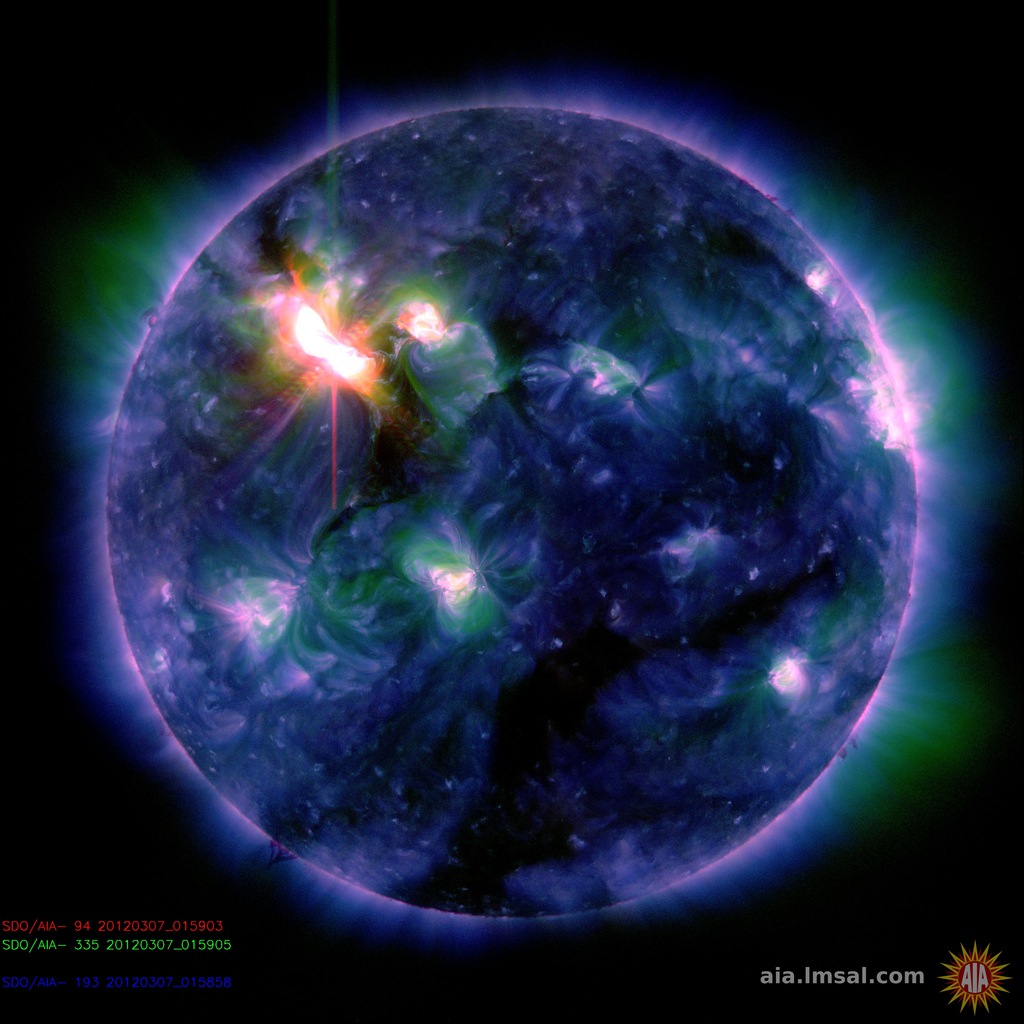
An X-1.1 class solar flare erupted from the Sun on Sunday, March 4 at 11:13 PM EST (0413 UTC March 5), sending an explosion of plasma and charged particles -- a coronal mass ejection (CME) -- hurtling through space. Forecasters at NOAA’s Space Weather Prediction Center (SWPC) are saying that the CME should miss Earth, but will hit Mercury and Venus.
Even if this CME misses, high-latitude sky watchers should still be alert for auroras in the nights ahead. An M3-class eruption from the same sunspot just a day before produced another, wider CME that might intersect Earth. The cloud is expected to deliver a glancing blow to Earth’s magnetic field on March 6 around 0430 UTC. Sunday night’s solar flare is only the second X-class eruption so far this year. X-class flares are the most powerful type of solar storm; M-class eruptions are considered midrange and C-class flares are the weakest.
According to Spaceweather.com, SWPC forecasters are estimating a 75 percent chance of M-class solar flares and a 30 percent chance of an X-flare from big sunspot 1429, which emerged on the Sun on March 2 and is estimated to be at least four to five times larger than Earth. The active region is slowly turning to face Earth, so if any such eruptions do occur, they are increasingly likely to be geoeffective. Forecasters say there is a 30-40 percent chance of polar geomagnetic storms through the rest of the week. The 1429 sunspot region continues to be quite active since it emerged on March 2, and scientists are predicting it will spew more flares as the week goes on.
When a CME hits the Earth’s atmosphere -- approximately 72 hours after exploding on the Sun -- the low bands will be depressed and signals will be weaker the lower the frequency. The absorption rate will be most severe on 160 meters, less on 80 and somewhat better on 40 meters. The maximum usable frequency (MUF) -- the highest frequency by which a radio wave can propagate between given terminals by ionospheric propagation alone, independent of power -- will be lower and auroral propagation on the VHF bands is quite possible.
When aurora occur, the electrons hit the ionosphere at the North and South geomagnetic poles, creating ionization. Waves that would normally travel off into space are bouncing off the aurora and being redirected back toward Earth. This can create opportunities for long-distance propagation via VHF and UHF.
VHF operators greet CMEs as a welcome opportunity for unusual, enhanced propagation. “CMEs can trigger the Aurora Borealis,” explained ARRL Contest Branch Manager and VHF aficionado Sean Kutzko, KX9X. “If the aurora is intense enough, you can use it as a ‘wall’ to bounce signals off of on 6 and 2 meters -- and sometimes higher. If you have a beam on the VHF bands, point it north (or south, if you’re in the Southern Hemisphere) and listen for strange-sounding signals.”
Kutzko noted that aurora can cause audio signals to become very distorted: “On 6 meters, SSB signals become quite difficult to understand, and on 2 meters, it renders sideband practically unusable. CW is the preferred mode of communication during an aurora opening. Even so, the pure tone of a CW signal becomes distorted as well, reducing the pure ‘beep’ tone to a whisper-like ‘pffft.’”
In 2013, solar activity levels are expected to peak with the next solar maximum within the 11-year solar activity cycle. “We now know how powerful space weather can be and how events that begin on the surface of the Sun can end up wreaking havoc here on Earth,” said SWPC Director Tom Bogdan. “This is why NOAA has a Space Weather Prediction Center -- to forecast when space weather is coming our way, so we can avoid or mitigate damages. We’re coming up to the next solar maximum, so we expect to see more of these storms coming from the Sun over the next three to five years.”

Tuesday, March 06, 2012

Latest Solar Flare Activity: March 2012

Latest Solar Flare Activity: latest news of Solar Flare Activity March 2012:

Big sunspot AR1429 has unleashed another major flare. This one is the strongest yet, an X5-class eruption on March 7th at 00:28 UT. NASA's Solar Dynamics Observatory recorded the extreme UV flash:
This eruption hurled a bright CME into space. First-look data from STEREO-B are not sufficient to determine if the cloud is heading for Earth. Our best guess is "probably, yes, but not directly toward Earth." A glancing blow to our planet's magnetosphere is possible on March 8th or 9th. Stay tuned for updates

latest news of Solar Flare Activity March 2012

Big sunspot AR1429 has unleashed another major flare. This one is the strongest yet, an X5-class eruption on March 7th at 00:28 UT. NASA's Solar Dynamics Observatory recorded the extreme UV flash:
This eruption hurled a bright CME into space. First-look data from STEREO-B are not sufficient to determine if the cloud is heading for Earth. Our best guess is "probably, yes, but not directly toward Earth." A glancing blow to our planet's magnetosphere is possible on March 8th or 9th. Stay tuned for updates

Thursday, March 01, 2012

Report of Solar flare Activity

Prepared jointly by the U.S. Dept. of Commerce, NOAA,
Space Weather Prediction Center and the U.S. Air Force.

Updated Mar 01 2200 UTC

Joint USAF/NOAA Report of Solar and Geophysical Activity
SDF Number 061 Issued at 2200Z on 01 Mar 2012

IA.  Analysis of Solar Active Regions and Activity from  29/2100Z
to 01/2100Z:  Solar activity has been low. There was one C-class
flare duing the past 24 hours, a C3/1f from Region 1423 (N17W21) at
01/1526Z. New Region 1427 (N15W01) was numbered today. A CME was
observed at 29/1824Z (using LASCO C2) from the north polar region of
the sun, however it is not expected to be geoeffective.

IB.  Solar Activity Forecast:  Solar activity is expected to be very
low to low.

IIA.  Geophysical Activity Summary 29/2100Z to 01/2100Z:
The geomagnetic field has been quiet to active with isolated storm
periods at high latitudes. The elevated activity appears to be
related to a solar sector boundary crossing.

IIB.  Geophysical Activity Forecast:  The geomagnetic field is
expected to be quiet to unsettled for the first and second days
(02-03 Mar) due to a small yet well positioned coronal hole.  A
return to quiet levels is expected on the third day (04 Mar).

III.  Event Probabilities 02 Mar-04 Mar
Class M    01/01/01
Class X    01/01/01
Proton     01/01/01
PCAF       green

latest Report of Solar flare and Geophysical Activity

Latest Report of Solar flare and Geophysical Activity
Joint USAF/NOAA Report of Solar and Geophysical Activity
SDF Number 060 Issued at 2200Z on 29 Feb 2012

IA. Analysis of Solar Active Regions and Activity from 28/2100Z
to 29/2100Z: Solar activity has been very low for the past 24 hours.
A series of CMEs were observed over the west limb at 29/0125Z,
29/0924Z, and 29/1212Z. Stereo-A imagery confirm the source regions
were behind the west limb and none of these are expected to be
geoeffective.

IB. Solar Activity Forecast: Solar activity is expected to be very
low.

IIA. Geophysical Activity Summary 28/2100Z to 29/2100Z:
The geomagnetic field has been mostly quiet.

IIB. Geophysical Activity Forecast: The geomagnetic field is
expected to be quiet for the first day (01 Mar). A slight increase
to quiet to unsettled levels is expected on the second day (02 Mar)
due to a small coronal hole. Quiet levels are expected on the third
day (03 Mar).

Solar Update / New Record

Solar activity continues on at very low levels.There is currently no chance for strong solar flares. A new sunspot is trying to form to the east of sunspot 1423 and is pictured below.

Despite the lack of Sunspots, February 29th will mark the 199th day in a row with an official visible Sunspot counted by SWPC Space Weather Operations (SWO). This is a new record for Cycle 24 and beats the previous record of 198 days set on August 13, 2011.

Tuesday, February 28, 2012

latest Solar and Geophysical Activity

Joint USAF/NOAA Report of Solar and Geophysical Activity
SDF Number 059 Issued at 2200Z on 28 Feb 2012

IA. Analysis of Solar Active Regions and Activity from 27/2100Z
to 28/2100Z: Solar activity was very low during the past 24 hours.

IB. Solar Activity Forecast: Solar activity is expected to be very
low for the next three days (29 Feb - 02 Mar) with just a slight
chance for an isolated C-class flare.

IIA. Geophysical Activity Summary 27/2100Z to 28/2100Z:
The geomagnetic field ranged from quiet to active levels with a
period of minor storm levels at some observatories during the local
nighttime hours. Quiet conditions prevailed from the beginning of
the period until about 07Z when a substorm interval began and
continued through about 09Z. The planetary activity reached active
levels but several individual stations attained minor storm levels
during the disturbance. Activity promptly returned to predominantly
quiet levels after the substorm and remained quiet for the rest of
the period. The disturbance was preceded by about two hours of
southward interplanetary magnetic field (IMF) seen at the ACE
spacecraft (0510-0702Z, with maximum southward deflection of -11
nT). The IMF was otherwise predominantly northwards during the
interval. ACE data also indicated a solar sector boundary crossing
at about 1534Z. The greater than 10 MeV protons observed by GOES
returned to background levels late on the 27th and remained there
through the end of the period.

IIB. Geophysical Activity Forecast: The geomagnetic field is
expected to be quiet for the first two days (29 Feb - 01 Mar). A
slight increase to quiet to unsettled levels is expected on the
third day (02 Mar) due to a small but well positioned coronal hole.

Sunday, February 26, 2012

Latest Solar Flares Feb 2012

Joint USAF/NOAA Report of Solar and Geophysical Activity
SDF Number 056 Issued at 2200Z on 25 Feb 2012

IA. Analysis of Solar Active Regions and Activity from 24/2100Z
to 25/2100Z: Solar activity was very low. Umbral separation was
... observed in Region 1422 (N15W78). Slight decay was observed in the
trailing spots of Region 1424 (N08E52). The rest of the spot groups
were relatively quiet and stable. A filament eruption on the SE
limb was observed in SDO/AIA 304 imagery beginning at 24/1911Z. A
corresponding CME off the SE limb was observed in LASCO C2 imagery
beginning at 24/1948Z. The CME is not expected to be geoeffective.

IB. Solar Activity Forecast: Solar activity is expected to be very
low with a chance for C-class activity for the next three days (26 -
28 February).

IIA. Geophysical Activity Summary 24/2100Z to 25/2100Z:
The geomagnetic field was at quiet to unsettled levels. Isolated
major storm conditions were observed at high latitudes (College)
during the periods ending at 25/1200Z and 25/1500Z. A greater than
10 MeV proton enhancement began at approximately 25/0330Z and
reached a maximum of 3 pfu at 25/1830Z and continued to be enhanced
by the end of the reporting period. The event did not reach event
threshold and likely originated from a backside event.

IIB. Geophysical Activity Forecast: The geomagnetic field is
expected to be mostly quiet on day 1 (26 February). Early on day 2
(27 February), unsettled to active conditions are expected with
minor storm periods possible due to the expected arrival of the 24
February CME. Conditions are expected to calm to quiet to unsettled
levels with active periods possible by day 3 (28 February).

III. Event Probabilities 26 Feb-28 Feb
Class M 01/01/01
Class X 01/01/01
Proton 01/01/01
PCAF green

IV. Penticton 10.7 cm Flux
Observed 25 Feb 108
Predicted 26 Feb-28 Feb 100/100/100
90 Day Mean 25 Feb 129

V. Geomagnetic A Indices
Observed Afr/Ap 24 Feb 006/004
Estimated Afr/Ap 25 Feb 004/006
Predicted Afr/Ap 26 Feb-28 Feb 004/005-011/015-010/010

VI. Geomagnetic Activity Probabilities 26 Feb-28 Feb
A. Middle Latitudes
Active 05/25/20
Minor storm 01/10/05
Major-severe storm 01/01/01
B. High Latitudes
Active 15/30/25
Minor storm 10/25/20
Major-severe storm 05/15/10