Joint USAF/NOAA Report of Solar and Geophysical Activity
SDF Number 124 Issued at 2200Z on 03 May 2012
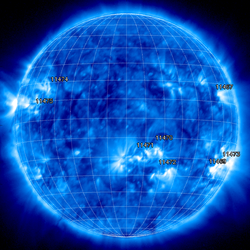
IA. Analysis of Solar Active Regions and Activity from 02/2100Z
to 03/2100Z: Solar activity has been at low levels for the past 24
hours. Multiple C-class events were observed during the period with
the largest event being a C2/Sf x-ray flare from new Region 1475
(N05E61). Even though Region 1475 is magnetically classified as an
alpha group, it remains responsible for a majority of todays
activity. There are currently seven sunspot regions on the disk,
with many regions stable or in a waning phase. No Earth directed
CMEs were observed in the past 24 hours.
IB. Solar Activity Forecast: Solar activity is expected to be at
low levels with a slight chance for M-class events for the next
three days (04 - 06 May).
IIA. Geophysical Activity Summary 02/2100Z to 03/2100Z:
The geomagnetic field has been at mostly quiet levels for the past 24
hours.
IIB. Geophysical Activity Forecast: The geomagnetic field is
expected to be at mostly quiet levels for the next three days (04 -
06 May).
Showing posts with label sun. Show all posts
Friday, May 04, 2012
Report of Latest Solar Wind Storm Activity May 4 2012
Tuesday, April 17, 2012
Latest solar flare report April 17 2012
Joint USAF/NOAA Report of Solar and Geophysical Activity
SDF Number 108 Issued at 2200Z on 17 Apr 2012
IA. Analysis of Solar Active Regions and Activity from 16/2100Z
to 17/2100Z: Solar activity has been low for the past 24 hours. A
long duration C1 flare was observed from new Region 1461 (N13E66) at
17/0809Z. An associated CME became visible in LASCO C2 imagery at
17/0800Z but does not appear to be Earth-directed. A filament
eruption occurred at approximately 17/1330Z near N24W40. The
associated CME was first visible in LASCO C2 imagery at 17/1424Z but
is not expected to be geoeffective. New Region 1460 (N16E26) was
also numbered overnight and is considered a Dso-beta type spot
group. Region 1459 (S15E40) has shown a significant decrease in
areal coverage and is now a Dao-beta type spot group.
IB. Solar Activity Forecast: Solar activity is expected to be low
with a slight chance for an M-class flare for the next three days
(18-20 April).
IIA. Geophysical Activity Summary 16/2100Z to 17/2100Z:
The geomagnetic field was mostly quiet during the past 24 hours. The
greater than 2 MeV electron flux at geosynchronous orbit reached
high levels during the period.
IIB. Geophysical Activity Forecast: The geomagnetic field is
expected to be mostly quiet on days one and two (18-19 April). Quiet
to unsettled conditions are expected with a chance for isolated
active periods on day three (20 April) due to a recurrent Solar
Sector Boundary Crossing (SSBC).
Joint USAF/NOAA Report of Solar and Geophysical Activity
SDF Number 108 Issued at 2200Z on 17 Apr 2012
IA. Analysis of Solar Active Regions and Activity from 16/2100Z
to 17/2100Z: Solar activity has been low for the past 24 hours. A
long duration C1 flare was observed from new Region 1461 (N13E66) at
17/0809Z. An associated CME became visible in LASCO C2 imagery at
17/0800Z but does not appear to be Earth-directed. A filament
eruption occurred at approximately 17/1330Z near N24W40. The
associated CME was first visible in LASCO C2 imagery at 17/1424Z but
is not expected to be geoeffective. New Region 1460 (N16E26) was
also numbered overnight and is considered a Dso-beta type spot
group. Region 1459 (S15E40) has shown a significant decrease in
areal coverage and is now a Dao-beta type spot group.
IB. Solar Activity Forecast: Solar activity is expected to be low
with a slight chance for an M-class flare for the next three days
(18-20 April).
IIA. Geophysical Activity Summary 16/2100Z to 17/2100Z:
The geomagnetic field was mostly quiet during the past 24 hours. The
greater than 2 MeV electron flux at geosynchronous orbit reached
high levels during the period.
IIB. Geophysical Activity Forecast: The geomagnetic field is
expected to be mostly quiet on days one and two (18-19 April). Quiet
to unsettled conditions are expected with a chance for isolated
active periods on day three (20 April) due to a recurrent Solar
Sector Boundary Crossing (SSBC).
Wednesday, February 08, 2012
Solar and Geophysical Activity Forecast
Updated Feb 08 2200 UTC
Joint USAF/NOAA Report of Solar and Geophysical Activity
SDF Number 039 Issued at 2200Z on 08 Feb 2012
IA. Analysis of Solar Active Regions and Activity from 07/2100Z
to 08/2100Z: Solar activity was low. Region 1410 (N16W90) produced a
slow rise and fall, limb event, C7 x-ray flare at 07/2216Z.
IB. Solar Activity Forecast: Solar activity is expected to be very
low to low for the next 3 days (09-11 February).
IIA. Geophysical Activity Summary 07/2100Z to 08/2100Z:
The geomagnetic field was mostly unsettled over the period due to
elevated ambient solar wind speeds and periods of southward Bz.
IIB. Geophysical Activity Forecast: The geomagnetic field is
expected to be mostly quiet to unsettled with isolated active
periods for days 1-2 (09-10 February) due to coronal hole effects.
Conditions should return to mostly quiet levels on day 3 (11
February).
Sunday, February 05, 2012
latest Solar and Geophysical Activity report
Updated Feb 05 2200 UTC
Joint USAF/NOAA Report of Solar and Geophysical Activity
SDF Number 036 Issued at 2200Z on 05 Feb 2012
IA. Analysis of Solar Active Regions and Activity from 04/2100Z
to 05/2100Z: Solar activity was at very low levels. The disk and
limb was quiet and stable with no Earth-directed CMEs detected.
IB. Solar Activity Forecast: Solar activity is expected to be very
low with a chance for C-class activity for the next three days (06 -
08 February).
IIA. Geophysical Activity Summary 04/2100Z to 05/2100Z:
The geomagnetic field was at quiet to unsettled levels with an
isolated high latitude active period. ACE satellite wind speeds
were steady between 400 to 450 km/s while the Bz component of the
interplanetary magnetic field did not vary beyond +/- 4 nT.
IIB. Geophysical Activity Forecast: The geomagnetic field is
expected to be at mostly quiet levels for the next three days (06 -
08 February).Are You Prepared for Emergency Survival Following a Solar Storm? Part IV - News - Weather
Solar storms are coming. The current solar maximum is projected to peak in late 2012 to early 2013. World organizations and governments are quietly organizing. What are our governments, and scientists doing to prepare. We know that they have been meeting with increased frequency, and diversity, but what answers or information have they given us about the very likely upcoming solar storm activity? What instructions have they given us about preparation?
The truth is the world governments and organizations are having a difficult time trying to plan for the potential upcoming solar super storm. The numbers of people that will be affected are just too great for them to come up with a plan to take care of everyone. They will surely come up with a plan, but they will only be able to protect a finite number of people. So the rest of us are left to fend for ourselves.
In order to address what youll need to prepare for an upcoming solar super storm, we must look at what the effects of such a storm will be. The satellites that surround the earth will be the first casualties of an extreme coronal mass ejection. Some scientist suggest that if they are put into a sleep like mode that they could survive. The shear amounts of energy that will bombard the electrical systems in these satellites lead us to believe otherwise. So communications are the first losses we will suffer. Cell phones, internet, television, and government coordination will cease. Next to go are the huge transformers at the power stations on the daylight side of the earth. When these transformers blow, they are more than likely be irreparable, at least on-site. The effect will be the loss of power grids across that side of the globe. Transportation will likely be greatly reduced as production, and distribution of fuels will be impacted.
With no power, short rang communication only, and scarce supply lines, communities will be forced to work together to survive. Medical supplies, food, and clean water will be the primary items needed for survival. Depending on where you live and the time of year, staying warm may also be an important consideration.
Many neighborhoods have begun setting up Community Emergency Response Teams or CERT. These organizations are preparing to help following many different types of disasters, and emergencies. They consist of professional police officers, fire fighters and emergency medical personnel, and they also train others in the neighborhood to assist in many different rolls. While these types of organizations will be vital in each community, individuals also need to prepare.
Each family should already have short term emergency survival kits that will last them for at least 72 hours, but more will be needed. It is recommended for individuals to keep their homes stocked with a decent amount of non-perishable foods. With no electricity food in refrigerators and freezers will need to be cooked and eaten in short order. It is also important to have a good supply of some MREs or non-perishable meals that have a long shelf life. It will be important to have camp stoves, barbeques, or emergency portable stoves with fuel tablets, to be able to cook with, boil water, and wash with. Lighting will be necessary in the night time hours, and batteries will only get you so far. We recommend lighting that uses human, or solar power to charge them up. For clean water you will either need to boil it, or have a way to purify it. Water purification tablets, and micro-water filters like those used when camping are best.
You can be prepared for the solar super storm, but it will take action on everyones part to stock up on the essentials. Communities, of individuals working together will be key, and these organizations need support, and supplies to be ready to assist for what ever emergency arises. So dont wait, take action now to prepare your family for whatever the future may bring.
0
The truth is the world governments and organizations are having a difficult time trying to plan for the potential upcoming solar super storm. The numbers of people that will be affected are just too great for them to come up with a plan to take care of everyone. They will surely come up with a plan, but they will only be able to protect a finite number of people. So the rest of us are left to fend for ourselves.
In order to address what youll need to prepare for an upcoming solar super storm, we must look at what the effects of such a storm will be. The satellites that surround the earth will be the first casualties of an extreme coronal mass ejection. Some scientist suggest that if they are put into a sleep like mode that they could survive. The shear amounts of energy that will bombard the electrical systems in these satellites lead us to believe otherwise. So communications are the first losses we will suffer. Cell phones, internet, television, and government coordination will cease. Next to go are the huge transformers at the power stations on the daylight side of the earth. When these transformers blow, they are more than likely be irreparable, at least on-site. The effect will be the loss of power grids across that side of the globe. Transportation will likely be greatly reduced as production, and distribution of fuels will be impacted.
With no power, short rang communication only, and scarce supply lines, communities will be forced to work together to survive. Medical supplies, food, and clean water will be the primary items needed for survival. Depending on where you live and the time of year, staying warm may also be an important consideration.
Many neighborhoods have begun setting up Community Emergency Response Teams or CERT. These organizations are preparing to help following many different types of disasters, and emergencies. They consist of professional police officers, fire fighters and emergency medical personnel, and they also train others in the neighborhood to assist in many different rolls. While these types of organizations will be vital in each community, individuals also need to prepare.
Each family should already have short term emergency survival kits that will last them for at least 72 hours, but more will be needed. It is recommended for individuals to keep their homes stocked with a decent amount of non-perishable foods. With no electricity food in refrigerators and freezers will need to be cooked and eaten in short order. It is also important to have a good supply of some MREs or non-perishable meals that have a long shelf life. It will be important to have camp stoves, barbeques, or emergency portable stoves with fuel tablets, to be able to cook with, boil water, and wash with. Lighting will be necessary in the night time hours, and batteries will only get you so far. We recommend lighting that uses human, or solar power to charge them up. For clean water you will either need to boil it, or have a way to purify it. Water purification tablets, and micro-water filters like those used when camping are best.
You can be prepared for the solar super storm, but it will take action on everyones part to stock up on the essentials. Communities, of individuals working together will be key, and these organizations need support, and supplies to be ready to assist for what ever emergency arises. So dont wait, take action now to prepare your family for whatever the future may bring.
0
Saturday, February 04, 2012
latest Report of Solar and Geophysical Activity
Feb 04 2200 UTC
Joint USAF/NOAA Report of Solar and Geophysical Activity
SDF Number 035 Issued at 2200Z on 04 Feb 2012
IA. Analysis of Solar Active Regions and Activity from 03/2100Z
to 04/2100Z: Solar activity was at very low levels. A six degree
long filament eruption was visible in SDO/AIA 304 imagery, first
observed at about 03/2031Z. The filament was centered near N25W27,
just to the northeast of Region 1410 (N16W44). SOHO LASCO C2
imagery observed a slow-moving CME off the north limb of the disk,
first visible at 04/0836Z. At this time, the CME does not appear to
have an Earthward-directed component. New Region 1414 (S06W19)
emerged on the disk as a simple B-type beta group.
IB. Solar Activity Forecast: Solar activity is expected to be very
low with a chance for C-class activity for the next three days (05 -
07 February).
IIA. Geophysical Activity Summary 03/2100Z to 04/2100Z:
The geomagnetic field was at mostly quiet levels at middle latitudes
while active to minor storm periods were observed at high latitudes.
ACE satellite observations indicated a steady increase in wind
velocities through the period from about 400 km/s to near 460 km/s.
The Bz component of the interplanetary magnetic field did not vary
much beyond +/- 5 nT for the period.
IIB. Geophysical Activity Forecast: The geomagnetic field is
expected to be at mostly quiet levels for the next three days (05 -
07 February).Tuesday, January 31, 2012
Solar Flares are we going to get fried
A solar flare is an intense flash of extreme radiation emanating from the Sun. Solar flares are classified as A, B, C, M or X (ranged from small to large).
Solar flares can produce streams of highly energetic particles in the solar wind, known as a solar proton event, or "coronal mass ejection" (CME). At high levels we speak of a Solar Radiation Storm.
These particles can impact the Earth's magnetosphere and can cause a geomagnetic storm. Such storms can interfere with modern technology on Earth, such as electrical power grids, communications systems and satellites.
In 2012 a new solar maximum is expected (Solar Cycle 24) and we could be in for a huge firework display. The Sun will be approaching the peak of its 11-year cycle, so we can expect a lot of solar activity. Certain predictions put the solar greatest extent of Solar Cycle 24 even more vigorous than the last solar maximum in 2002-2003 take into account all those record breaking X-class flares. But should we be worried?
On March 13th, 1989 a huge solar induced magnetic storm played havoc with the ionosphere, and the earth's magnetic field. This storm, the second largest storm experienced in the past 50 years, totally shut down Hydro-Quebec, the power grid servicing Canada's Quebec province. Service restoration took more than nine hours.
The solar storm of 1859, also known as the Solar Superstorm was the most powerful solar storm in recorded history. Aurorae were seen around the world. In the Rocky Mountains it was so bright that the glow awoke gold miners, who began preparing breakfast because they thought it was morning.
Solar flares can produce streams of highly energetic particles in the solar wind, known as a solar proton event, or "coronal mass ejection" (CME). At high levels we speak of a Solar Radiation Storm.
These particles can impact the Earth's magnetosphere and can cause a geomagnetic storm. Such storms can interfere with modern technology on Earth, such as electrical power grids, communications systems and satellites.
In 2012 a new solar maximum is expected (Solar Cycle 24) and we could be in for a huge firework display. The Sun will be approaching the peak of its 11-year cycle, so we can expect a lot of solar activity. Certain predictions put the solar greatest extent of Solar Cycle 24 even more vigorous than the last solar maximum in 2002-2003 take into account all those record breaking X-class flares. But should we be worried?
On March 13th, 1989 a huge solar induced magnetic storm played havoc with the ionosphere, and the earth's magnetic field. This storm, the second largest storm experienced in the past 50 years, totally shut down Hydro-Quebec, the power grid servicing Canada's Quebec province. Service restoration took more than nine hours.
The solar storm of 1859, also known as the Solar Superstorm was the most powerful solar storm in recorded history. Aurorae were seen around the world. In the Rocky Mountains it was so bright that the glow awoke gold miners, who began preparing breakfast because they thought it was morning.
Subscribe to:
Posts (Atom)