Joint USAF/NOAA Report of Solar and Geophysical Activity
SDF Number 285 Issued at 2200Z on 11 Oct 2012

IA.  Analysis of Solar Active Regions and Activity from  10/2100Z
to 11/2100Z:  Solar activity was low.  Region 1589 (N12E49) was
responsible for the largest flare of the period; a C4 x-ray flare at
11/0804Z.  Region 1589 is currently the most complex region with a
Beta-Gamma magnetic classification.  New Region 1590 (S29E59)
rotated onto the southeast limb and was numbered today.  No
Earth-directed coronal mass ejections were observed.

IB.  Solar Activity Forecast:  Solar activity is expected to be low
with a chance for isolated M-class activity for the forecast period
(12-14 October).

IIA.  Geophysical Activity Summary 10/2100Z to 11/2100Z:
The geomagnetic field was quiet.  Solar wind speed, measured at the
ACE spacecraft, was slightly elevated between approximately 440 to
500 km/s while the Bz component of the interplanetary magnetic field
did not vary much beyond +/- 4 nT. The greater than 2 MeV electron
flux at geosynchronous orbit was at high levels throughout the
period.

IIB.  Geophysical Activity Forecast:  The geomagnetic field is
expected to be mostly quiet on days 1-2 (12-13 October).  On day 3
(14 October) a coronal hole high speed stream is expected to move
into geoeffective position causing quiet to unsettled conditions
with a chance for active periods.

Solar Panel kits Survival kits Latest Solar Flare Activity Solar flare storm
Showing posts with label Latest Solar Flare News. Show all posts
Showing posts with label Latest Solar Flare News. Show all posts
Thursday, October 11, 2012
Latest Report of Solar flares and Geophysical Activity

Sunday, June 24, 2012
Report of Solar and Geophysical Activity 24 Jun 2012
Joint USAF/NOAA Report of Solar and Geophysical Activity
SDF Number 176 Issued at 2200Z on 24 Jun 2012

IA.  Analysis of Solar Active Regions and Activity from  23/2100Z
to 24/2100Z:  Solar activity was very low.

IB.  Solar Activity Forecast:  Solar activity is expected to be very
low to low.

IIA.  Geophysical Activity Summary 23/2100Z to 24/2100Z:
Geomagnetic field activity was at quiet levels. The greater than 2
MeV electron flux at geosynchronous orbit reached high levels during
the period.

IIB.  Geophysical Activity Forecast:  Geomagnetic activity is
expected to be mostly quiet during the period (25 - 27 June).
Wednesday, May 16, 2012
Latest Solar Flare News May 17 2012
Just as we thought we have seen the last of Sunspot 1476, the former active region decided to produce a solar flare reaching above the M5.0 level. The GOES Solar X-Ray data did show M4.6 before it stopped reporting at 01:43 UTC Thursday morning. SDO/EVE data suggests it may have been closer to M8.0. Because of the sunspots location, any possible CME may be directed mostly away from Earth.

Joint USAF/NOAA Report of Solar and Geophysical Activity
SDF Number 137 Issued at 2200Z on 16 May 2012

IA.  Analysis of Solar Active Regions and Activity from  15/2100Z
to 16/2100Z:  Solar activity was low. Region 1476 (N13W73) produced a
few C-class flares while continuing to decay. Regions 1482 (N13E10)
and 1484 (N09E38) also produced a few low level C-class events. A
pair of CMEs associated with apparent filament eruptions were
observed in LASCO C2/C3, but neither appear to be earth directed.

IB.  Solar Activity Forecast:  Solar activity is expected to be very
low to low for the next 3 days (17-19 May).

IIA.  Geophysical Activity Summary 15/2100Z to 16/2100Z:
The geomagnetic field was mostly quiet. The greater than 2 MeV
electron flux at geosynchronous orbit reached high levels during the
period.

IIB.  Geophysical Activity Forecast:  With the exception of an
isolated unsettled or active period early on day 1 (17 May) from an
expected solar sector boundary crossing, geomagnetic field
conditions are expected to be mostly quiet throughout the period
(17-19 May).
Wednesday, May 09, 2012
latest solar solar storm flare news may 9 2012
U
M4.7 Solar Flare
Large Sunspot 1476 awoke this morning and produced a moderate M4.7 Solar Flare at 12:32 UTC. Video and images are now listed below. There is now a growing threat for an X-Class event. Stay Tuned to SolarHam.com for the latest information.
M4.7 Solar Flare
Large Sunspot 1476 awoke this morning and produced a moderate M4.7 Solar Flare at 12:32 UTC. Video and images are now listed below. There is now a growing threat for an X-Class event. Stay Tuned to SolarHam.com for the latest information.
Solar Flare Update: Moderate Solar activity continued on Wednesday afternoon around monster Sunspot group 1476. This region is now responsible for several M-Class events including an M4.7 and M4.1.
Northern Exposure
In between all of the Solar Flares, Zoltan Kenwell in Alberta, Canada captured this nice Aurora image during last nights geomagnetic disturbance. The solar wind combined with a south tilting Bz helped trigger this event. Thank You Zoltan for the great image.
In between all of the Solar Flares, Zoltan Kenwell in Alberta, Canada captured this nice Aurora image during last nights geomagnetic disturbance. The solar wind combined with a south tilting Bz helped trigger this event. Thank You Zoltan for the great image.
Solar activity is currently moderate with two M-Class flares within the past 24 hours. The largest of these events was an M4.7 at 12:32 UTC Wednesday morning around Sunspot 1476. This region has a Beta-Gamma-Delta magnetic configuration and could produce an X-Class event. New Sunspot 1477 rotated into view off the southeast limb. This looks to be the return of old Sunspot 1462. Elsewhere, all other regions are currently quiet.
Updated May 09 2200 UTC

Joint USAF/NOAA Report of Solar and Geophysical Activity
SDF Number 130 Issued at 2200Z on 09 May 2012

IA.  Analysis of Solar Active Regions and Activity from  08/2100Z
to 09/2100Z:  Solar activity has been at moderate levels for the past
24 hours.  Region 1476 (N10E22) continues to be the most complex and
most active spot region on the visible disk.  It produced an M4/1n
x-ray flare at 09/1232Z, and an M1/1b x-ray flare at 09/1408Z.  This
spot region continues to grow in area, reaching 1050 Millionths and
remains a Fkc/beta-gamma-delta configuration.

IB.  Solar Activity Forecast:  Solar activity is expected to be at
low to moderate levels for the next three days (10-12 May).

IIA.  Geophysical Activity Summary 08/2100Z to 09/2100Z:
The geomagnetic field has been at unsettled to active levels for the
past 24 hours.

IIB.  Geophysical Activity Forecast:  The geomagnetic field is
expected to be unsettled to active with a slight chance for minor
storming on day one (10 May) due to increased wind speeds associated
with the Coronal Hole High Speed Stream (CH HSS).  Days two and
three (11-12 May) are expected to be at quiet to unsettled levels as
the effects of the CH HSS begin to wane.
Tuesday, May 08, 2012
Report of Latest Solar Wind Storm Activity May 8 2012
1470-1471 Produces M1.9 Flare and minor CME
Sunspot combo 1470-1471 produced a long duration M1.9 flare on Monday morning. This event peaked at 14:31 UTC and triggered a 10cm Radio Burst (TenFlare) lasting 12 minutes and measuring 240 sfu. Sometimes a long duration event (LDE) will produce a Coronal Mass Ejection (CME). Stay Tuned for more information.
Sunspot combo 1470-1471 produced a long duration M1.9 flare on Monday morning. This event peaked at 14:31 UTC and triggered a 10cm Radio Burst (TenFlare) lasting 12 minutes and measuring 240 sfu. Sometimes a long duration event (LDE) will produce a Coronal Mass Ejection (CME). Stay Tuned for more information.
Update: A minor CME was generated and may be Earth directed. Only minor geomagnetic activity is expected by May 10th.
Updated May 08 2200 UTC

Joint USAF/NOAA Report of Solar and Geophysical Activity
SDF Number 129 Issued at 2200Z on 08 May 2012

IA.  Analysis of Solar Active Regions and Activity from  07/2100Z
to 08/2100Z:  Solar activity has been at moderate levels for the past
24 hours.  Region 1476 (N11E35) is the most complex region on the
visible disk, has grown to become a Fkc/beta-gamma-delta
configuration, and has an area of approximately 940 Millionths.  It
also produced the largest flare, a M1/1f at 08/1308Z, as well as
several C-class flares.  COR2 imagery from the STEREO-A spacecraft
indicated two weak Earth-directed CMEs that are not expected to have
significant impacts upon arrival.

IB.  Solar Activity Forecast:  Solar activity is expected to be at
low to moderate levels for the next three days (09 - 11 May).

IIA.  Geophysical Activity Summary 07/2100Z to 08/2100Z:
The geomagnetic field has been at quiet levels for the past 24 hours.

IIB.  Geophysical Activity Forecast:  The geomagnetic field is
expected to be quiet to unsettled on day one (09 May).  Day two (10
May) is expected to be at quiet to active levels with a chance for
minor storm periods due to the effects of the Coronal Hole High
Speed Stream (CH HSS) and the anticipated arrival of the CME that
departed the solar disk on 07 May.  Day three (11 May) is expected
to return to quiet to unsettled levels as the effects of the CH HSS
begin to wane.
Sunday, May 06, 2012
Report of Latest Solar Wind Storm Activity May 6 2012
1476 Seething With Activity
Sunspot 1476 is seething with flares on Sunday afternoon. Multiple mid level C-Class flares have been detected along with an impulsive M1.3 flare at 17:47 UTC. Continue to monitor this region as activity is increasing.
Sunspot 1476 is seething with flares on Sunday afternoon. Multiple mid level C-Class flares have been detected along with an impulsive M1.3 flare at 17:47 UTC. Continue to monitor this region as activity is increasing.
Updated 5/6/2012 @ 13:30 UTC
Solar Update
Solar activity is now at moderate levels. New and active Sunspot 1476 has produced three low level M-Class flares thus far. There will continue to be a chance for another moderate solar flare on Sunday. This region is still not in the best position for Earth directed explosions, however this will change with each passing day.
Three M-Class Flares / Sunspot 1476
Solar activity increased to moderate levels thanks to newly numbered Sunspot 1476. This new region rotated into view off the northeast limb and has so far produced a pair of M-Class flares. The latest event was an M1.3 at 23:01 UTC Saturday evening. Stay Tuned to SolarHam.com as solar activity is again increasing.
Solar activity increased to moderate levels thanks to newly numbered Sunspot 1476. This new region rotated into view off the northeast limb and has so far produced a pair of M-Class flares. The latest event was an M1.3 at 23:01 UTC Saturday evening. Stay Tuned to SolarHam.com as solar activity is again increasing.
UPDATE: Sunspot 1476 did generate a third low level M-Class flare early on Sunday morning.
Saturday, May 05, 2012
Report of Latest Solar Wind Storm Activity May 5 2012
Two M-Class Flares / Sunspot 1476
Solar activity increased to moderate levels thanks to newly numbered Sunspot 1476. This new region rotated into view off the northeast limb and has so far produced a pair of M-Class flares. The latest event was an M1.3 at 23:01 UTC Saturday evening. solar activity is again increasing.
Solar activity increased to moderate levels thanks to newly numbered Sunspot 1476. This new region rotated into view off the northeast limb and has so far produced a pair of M-Class flares. The latest event was an M1.3 at 23:01 UTC Saturday evening. solar activity is again increasing.

Solar Update
Solar activity increased somewhat due to the new sunspot rotating into view off the northeast limb. This region should be numbered 1476 on Saturday. There will be a chance for an M-Class event. All other regions have been fairly quiet with the exception of a C2.0 flare around Sunspot 1471 in the southern hemisphere.
Solar activity increased somewhat due to the new sunspot rotating into view off the northeast limb. This region should be numbered 1476 on Saturday. There will be a chance for an M-Class event. All other regions have been fairly quiet with the exception of a C2.0 flare around Sunspot 1471 in the southern hemisphere.
Updated May 05 2200 UTC

Joint USAF/NOAA Report of Solar and Geophysical Activity
SDF Number 126 Issued at 2200Z on 05 May 2012

IA.  Analysis of Solar Active Regions and Activity from  04/2100Z
to 05/2100Z:  Solar activity was at moderate levels. New Region 1476
(N09E67) produced several C-class flares along with an M1/Sn at
05/1329Z. The regions proximity to the limb makes spot
classification difficult, however, it is currently considered a
Dko-beta type group. Region 1469 (S26W77) continues to produce low
level C-class activity as it rotates around the west limb. A model
run was completed after the forecast was issued yesterday to include
the CME observed off the southwest limb yesterday. It was determined
that the CME has a slight Earth-directed component. A second CME,
first visible in STEREO A COR2 imagery at 05/0309Z, appeared to be
associated with a C1 flare from Region 1469 observed at 04/2350Z.
Although both CMEs have a weak Earth-directed component, neither are
expected to cause significant geomagnetic activity. A third CME
associated with a C2/Sf flare from Region 1470 (S15W31) observed at
05/0639Z, first became visible in SDO AIA imagery at approximately
05/0600Z. Due to the source location, it is probable that the CME is
Earth-directed and a model run is currently in progress to determine
geoeffectiveness.

IB.  Solar Activity Forecast:  Solar activity is expected to be low
with a chance for M-class flares for the next three days (06-08
May).

IIA.  Geophysical Activity Summary 04/2100Z to 05/2100Z:
The geomagnetic field was quiet during the past 24 hours.

IIB.  Geophysical Activity Forecast:  The geomagnetic field is
expected to be quiet on day one (06 May). Quiet to unsettled
conditions are possible on days two and three (07-08 May) due to
weak effects from the CMEs observed on 04 May.
Friday, May 04, 2012
Report of Latest Solar Wind Storm Activity May 4 2012
Joint USAF/NOAA Report of Solar and Geophysical Activity
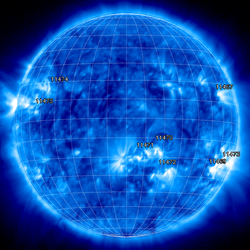
SDF Number 124 Issued at 2200Z on 03 May 2012

IA.  Analysis of Solar Active Regions and Activity from  02/2100Z
to 03/2100Z:  Solar activity has been at low levels for the past 24
hours. Multiple C-class events were observed during the period with
the largest event being a C2/Sf x-ray flare from new Region 1475
(N05E61). Even though Region 1475 is magnetically classified as an
alpha group, it remains responsible for a majority of todays
activity. There are currently seven sunspot regions on the disk,
with many regions stable or in a waning phase. No Earth directed
CMEs were observed in the past 24 hours.

IB.  Solar Activity Forecast:  Solar activity is expected to be at
low levels with a slight chance for M-class events for the next
three days (04 - 06 May).

IIA.  Geophysical Activity Summary 02/2100Z to 03/2100Z:
The geomagnetic field has been at mostly quiet levels for the past 24
hours.

IIB.  Geophysical Activity Forecast:  The geomagnetic field is
expected to be at mostly quiet levels for the next three days (04 -
06 May).
Tuesday, May 01, 2012
Latest Solar Flare Storm Activity update may 1 2012
Solar Update
Numerous C-Class flares were observed within the past 12 hours. A long duration C3.9 event peaked at 07:38 UTC Monday morning and was located near departing Sunspot 1465 off the southwest limb. A Coronal Mass Ejection (CME) is seen in the latest STEREO Ahead COR2 images. This plasma cloud will most likely miss Earth. Another flare measuring C5.6 near the same region followed at 10:23 UTC. Sunspot 1471 in the southeast quadrant produced a C6.0 flare at 10:41 UTC. There will continue to be a chance for C-Class flares and perhaps an isolated M-Class event.
Joint USAF/NOAA Report of Solar and Geophysical Activity


IA.  Analysis of Solar Active Regions and Activity from  29/2100Z
to 30/2100Z:  Solar activity has been at low levels for the past 24
hours. Before rotating off the west limb of the solar disk, Region
1465 (S18W95) produced a long duration C3 x-ray flare at 30/0738Z.
Associated with this event were both a Type II radio sweep
(estimated shock velocity of 645 km/s) and a non-Earth directed CME.
Region 1471 (S22E45) also produced multiple C-class events and
appears to be growing in sunspot area and magnetic complexity as it
rotates further into view. No new sunspot regions were numbered
today.

IB.  Solar Activity Forecast:  Solar activity is expected to be at
low levels for the next three days (01 - 03 May).

IIA.  Geophysical Activity Summary 29/2100Z to 30/2100Z:
The geomagnetic field has been at quiet levels for the past 24 hours.
Solar wind speeds, as measured by the ACE spacecraft, remained at
nominal levels throughout the summary period.

IIB.  Geophysical Activity Forecast:  The geomagnetic field is
expected to be at quiet to unsettled levels for days one and two (01
- 02 May) as a coronal hole high speed stream moves into a
geoeffective position. A return to quiet levels is expected on day
three (03 May) as the effects of the high speed stream wane.

III.  Event Probabilities 01 May-03 May
Class M    10/10/10
Class X    01/01/01
Proton     01/01/01
PCAF       green

IV.  Penticton 10.7 cm Flux
Observed           30 Apr 114
Predicted   01 May-03 May  115/115/115
90 Day Mean        30 Apr 112

V.  Geomagnetic A Indices
Observed Afr/Ap 29 Apr  005/005
Estimated Afr/Ap 30 Apr  002/003
Predicted Afr/Ap 01 May-03 May  007/008-007/008-004/005

VI.  Geomagnetic Activity Probabilities 01 May-03 May
A.  Middle Latitudes
Active                15/15/10
Minor storm           05/05/01
Major-severe storm    01/01/01
B.  High Latitudes
Active                25/25/15
Minor storm           10/10/05
Major-severe storm    01/01/01
Tuesday, April 24, 2012
Todays Solar Flare Activity April 24 2012 Causing Geomagnetic Storm Aurora
C-Class Flare and CME
A couple of new sunspots are rotating into view off the eastern limb. One of these regions located off the northeast limb produced a C3.7 Solar Flare at 07:45 UTC this morning and was associated with a Type II Sweep Frequency Event and CME. Due to the spots location, the plasma cloud should be directed mostly towards the east.
ALERT: Type II Radio Emission
Begin Time: 2012 Apr 24 0748 UTC
Estimated Velocity: 1029 km/s
Description: Type II emissions occur in association with eruptions on the sun and typically indicate a coronal mass ejection is associated with a flare event.
IA. Analysis of Solar Active Regions and Activity from 22/2100Z
to 23/2100Z: Solar activity has been at low levels for the past 24
hours. There are currently 8 active regions on the disk, with 5
regions having sunspots. The spotted regions on the disk all
remained rather quiet and stable throughout the period. However,
around plage Region 1461 (N10W19), two C-class events were observed
today with associated Earth directed CMEs.
IB. Solar Activity Forecast: Solar activity is expected to be at
low levels with a chance for M-class x-ray events for the next three
days (24 - 26 April).
IIA. Geophysical Activity Summary 22/2100Z to 23/2100Z:
The geomagnetic field has been at quiet to minor storm levels for the
past 24 hours. Observations made by the ACE spacecraft, around
23/0200Z, indicated the arrival of a CME that lifted off the solar
disk on 19 April. Solar wind velocities increased from 350 - 400
km/s with the total IMF reaching around 18 nT. The Boulder
magnetometer measured a 31 nT sudden impulse at 23/0325Z in
conjunction with the CME arrival here at Earth. From then on, active
to minor storm levels were observed due to multiple periods of
sustained negative Bz.
IIB. Geophysical Activity Forecast: The geomagnetic field is
expected to be at quiet to active levels with a slight chance for a
minor storm on day 1 (24 April) as effects from the CME wane and a
coronal hole high speed stream (CH HSS) moves in. Quiet to active
levels are expected on day two (25 April) as the effects of the CH
HSS continue. An increase to quiet to minor storm levels are
expected on day three (26 April) as the two CMEs, observed earlier
in the period, are expected to become geoeffective.
Friday, April 20, 2012
Report of latest solar flare activity April 20 2012
Despite the amount of large Sunspots on the Earth facing side of the Sun, solar activity has been fairly low over the past 24 hours. None of the current visible sunspots are magnetically complex (at this time). There will remain the chance for an isolated M-Class event. The sunspot totals are also helping to increase the daily Solar Flux readings. The solar flux ended near 140 on Thursday.

Prepared jointly by the U.S. Dept. of Commerce, NOAA,
Space Weather Prediction Center and the U.S. Air Force.

Updated Apr 19 2200 UTC

Joint USAF/NOAA Report of Solar and Geophysical Activity
SDF Number 110 Issued at 2200Z on 19 Apr 2012

IA.  Analysis of Solar Active Regions and Activity from  18/2100Z
to 19/2100Z:  Solar activity was low. The largest event of the period
was a C7 x-ray flare at 19/1126Z associated with Types II and IV
radio sweeps and a non-Earth-directed CME. This event may have
originated in old Region 1455 (N05, L=206), now about two days
beyond the west limb. Regions 1460 (N16W01) and 1463 (S26W49) each
produced a low-level C-class flare. Region 1460 showed spot growth
in its intermediate portion. Region 1462 (S24W31) produced a C1
flare at 19/1515Z associated with a CME that may have had an
Earthward component. Further analysis is required to determine if
the CME is likely to be geoeffective. New Region 1464 (N23E01,
Bxo-Beta) was numbered.

IB.  Solar Activity Forecast:  Solar activity is expected to be low
during days 1 - 3 (20 - 22 April) with a chance for an isolated
M-class flare.

IIA.  Geophysical Activity Summary 18/2100Z to 19/2100Z:
The geomagnetic field was quiet.

IIB.  Geophysical Activity Forecast:  Geomagnetic field activity is
expected to be at quiet to unsettled levels on day 1 (20 April) with
a chance for brief active levels due to a recurrent solar sector
boundary crossing. Quiet levels are expected during days 2- 3 (21 -
22 April).
Thursday, April 19, 2012
Latest Solar Storms, Flare and Geophysical Activity news
Updated Apr 19 2200 UTC
Joint USAF/NOAA Report of Solar and Geophysical Activity
SDF Number 110 Issued at 2200Z on 19 Apr 2012
IA. Analysis of Solar Active Regions and Activity from 18/2100Z
to 19/2100Z: Solar activity was low. The largest event of the period
was a C7 x-ray flare at 19/1126Z associated with Types II and IV
radio sweeps and a non-Earth-directed CME. This event may have
originated in old Region 1455 (N05, L=206), now about two days
beyond the west limb. Regions 1460 (N16W01) and 1463 (S26W49) each
produced a low-level C-class flare. Region 1460 showed spot growth
in its intermediate portion. Region 1462 (S24W31) produced a C1
flare at 19/1515Z associated with a CME that may have had an
Earthward component. Further analysis is required to determine if
the CME is likely to be geoeffective. New Region 1464 (N23E01,
Bxo-Beta) was numbered.
IB. Solar Activity Forecast: Solar activity is expected to be low
during days 1 - 3 (20 - 22 April) with a chance for an isolated
M-class flare.
IIA. Geophysical Activity Summary 18/2100Z to 19/2100Z:
The geomagnetic field was quiet.
IIB. Geophysical Activity Forecast: Geomagnetic field activity is
expected to be at quiet to unsettled levels on day 1 (20 April) with
a chance for brief active levels due to a recurrent solar sector
boundary crossing. Quiet levels are expected during days 2- 3 (21 -
22 April).
Monday, April 16, 2012
Latest solar flare report April 16 2012
Latest Solar Flare Report April 16 2012

The returning region off the northeast limb looks to be providing us with some Solar Fireworks. A massive eruption that registered as an M1.7 event, peaked at 17:45 UTC on Monday afternoon. This will most likely launch a blob of plasma into space. Due to the location of this event, the cloud will probably be directed away from Earth.
The active region off the northeast limb is now rotating into view and initially appeared to be spotless. Currently at 13:45 UTC a Sunspot is just now coming into view. We will get a better look at this region as the day progresses.
Sunspot 1455 which is turning closer to the western limb with every passing hour, did form some new spots on Sunday. This region may produce C-Class flares. Sunspot cluster 1459 in the southeast quadrant covers a large area but has yet to produce a noteworthy flare. There will remain a small risk for an M-Class event.
Joint USAF/NOAA Report of Solar and Geophysical Activity
SDF Number 107 Issued at 2200Z on 16 Apr 2012
IA. Analysis of Solar Active Regions and Activity from 15/2100Z
to 16/2100Z: Solar activity was moderate during the past 24 hours.
An M1 flare was observed from a region around the east limb at
16/1745Z. Region 1459 (S15E56) continued to grow and is now
considered an Fhi-beta type group. A filament erupted at
approximately 16/1300Z near S43E33. The associated CME is not
expected to be geoeffective.
IB. Solar Activity Forecast: Solar activity is expected to be low
with a slight chance for M-class flares for the next three days
(17-19 April).
IIA. Geophysical Activity Summary 15/2100Z to 16/2100Z:
The geomagnetic field was quiet during the past 24 hours. The greater
than 2 MeV electron flux at geosynchronous orbit was at high levels
throughout the period.
IIB. Geophysical Activity Forecast: The geomagnetic field is
expected to be quiet for the next three days (17-19 April).
Saturday, April 14, 2012
April 14 2012 Solar flare and Geophysical Activity
Joint USAF/NOAA Report of Solar and Geophysical Activity
SDF Number 105 Issued at 2200Z on 14 Apr 2012
IA. Analysis of Solar Active Regions and Activity from 13/2100Z
to 14/2100Z: Solar activity was very low. Region 1455 (N06W34)
produced occasional B-class x-ray flares during the first half of
the period. Region 1455 showed minor spot and penumbral decay during
the period and simplified from a beta-gamma to a beta magnetic
classification. New Regions 1458 (N07E70) and 1459 (S15E79) were
numbered. Neither were remarkable, but analysis was hampered due to
limb proximity. There were no Earth-directed CMEs observed during
the period.
IB. Solar Activity Forecast: Solar activity is expected to be very
low during days 1 - 3 (15 - 17 April) with a chance for isolated
C-class flares.
IIA. Geophysical Activity Summary 13/2100Z to 14/2100Z:
Geomagnetic field activity was at quiet to active levels. ACE solar
wind observations indicated the continued presence of a coronal hole
high-speed stream (CH HSS) with speeds in the 499 to 614 km/s range.
The greater than 2 MeV electron flux at geosynchronous orbit reached
high levels during the period.
IIB. Geophysical Activity Forecast: Geomagnetic field activity is
expected to be at quiet to unsettled levels on day 1 (15 April) with
a chance for active levels due to persistent CH HSS effects.
Activity is expected to decrease to mostly quiet levels during days
2 - 3 (16 - 17 April) as the CH HSS subsides.
Thursday, April 12, 2012
april 12 2012 Solar flare and Geophysical Activity
Solar Wind Increase / Aurora Watch
The solar wind did show a gradual increase this morning to near 500 km/s and combined with a south tilting Bz component of the interplanetary magnetic field, geomagnetic activity at very high latitudes did increase. Visible Aurora is likely at high latitudes.
Aurora Watch: The Kp index continues to rise with the help of a high speed solar wind stream now near 550 km/s. The Bz has been pointing south at times and minor geomagnetic storming at high latitudes may soon be possible.
Updated 4/12/2012 @ 12:10 UTC
Solar Update / Farside Solar Flare
New Sunspot 1455 continues to grow but has only produced B-Class activity thus far. Another sunspot did form in the southern hemisphere and was numbered 1456. It looks to have already faded away. Existing sunspot 1454 located in the southeast quadrant remains stable. There will be a chance for a C-Class flare around AR11455.
Joint USAF/NOAA Report of Solar and Geophysical Activity
SDF Number 103 Issued at 2200Z on 12 Apr 2012
IA. Analysis of Solar Active Regions and Activity from 11/2100Z
to 12/2100Z: Solar activity has been at very low levels for the past
24 hours. Region 1455 (N06W05) has been the most active region
producing multiple B-class x-ray events. Region 1455 has shown rapid
growth in area and magnetic complexity, now a D-type beta group. New
Region 1456 (S20W19) was numbered today. Multiple CMEs were observed
during the period but none appear to be Earth directed.
IB. Solar Activity Forecast: Solar activity is expected to be at
very low levels with a chance for C-class activity for the next
three days (13 - 15 April) as Regions 1455 and 1456 continue to grow
and evolve.
IIA. Geophysical Activity Summary 11/2100Z to 12/2100Z:
The geomagnetic field has been at quiet to active levels over the
past 24 hours. Characteristics of an anticipated high speed solar
wind stream from a coronal hole were observed by the ACE spacecraft,
with subsequent elevated geomagnetic levels here at Earth.
Measurements from the ACE spacecraft showed an increase in solar
wind speeds from around 370 km/s to around 600 km/s with the total
IMF hovering around 12 nT.
IIB. Geophysical Activity Forecast: The geomagnetic field is
expected to be at unsettled to active levels with the chance for
minor storm periods on day one (13 April) as the effects of a
coronal hole high speed stream (CH HSS) continue. Quiet to unsettled
levels with a chance for active periods are expected on day two (14
April) as the effects of the CH HSS wane. Predominantly quiet levels
are expected on day three (15 April) as the geomagnetic field
returns to nominal levels.
Tuesday, April 03, 2012
Solar Flare Impact in 2012
The Sun revolves at a 7.25 degree angle just like the Earth. However, due to its imperfect rotation behavior, the sun tends to "wobble", disrupting the internal core and making it highly unstable. The internal disruption eventually works its path to the outer surface and shoots out as a solar flare. Solar flares are little bits of the sun that launches out from the sun, giving off hazardous radiation and tremendous electrical power that go out into space like a bullet.
Solar Cycles
Just like how the earth has 4 seasons throughout the year, the sun goes through "solar cycles" taking 11 years to complete. The previous cycle was at its peak in 2001. Every cycle has a stage when the flares are most powerful, often occurring close to the solar equator, known as the "solar maximum", with the next massive one expected to take place in December 21, 2012 - a date predicted by the Mayan Calendar! Recently, the sun has been going through a long period of quiet solar activity as scientists have concluded that the sun is closing in on the final cycle. The quiet period alarmed NASA scientists and as they issued warnings that we will be seeing a seriously violent sun storm soon.
Impact to Earth
Many solar flares that hit earth were minor, however, small flares can still be threatening. For example, in 1989 a flare struck North America and wiped out many electric grids in the United States and Canada resulting in blackouts. Solar flares are also known to affect human life because a huge flare that's predicted to strike in 2012 would completely take out satellites, telecommunications, computers, and GPS.
Solar flares 2012 predictions are one of many cataclysmic events slated for the year of uncertainty. Always be informed on the latest news and learn ways to prepare and survive the 2012 predictions doomsday.
Sunday, April 01, 2012
Latest Report of Solar flares and Geophysical Activity
Joint USAF/NOAA Report of Solar and Geophysical Activity
SDF Number 091 Issued at 2200Z on 31 Mar 2012
IA. Analysis of Solar Active Regions and Activity from 30/2100Z
to 31/2100Z: Solar activity was low. A single C1/Sf flare was
observed from Region 1451 (N17E53) at 30/2112Z. New Region 1451 was
a simple Cro type group with a beta magnetic configuration. New
Region 1450 (N15E38) was also numbered and also a Cro type group
with beta magnetic characteristics. The remaining regions were
quiet and magnetically simple.
IB. Solar Activity Forecast: Solar activity is expected to be at
very low to low levels. An isolated C-class flare is likely with a
slight chance for an M-class event.
IIA. Geophysical Activity Summary 30/2100Z to 31/2100Z:
The geomagnetic field was at quiet levels. Solar wind speed measured at the ACE spacecraft ranged from around 450 km/s at the beginning of the period to 350 km/s at the end of the period. Bz was generally neutral. ACE data suggested a solar sector boundary crossing from negative to positive sector around 31/14Z.
IIB. Geophysical Activity Forecast: The geomagentic field is
expected to be predominantly quiet for the next three days (01-03
April).
Tuesday, March 27, 2012
Strong Solar Flare from 1429 sunspot
Sunspot 1429 just generated another Coronal Mass Ejection and is seen in the latest Lasco C2 images. This explosion was much smaller than the event from last night, but should be a sign of things to come.

The Kp Index is creeping very close to the G1 Geomagnetic Storm Level. The Bz component of the Interplanetary Magnetic Field is tipped sharply south and combined with a gusty solar wind, Aurora at high latitudes will be possible tonight.
The solar wind speed has shown a gradual increase today. This gradual increase is expected to continue over the next 24-48 hours due to a solar sector boundary crossing. Minor geomagnetic activity will be possible at high latitudes.
Thursday, March 22, 2012
Report of Solar flare Activity march 2012
Prepared jointly by the U.S. Dept. of Commerce, NOAA,
Space Weather Prediction Center and the U.S. Air Force.

Updated Mar 22 2200 UTC

Joint USAF/NOAA Report of Solar and Geophysical Activity
SDF Number 082 Issued at 2200Z on 22 Mar 2012

IA.  Analysis of Solar Active Regions and Activity from  21/2100Z
to 22/2100Z:  Solar activity was low.  Region 1440 (S25W38) produced
todays only C-class flare at 22/1750Z.  This region appears to be
decaying and currently shows a beta-gamma configuration. Three new
sunspot groups were numbered today: Region 1441 (S27W56), Region
1442 (N13E49) and Region 1443 (N16E62). All of these regions were
small, quiet, and  stable.

IB.  Solar Activity Forecast:  Solar activity is expected to be very
low with a chance for an isolated C-flare from Region 1440.

IIA.  Geophysical Activity Summary 21/2100Z to 22/2100Z:
The geomagnetic field was quiet with an isolated unsettled period
from 22/1800Z to 22/2100Z.  Solar wind data appeared to indicate a
solar sector boundary crossing at about 22/1930Z. The greater than 2
MeV electron flux at geosynchronous orbit was at high levels
throughout the period.

IIB.  Geophysical Activity Forecast:  The geomagnetic field is
expected to be quiet for the next three days (23-25 March).
Monday, March 19, 2012
latest Report of Solar flare and Geophysical Activity
Joint USAF/NOAA Report of Solar and Geophysical Activity
SDF Number 078 Issued at 2200Z on 18 Mar 2012

IA.  Analysis of Solar Active Regions and Activity from  17/2100Z
to 18/2100Z:  Solar activity was low.  Region 1434 (S20W40) produced
a single C1/Sn flare at 17/0237Z and ended the period as a Dso type
group with beta magnetic characteristics.  Region 1435 (S25W50) grew
larger and more magnetically complex, ending as a Dao type group
with beta-gamma magnetic characteristics.  A non-Earth-directed CME
was observed in SOHO/LASCO C2 imagery at 18/0024Z and believed to
originate from old Region 1429 (N19, L=295).

IB.  Solar Activity Forecast:  Solar activity is expected to be low
with a slight chance for an M-class flare from Regions 1434 or 1435.

IIA.  Geophysical Activity Summary 17/2100Z to 18/2100Z:
The geomagnetic field ranged from quiet to active levels.  The
coronal hole high speed stream abated over the course of the day.
Solar wind speed at the ACE spacecraft began declining from 650 km/s
at 17/2300Z to end the period near 500 km/s. Bt decreased and Bz was
neutral to slightly negative.  With the departure of the high speed
stream, the geomagnetic field activity decreased from active to
quiet levels. The greater than 2 MeV electron flux at geosynchronous
orbit reached high levels during the period.

IIB.  Geophysical Activity Forecast:  The geomagnetic field is
expected to range from quiet to active levels as a CME from 15 March
arrives early in the period on Day 1 (19 March).  There is a slight
chance for minor storm levels.  Activity levels are expected to
decline to unsettled on Day 2 (20 March) and quiet by Day 3 (21
March) as the effects from the CME subside.

III.  Event Probabilities 19 Mar-21 Mar
Class M    15/15/15
Class X    05/05/05
Proton     05/05/05
PCAF       green
Subscribe to:
Posts (Atom)