Showing posts with label latest solar flare activity. Show all posts

Tuesday, September 05, 2017

M5.5 Eruption / Earth Directed CME / Radiation Storm

SOLARHAM.com | Solar Cycle 24 | Space Weather and Amateur Radio Website

M5.5 Eruption / Earth Directed CME / Radiation Storm
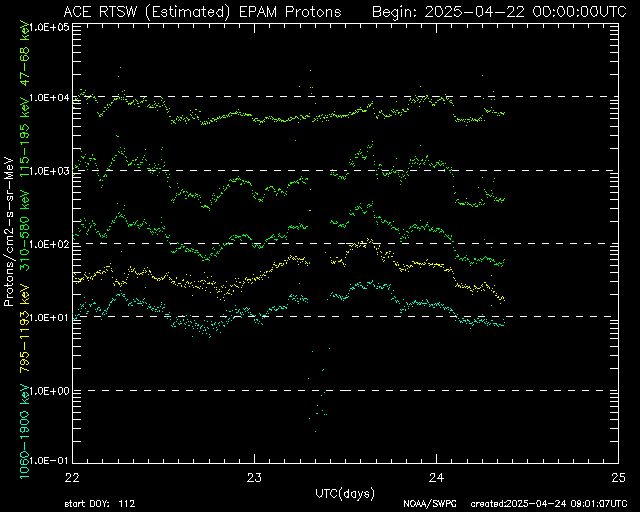
Moderately strong M5.5 solar flare event observed around region 2673 on Monday evening.UPDATE: An update regarding the M5.5 solar flare event around region 2673 this evening at 20:33 UTC. The flare was associated with a Type II radio emission with an estimated velocity of 1472 km/s, along with a 10cm radio burst (TenFlare) lasting 52 minutes and measuring 1600 solar flux units (SFU). Low energy proton levels as measured by the GOES-13 spacecraft are currently on the rise. Updated coronagraph imagery courtesy of LASCO C3 shows a coronal mass ejection (CME) leaving the sun and at least a portion of this cloud may be Earth directed. More updates to follow.

UPDATE #2 @ 00:45 UTC (Sep 5): Proton levels continue to rise following the eruption around 2673 earlier this evening. A minor (S1) radiation storm is currently in progress.

M5.5 Eruption / Earth Directed CME / Radiation Storm


Sunday, June 21, 2015

latest solar flare activity - Strong G3 Geomagnetic Storm June 22 2015


The NOAA Space Weather Prediction Center (SWPC) has issued a Strong G3 Geomagnetic Storm watch beginning tomorrow (June 22). The expected storm is the result of a full halo CME observed early Sunday morning. Sky watchers at middle to high latitudes should be alert for visual aurora during the next several days.


Solar activity during the past 24 hours was moderate. Region 2367 was responsible for the strongest X-Ray event of the period, an impulsive M3.8 flare peaking at 09:44 UTC. A noteworthy CME from this event is unlikely. The most interesting event of the past 24 hours was a dual M-Flare event around region 2371 during the early hours of June 21. An M2.0 flare was quickly followed up by an M2.6 event at 02:34 UTC.


 A full halo coronal mass ejection (CME) became visible soon after in coronagraph imagery and appears to be Earth directed. An impact to our geomagnetic field will be possible during the next 48-72 hours and could lead to geomagnetic storming at high latitudes. Additional isolated M-Flares will be possible around both regions 2367 and 2371 during the next day. Stay tuned to SolarHam.com for the latest information.


Strong, G3, Geomagnetic Storm, (June 22,geomagnetic solar flare storm, geophysical activity, latest solar, latest solar flare, latest solar flare activity, X-class flares, Survival kits, storm latest, Space Weather Prediction Center, space weather, solar wind activity, Solar Update, solar storms, solar storm latest, solar storm 2015, solar wind storm, solar storm, solar solar storm 2015 solar wind storm, storm activity Forecas, Solar  Wind Storm, Solar flare Activity 13 May 2015, solar flare storm, Solar flare storm activity Forecast june 13 2015, solar flare activity in 2015, 

Tuesday, May 12, 2015

latest solar flare activity 2015 and Survival kits

Solar activity remained at low levels. A C2 flare from west of
Region 2335 (S14W85, Bxo/beta) at 12/0302 UTC was accompanied by an
eruption visible in LASCO C2 coronagraph imagery beginning at 12/0248
UTC, and associated with a proton enhancement observed shortly after. 
Region 2339 (N14W19, Fkc/beta-gamma) remained the largest of the 10
spotted regions on the visible disk. There was no significant
development of any of the regions.

The location of the CME described above makes a geoeffective event
unlikely. Analysis and modeling of the CME support the west limb event
heading upstream of Earth with no significant impacts expected.

.Forecast...
Solar activity is expected to be low with a chance for M-class
(R1-R2/Minor-Moderate) flare activity over the next three days (13-15
May) with Region 2339 being the most likely source.

Energetic Particle .24 hr Summary... The greater than 2 MeV electron flux at geosynchronous orbit was at normal levels. The greater than 10 MeV proton flux at geosynchronous orbit began at background levels but rose after the C2 flare at 12/0302 UTC mentioned above. Flux at GOES reached a peak of 6 pfu at 12/0720. Upstream at the ACE spacecraft, a maximum of 8 pfu was recorded by the SIS instrument at 12/0855 UTC. The uptick in proton flux prompted a warning at 12/0627 UTC which was later canceled. .Forecast... The greater than 2 MeV electron flux at geosynchronous orbit is expected to persist at normal levels over the next three days (13-15 May). The 10 MeV proton flux is expected to remain below S1 (Minor) thresholds while decreasing back to background levels as the period progresses. Solar Wind .24 hr Summary... Solar wind speed at the ACE spacecraft saw signatures suggesting the onset of the recurrent negative polarity coronal hole high speed stream (CH HSS) during the period. Wind speeds remained low through the majority of the day between around 340 km/s to around 370 km/s. After 12/1700 UTC the winds began a steady rise in velocity to above 500 km/s, eventually seeing a a peak of 605 km/s. Bt was enhanced above 5 nT through most of the day, reaching a peak of 17 nT, while Bz saw a maximum southward deflection of -16 nT near the end of the period. Temperature has also seen a positive trend after 12/0400 UTC and continues to increase. .Forecast... The solar wind environment at the ACE spacecraft is expected to continue to see enhancements from the CH HSS over the next three days. Wind speeds are expected to continue to increase until early on day one (13 May) and slowly decline through day three (15 May).
Geospace .24 hr Summary... The geomagnetic field was at quiet to unsettled levels. .Forecast... The geomagnetic field is expected to be at unsettled to active levels with minor (G1-Minor) storming conditions likely on day one (13 May) with the onset of a CH HSS. On day two through three (14 - 15 May), the high speed stream is expected to taper off, bringing geomagnetic conditions below minor (G1-Minor) thresholds.

Analysis of Solar Active Regions and Activity from 11/2100Z to
12/2100Z: Solar activity has been at low levels for the past 24 hours.
The largest solar event of the period was a C3 event observed at
12/1151Z from Region 2339 (N14W19). There are currently 10 numbered
sunspot regions on the disk.
IB.  Solar Activity Forecast: Solar activity is expected to be low with
a chance for M-class flares on days one, two, and three (13 May, 14 May,
15 May).

IIA.  Geophysical Activity Summary 11/2100Z to 12/2100Z: The geomagnetic
field has been at quiet to unsettled levels for the past 24 hours. Solar
wind speed, as measured by the ACE spacecraft, reached a peak speed of
455 km/s at 12/1850Z. Total IMF reached 15 nT at 12/0649Z. The maximum
southward component of Bz reached -9 nT at 12/1459Z. Protons greater
than 10 MeV at geosynchronous orbit reached a peak level of 6 pfu at
12/0730Z.
IIB.  Geophysical Activity Forecast: The geomagnetic field is expected
to be at unsettled to minor storm levels on day one (13 May), quiet to
unsettled levels on day two (14 May) and quiet levels on day three (15
May).

III.  Event probabilities 13 May-15 May
Class M    30/30/30
Class X    05/05/05
Proton     05/05/05
PCAF       green

IV.  Penticton 10.7 cm Flux
Observed           12 May 163
Predicted   13 May-15 May 160/155/150
90 Day Mean        12 May 127

V.  Geomagnetic A Indices
Observed Afr/Ap 11 May  015/021
Estimated Afr/Ap 12 May  015/019
Predicted Afr/Ap 13 May-15 May  019/025-011/012-007/008

VI.  Geomagnetic Activity Probabilities 13 May-15 May
A.  Middle Latitudes
Active                40/35/20
Minor Storm           25/15/05
Major-severe storm    05/01/01
B.  High Latitudes
Active                10/10/15
Minor Storm           25/30/25
Major-severe storm    60/45/25

Wednesday, March 25, 2015

Solar Geophysical Activity Report and Forecast march 2015

Solar Activity

.24 hr Summary...
Solar activity remained at low levels. There were several C-class/Sf
flares observed, many of which originated from an unnumbered region on
the southeast limb and most from Region 2305. Region 2305 (S08E19,
Ekc/beta-gamma-delta) continued to grow in area, maintained an increased
magnetic complexity, and produced the largest flare of the period, a
C8/1n flare at 25/0446 UTC. No Earth directed CMEs were observed with
available imagery and observation data.

.Forecast...
Solar activity is likely to be at low levels with a chance for an
M-class (R1-Minor) flare for the forecast period (26-28 Mar).

Energetic Particle

.24 hr Summary...
The greater than 2 MeV electron flux at geosynchronous orbit was once
again at high levels. The greater than 10 MeV proton flux at
geosynchronous orbit returned to near background values.

.Forecast...
The greater than 2 MeV electron flux at geosynchronous orbit is forecast
to remain at high levels through day three (26-28 Mar). The greater than
10 MeV proton flux at geosynchronous orbit is expected to be at or near
background conditions for days one through three (26-28 Mar).

Solar Wind

.24 hr Summary...
The solar wind environment at the ACE spacecraft reflected the continued
influence of a positive polarity high speed solar wind stream.  Wind
speed hovered between 580 and 500 km/s. Bt was at or below 7 nT while
Bz remained at or above -5 nT.  Phi was mostly positive.

.Forecast...
The high speed wind stream is expected to gradually decrease through
days one and two (26-27 Mar). A solar sector boundary crossing (SSBC) to
a negative Phi orientation is forecast late on day two. A recurrent
negative polarity solar wind structure is expected to become
geoeffective, with velocities near 700 km/s expected for day three (28
Mar).

Geospace

.24 hr Summary...
The geomagnetic field ranged from quiet to active levels in response to
the continued influence of the positive polarity high speed solar wind
stream.

.Forecast...
The geomagnetic field is expected to range from quiet to unsettled
levels through day one (26 Mar).  Unsettled to active conditions are
expected on day two (27 Mar) with the SSBC. Day three (28 Mar) is
forecast to see activity as high as a minor storm due to the onset of
the recurrent negative polarity high speed stream.

Thursday, October 23, 2014

Solar Geophysical Activity Report and Forecast Oct 23 2014

Solar Geophysical Activity Report and Forecast
SDF Number 296 Issued at 2200Z on 23 Oct 2014
IA. Analysis of Solar Active Regions and Activity from 22/2100Z to 23/2100Z: Solar activity has been at moderate levels for the past 24 hours. The largest solar event of the period was a M1 event observed at 23/0950Z from Region 2192 (S14W06). There are currently 5 numbered sunspot regions on the disk. IB. Solar Activity Forecast: Solar activity is expected to be moderate with a chance for X-class flares on days one, two, and three (24 Oct, 25 Oct, 26 Oct). IIA. Geophysical Activity Summary 22/2100Z to 23/2100Z: The geomagnetic field has been at quiet to active levels for the past 24 hours. Solar wind speed, as measured by the ACE spacecraft, reached a peak speed of 503 km/s at 22/2349Z. Total IMF reached 6 nT at 23/2100Z. The maximum southward component of Bz reached -5 nT at 23/1717Z. Electrons greater than 2 MeV at geosynchronous orbit reached a peak level of 6898 pfu. IIB. Geophysical Activity Forecast: The geomagnetic field is expected to be at unsettled to active levels on day one (24 Oct) and quiet to unsettled levels on days two and three (25 Oct, 26 Oct). Protons have a chance of crossing threshold on days one through three (24-26 Oct). III. Event probabilities 24 Oct-26 Oct Class M 85/85/85 Class X 45/45/45 Proton 35/40/45 PCAF green IV. Penticton 10.7 cm Flux Observed 23 Oct 227 Predicted 24 Oct-26 Oct 230/230/230 90 Day Mean 23 Oct 138 V. Geomagnetic A Indices Observed Afr/Ap 22 Oct 010/011 Estimated Afr/Ap 23 Oct 008/010 Predicted Afr/Ap 24 Oct-26 Oct 012/015-009/010-007/010 VI. Geomagnetic Activity Probabilities 24 Oct-26 Oct A. Middle Latitudes Active 30/25/20 Minor Storm 15/05/05 Major-severe storm 01/01/01 B. High Latitudes Active 15/15/15 Minor Storm 30/30/25 Major-severe storm 45/30/25

Oct 23 2014, Current Solar Flare Activity, current solar flares, solar wind activity, Latest Solar Flare Activity, solar flare activity, solar activity 2014, 2014, oct 2014

Good morning. Here is an updated look at the visible solar disk, along with active region (AR) 2192 on Thursday. Solar activity during the past 24 hours was high. AR 2192 was responsible for a strong X1.6 solar flare on Wednesday peaking at 14:28 UTC. Unfortunately for sky watchers, the latest event again failed to produce a coronal mass ejection (CME). The active region also produced a few M-Flares, including an M1.1 at 09:50 UTC Thursday morning. AR 2192 expanded to a size of 2700 millionths which puts it on par, at least in terms of total area coverage with legendary Cycle 23 sunspot 486 from October 2003. AR 2192 is now in a near perfect geoeffective position for Earth directed eruptions. The cluster still maintains a complex Beta-Gamma-Delta magnetic configuration and could produce additional moderate to strong solar flares. Elsewhere, a region located near the southeast limb produced an M1.4 flare at 15:57 UTC Wednesday, along with a handful of C-Flares. All other visible regions are currently stable.

Monday, February 24, 2014

Solar Active Regions and Activity feb 23 2014

Activity again reached moderate levels due to a low level M-Flare (M1.2) at 11:17 UTC Monday morning. Most flare activity, including the M1.2 flare, is being centered around former region 1967 which is now returning into view off the east limb. A dark core belonging to the long lasting active region is now visible in the latest imagery. It appears that 1967 is in an advanced state of decay and may no longer be a large threat for strong X-Class solar flares. We will have a better look at the entire region within the next 24 hours. Elsewhere, sunspot duo 1981-1982 remains stable as it transits the center of the visible disk. All other regions, including region 1987, remain quiet. There will continue to be a chance for an isolated M-Class event with regions 1981-1982 and returning region 1967 being the likely source. 

Analysis of Solar Active Regions and Activity from 23/2100Z to
24/2100Z: Solar activity has been at moderate levels for the past 24
hours. The largest solar event of the period was a M1 event observed at
24/1205Z. There are currently 5 numbered sunspot regions on the disk.
IB.  Solar Activity Forecast: Solar activity is likely to be moderate
with a slight chance for an X-class flare on days one, two, and three
(25 Feb, 26 Feb, 27 Feb).

IIA.  Geophysical Activity Summary 23/2100Z to 24/2100Z: The geomagnetic
field has been at quiet to active levels for the past 24 hours. Solar
wind speed, as measured by the ACE spacecraft, reached a peak speed of
589 km/s at 24/0550Z. Total IMF reached 9 nT at 23/2224Z. The maximum
southward component of Bz reached -3 nT at 23/2101Z.
IIB.  Geophysical Activity Forecast: The geomagnetic field is expected
to be at quiet to unsettled levels on days one and three (25 Feb, 27
Feb) and quiet levels on day two (26 Feb).

III.  Event probabilities 25 Feb-27 Feb
Class M    60/60/60
Class X    10/10/10
Proton     01/01/01
PCAF       green

IV.  Penticton 10.7 cm Flux
Observed           24 Feb 171
Predicted   25 Feb-27 Feb 175/180/180
90 Day Mean        24 Feb 157

V.  Geomagnetic A Indices
Observed Afr/Ap 23 Feb  012/017
Estimated Afr/Ap 24 Feb  008/007
Predicted Afr/Ap 25 Feb-27 Feb  009/008-006/005-007/007

VI.  Geomagnetic Activity Probabilities 25 Feb-27 Feb
A.  Middle Latitudes
Active                10/05/15
Minor Storm           01/01/05
Major-severe storm    01/01/01
B.  High Latitudes
Active                15/15/15
Minor Storm           20/15/25
Major-severe storm    20/05/25

Tuesday, January 07, 2014

Major Solar Flare activity - jan 7 2014

  Major Solar Flare Detected + CME
A major solar flare measuring X1.2 was detected on Tuesday afternoon peaking at 18:30 UTC. The source of the eruption was region 1943, with interaction between sunspot 1944. Because the flare appears to be long in duration, a coronal mass ejection is possible (see below). The blast site is in a great geoeffective position for Earth directed eruptions. Attached image by the Solar Dyanamics Observatory (SDO) below, captures a "wave" of plasma racing away from the blast site.


Prepared jointly by the U.S. Dept. of Commerce, NOAA,
Space Weather Prediction Center and the U.S. Air Force.
UPDATED 2014 Jan 07 1230 UTC

.24 hr Summary...
Solar activity reached high levels during the past 24 hours. Region 1944
(S09E06, Fkc/beta-gamma-delta) remained the largest, most complex spot
group on the visible disk and produced the largest flare of the period,
a M7/2b flare at 07/1013 UTC. The flare had an associated 10 cm
Castelli-U radio burst with a peak flux of 409 sfu. This region
continued to exhibit growth, mainly in its leader spots, and produced
several low-level C-class flares throughout the period. Region 1946
(N09E01, Dac/beta-gamma) was the second largest region on the visible
disk and produced the second largest flare of the period, a M1/1n flare
at 07/0353 UTC. It showed signs of consolidation in the trailer spots as
well as separation between the intermediate and trailer spots, and was
responsible for additional low-level C-class flares. The remaining five
spot groups on the visible disk were either stable or showed signs of
decay. Analysis of any coronal mass ejection activity associated with
either the M1 or the M7 flare will be conducted as imagery becomes
available.
   
.Forecast...
Solar activity is expected to remain at moderate levels (R1-Minor to
R2-Moderate) for the next three days (07-09 Jan) with a chance for
X-class (R3-Strong) flares from active Regions 1944 and 1946.  

ALERT: Type II Radio Emission
Begin Time: 2014 Jan 07 1817 UTC
Estimated Velocity: 1064 km/s
Description: Type II emissions occur in association with eruptions on the sun and typically indicate a coronal mass ejection is associated with a flare event.
Updated 01/07/2014 @ 15:30 UTC
CME Sweeps Past Earth
The ACE Spacecraft detected a solar wind increase to above 400km/s at 14:25 UTC. A geomagnetic sudden impulse measuring 7 nT was detected by the Boulder, Colorado magnetometer at 15:15 UTC. This signals the passage of an expected coronal mass ejection (CME) past our planet. The initial impact appears to be weak.

Thursday, October 17, 2013

latest Solar flare activity and geomagnetic storms update 10/17/2013


Solar activity is currently at relatively low levels with numerous C-Class flares detected around sprawling sunspot 1861. The active region continues to evolve magnetically as it rotates towards the west limb. There will remain a chance for an isolated M-Class event within the next 24 hours. All other regions, including formerly active sunspot 1865 remain stable. A new sunspot is forming quickly in the southeast quadrant and should be monitored for further growth. Old sunspot 1850 rotated back into view off the east limb and appears to be stable at this time. 
Solar activity was low. Region 1865 (S22W37, Dso/beta-delta) and Region
1861 (S10W57, Dhc/beta-gamma) were responsible for multiple C-class
flares. Region 1861 produced a C1/Sf flare at 16/0920 UTC with
associated weak types II (est. shock speed 548 km/s) and IV radio
sweeps. After analysis, the associated CME was determined to have a
narrow south-western trajectory unlikely to be geoeffective.

.Forecast...
Solar activity is expected to be low with a chance for an M-class (R1-R2
Minor to Moderate) flare for the forecast period (17-19 Oct). The most
likely regions for M-class flare activity continue to be Regions 1861
and 1865.

Energetic Particle

.24 hr Summary...
The greater than 2 MeV electron flux at geosynchronous orbit was at
normal to moderate levels.  The greater than 10 MeV proton flux at
geosynchronous orbit was at background levels.

.Forecast...
The greater than 2 MeV electron flux at geosynchronous orbit is expected
to be at moderate to high levels for the forecast period (17-19 Oct). 
The greater than 10 MeV proton flux at geosynchronous orbit is expected
to remain at background levels.

Solar Wind

.24 hr Summary...
Solar wind parameters, measured at the ACE spacecraft, indicated the
remnant presence of a coronal hole high-speed stream (CH HSS). Speed
decreased from near 550 km/s at the beginning of the period to just over
460 km/s by the end of the period. IMF total field held steady at
around 4 nT, while IMF Bz intermittently dipped southward briefly
as low as -4 nT. Phi angle remained in a positive (Away) orientation
throughout the period.

.Forecast...
Enhanced solar wind variability is expected to persist for the next two
days (17-18 Oct) from combined effects of residual CH HSS and the
anticipated arrival of the CME from 13 Oct, now expected early on day
one (17 Oct). A return to ambient conditions is forecast for day three
(19 Oct).
Geospace .24 hr Summary... The geomagnetic field was quiet to unsettled with an isolated active period at 16/00-03 UTC due to residual CH HSS effects. .Forecast... The geomagnetic field is expected to be unsettled to active with a slight chance for minor storm (G1-minor) levels late on day one (17 Oct) with the anticipated arrival of the weak CME from 13 October. Day two (18 Oct) should expect a decrease, with quiet to unsettled periods expected as CH HSS and CME effects wane. A return to mostly quiet conditions is forecast for day three (19 Oct).

Sunday, August 25, 2013

latest solar flare activity 2013 Aug 25


UPDATED 2013 Aug 25 

.24 hr Summary...
Solar activity was very low. There were no reportable flares this
period. All regions presently on the disk were either stable or
decaying. A disappearing filament was observed near N33W07 at
approximately 25/0800 UTC. No associated CME was visible at the
time of this report. The situation will be analyzed further if future 
imagery deems necessary.

.Forecast...
Solar activity is likely to be low (Below M1-Minor) for days one and two
(25 - 26 Aug) and expected to be very low with a chance for C-class
flare activity on day three (27 Aug).


Energetic Particle

.24 hr Summary...
The greater than 2 MeV electron flux at geosynchronous orbit was at
moderate to high levels, reaching a maximum flux value of 3,575 pfu at
24/1825 UTC. The greater than 10 MeV proton flux at geosynchronous
orbit was at background levels throughout the period.

.Forecast...
The greater than 2 MeV electron flux is expected to be at moderate to
high levels for the next three days (25 - 27 Aug). The greater than 10
MeV proton flux is expected to remain at background levels (Below
S1-Minor) for the next three days (25 - 27 Aug).


Solar Wind

.24 hr Summary...
Solar wind parameters, measured at the ACE spacecraft, decreased to near
background levels during the period. Speeds began at approximately 475
km/s reaching 400 km/s at the time of this report. Total field decreased
from 7 nT to 5 nT. IMF Bz was predominately positive until 25/0310 UTC,
when a positive (away) to negative (towards) solar sector boundary
crossing occurred. At that time Bz turned south and has remained at a
steady -3 nT.

.Forecast...
Solar wind speed is expected to remain steady around 400 km/s on day one
(25 Aug), before becoming enhanced on days two and three (26 - 27 Aug)
due to coronal hole high speed stream (CH HSS) effects.


Geospace

.24 hr Summary...
The geomagnetic field was at quiet levels.

.Forecast...
The geomagnetic field is expected to be quiet to unsettled (Below
G1-Minor) with a chance for isolated active conditions in the nighttime
sector on day one (25 Aug) due to prolonged negative Bz. The field is
expected to be predominately quiet to unsettled levels for days two and
three (26 - 27 Aug) due to CH HSS influence.

Friday, August 23, 2013

latest solar flare activity august 23 2013

Analysis of Solar Active Regions and latest solar flare activity august 23 2013from 22/2100Z to
23/2100Z: Solar activity has been at low levels for the past 24 hours.
The largest solar event of the period was a C1 event observed at
22/2207Z from Region 1828 (N14E26). There are currently 9 numbered
sunspot regions on the disk.
 
 IB.  Solar Activity Forecast: Solar activity is expected to be low with
a slight chance for an M-class flare on day one (24 Aug) and expected to
be low on days two and three (25 Aug, 26 Aug).


IIA.  Geophysical Activity Summary 22/2100Z to 23/2100Z: The geomagnetic
field has been at quiet to active levels for the past 24 hours. Solar
wind speed, as measured by the ACE spacecraft, reached a peak speed of
593 km/s at 22/2215Z. Total IMF reached 7 nT at 22/2100Z. The maximum
southward component of Bz reached -5 nT at 22/2205Z. Electrons greater
than 2 MeV at geosynchronous orbit reached a peak level of 1857 pfu.

IIB.  Geophysical Activity Forecast: The geomagnetic field is expected
to be at unsettled to minor storm levels on day one (24 Aug), quiet to
minor storm levels on day two (25 Aug) and quiet to unsettled levels on
day three (26 Aug). 
 
Solar activity was low.  Region 1820 (S12W73, Cao/beta) produced a C1 at
23/1557 UTC, which was the largest event of the period.  Region 1830
(S05W64, Dao/beta) showed minor growth while the other regions on the
disk were either stable or decaying.  A narrow coronal mass ejection
(CME) from Region 1820 was observed on LASCO C2 coronagraph imagery at
23/0048 UTC, but was not Earth-directed.

.Forecast...
Solar activity is expected to be low with a slight chance for M-class
flares on day one (24 Aug).  Solar activity is expected to be low for
days two and three (25 - 26 Aug).

Energetic Particle

.24 hr Summary...
The greater than 2 MeV electron flux at geosynchronous orbit was at
normal to high levels, reaching a maximum value of 1,860 pfu at 23/1710
UTC.  The greater than 10 MeV proton flux at geosynchronous orbit was at
background levels.

.Forecast...
The greater than 2 MeV electron flux at geosynchronous orbit is expected
to be at normal to high levels for the next three days (24 - 26 Aug). 
The greater than 10 MeV proton flux at geosynchronous orbit is expected
to remain at background levels for the next three days (24 - 26 Aug).

Solar Wind

.24 hr Summary...
Solar wind parameters, measured at ACE, were indicative of waning
coronal hole high speed stream (CH HSS) influence.  Solar wind speed
steadily decreased from initial values near 560 km/s to end-of-period
values near 475 km/s.  The total field strength ranged from 6 nT to 2 nT
while the Bz component ranged from +4 nT to -5 nT.  The phi angle
remained in a predominately positive (away) sector throughout the
period.

.Forecast...
Solar wind speed is expected to increase on day one (24 Aug) and remain
enhanced for days two and three (25 - 26 Aug) with arrival of the 21 Aug
CME and onset of a CH HSS late on day three.

Geospace

.24 hr Summary...
The geomagnetic field was at quiet to active levels.

.Forecast...
With arrival of the 21 Aug CME, the geomagnetic field is expected to be
at unsettled to G1 (Minor) geomagnetic storm levels on day one (24 Aug),
decreasing to quiet to G1 (Minor) geomagnetic storm levels on day two
(25 Aug).  Predominately quiet to unsettled conditions are expected on
day three (26 Aug) with waning CME effects and the onset of a CH HSS.

Friday, August 16, 2013

SOLAR FLARE STORM aug 16 2013

Updated 08/16/2013 @ 20:55
Geomagnetic Storm Watch
A solar wind stream flowing past Earth remains above 700 km/s. A brief period of minor geomagnetic storming (Kp=5) was observed early this morning at high latitudes. Additional flareups of minor storming will be possible today, particularly if the Bz/IMF component decides to tip south for an extended period of time. Stay tuned for the latest information.

UPDATE: A solar wind stream flowing from a geoeffective coronal hole remains elevated near 700 km/s heading into Friday evening and the Bz/IMF component remains fairly stable. Only minor geomagnetic disturbances (Kp=4) have been detected today so far. There will remain a chance for isolated storm conditions (Kp=5) at high latitudes tonight. Be on the lookout for visible aurora should geomagnetic conditions allow.

Solar activity is currently low with only minor B-Class activity detected within the past 12 hours and an impulsive C1.3 flare moments ago at 12:47 UTC around Sunspot 1818. Both regions 1817 and 1818 have a Beta-Gamma-Delta magnetic configuration. There will remain a chance for C-Class flares and perhaps an isolated M-Class event. A small eruption registering as a C2.9 solar flare Thursday evening to the west of 1817 generated a faint Coronal Mass Ejection (CME) now visible in the updated Lasco C2 imagery. It does not appears to be Earth directed.
UPDATE: 1817 again appears to be weakening, but 1818 retains a delta configuration and is currently producing impulsive C-Class solar flares.
A small eruption registering as a C2.9 solar flare Thursday evening to the west of 1817 generated a faint Coronal Mass Ejection (CME) now visible in the updated Lasco C2 imagery. It does not appears to be Earth directed.

Thursday, August 15, 2013

latest current solar flare storm activity august 15 2013


 latest current solar flare storm activity august 15 2013
Solar activity was at low levels. The largest event of the period, a
C2/Sf flare, erupted from Region 1818 (S07W07, Dki/beta) at 15/1756 UTC.
The region continued to exhibit a horizontal shear line and slight areal
growth over the period. The other region of interest, Region 1817
(S21W31, Ekc/beta-gamma-delta) exhibited some intermediate spot decay
but redeveloped intermixed magnetic fields including a weak delta within
the large leader spot. The region was responsible for a C1/Sf at 15/1835
UTC. Two new regions were numbered during the period; Region 1822
(S08E57, Dao/beta) rapidly evolved on the disk and Region 1823 (S07E72,
Hsx/alpha) rotated onto the disk. The remaining spot groups were either
stable or in slight decay. At about 14/2000 UTC, both SDO/AIA 304 and
GONG H-alpha imagery observed a 21 degree long filament eruption
centered near S28W70. At 14/2200 UTC, SOHO/LASCO C2 imagery observed 
a slow-moving CME off the SW limb with a majority of the ejecta directed
just south of the ecliptic plane. WSA Enlil analysis indicated this CME
did not have an Earth-directed component.
.Forecast... Solar activity is expected to remain low for the next three days (16 - 18 Aug) with a chance for M-class activity (R1-R2 Radio Blackouts). Energetic Particle .24 hr Summary... The greater than 2 MeV electron flux at geosynchronous orbit was at normal levels. The greater than 10 MeV proton flux at geosynchronous orbit was at background levels. .Forecast... The greater than 2 MeV electron flux at geosynchronous orbit is expected to be at normal to moderate levels, with a chance for high levels, for the next three days (16 - 18 Aug). The greater than 10 MeV proton flux at geosynchronous orbit is expected to be at background levels for the next three days (16 - 18 Aug). Solar Wind .24 hr Summary... Solar wind measurements at the ACE spacecraft were consistent with coronal hole high speed stream (CH HSS) conditions as Earth remained under the influence of (-) CH54. Winds speeds began the period at around 475 km/s and remained steady at this speed through about 15/1130 UTC. A gradual rise was then observed to about 600 km/s through 15/1845 UTC where speeds remained steady through the end of the period. Interplanetary magnetic field (IMF) Bt varied between 4 nT and 11 nT while the Bz component of the IMF varied between +11 to -9 nT. Phi was in a predominately negative (toward) orientation through about 15/1000 UTC when it became variable between negative and positive (away). .Forecast... Solar wind conditions should continue to reflect CH HSS effects for the next two days (16 - 17 Aug). Peak speeds are forecast to be in the 550 km/s to 600 km/s range as the bulk of CH54 becomes more geoeffective. By day three (18 Aug), solar wind speeds are expected to slowly decrease as CH HSS effects began to wane. Geospace .24 hr Summary... The geomagnetic field was at quiet to active levels due to CH HSS effects. .Forecast... The geomagnetic field is expected to be at quiet to unsettled levels with isolated active periods on day one (16 Aug) as CH HSS effects persist. Quiet to unsettled conditions are expected on day two (17 Aug) becoming mostly quiet on day three (18 Aug) as CH HSS effects wane

Tuesday, July 02, 2013

latest current solar flare storm activity 02 Jul 2013


Joint USAF/NOAA Solar Geophysical Activity Report and Forecast
SDF Number 183 Issued at 2200Z on 02 Jul 2013


IA.  Analysis of Solar Active Regions and Activity from 01/2100Z to
02/2100Z: Solar activity has been at low levels for the past 24 hours.
The largest solar event of the period was a C7 event observed at
02/1749Z from Region 1785 (S11E62). There are currently 7 numbered
sunspot regions on the disk.

IB.  Solar Activity Forecast: Solar activity is likely to be low with a
slight chance for an M-class flare on days one and two (03 Jul, 04 Jul)
and expected to be very low with a chance for a C-class flares on day
three (05 Jul).


IIA.  Geophysical Activity Summary 01/2100Z to 02/2100Z: The geomagnetic
field has been at quiet levels for the past 24 hours. Solar wind speed,
as measured by the ACE spacecraft, reached a peak speed of 498 km/s at
01/2136Z. Electrons greater than 2 MeV at geosynchronous orbit reached a
peak level of 4429 pfu.

IIB.  Geophysical Activity Forecast: The geomagnetic field is expected
to be at quiet levels on day one (03 Jul), quiet to unsettled levels on
day two (04 Jul) and quiet to active levels on day three (05 Jul).


III.  Event probabilities 03 Jul-05 Jul
Class M    10/10/05
Class X    01/01/01
Proton     01/01/01
PCAF       green

Tuesday, October 23, 2012

Current Solar activity is at high levels oct 23 2012

Solar Update / Sunspot 1598
 
Solar activity is currently at high levels with one X-Class Flare, one M-Class Flare and several C-Class flares detected within the past 24 hours. Almost all of the activity has been centered around active Sunspot 1598 located in the southeast quadrant. There will remain a chance for moderate solar flares on Tuesday with a possibility of a major solar flare within the next 24-48 hours. 

On This Day in 2003
 
On this day back in 2003, A large Sunspot numbered 486 rotated into view off the eastern limb. It was responsible for numerous major solar flares which directly lead to what many remember as the 2003 Halloween Solar Storms. Extreme Geomagnetic activity resulted and this generated one of the best visible Aurora displays of all time. Currently Sunspot 1598 is following the same path, however it not yet anywhere near the complexity of old Sunspot 486.


X1.8 Solar Flare An impulsive, yet strong Solar Flare, just took place around Sunspot 1598. The latest event measured X1.8 and peaked at 03:17 UTC Tuesday morning. Impulsive solar flares do not usually produce large Coronal Mass Ejections, however I will provide updates as new information comes in. The image and movie below both captures the flare in progress.

Thursday, October 11, 2012

Latest Report of Solar flares and Geophysical Activity


Joint USAF/NOAA Report of Solar and Geophysical Activity
SDF Number 285 Issued at 2200Z on 11 Oct 2012

IA.  Analysis of Solar Active Regions and Activity from  10/2100Z
to 11/2100Z:  Solar activity was low.  Region 1589 (N12E49) was
responsible for the largest flare of the period; a C4 x-ray flare at
11/0804Z.  Region 1589 is currently the most complex region with a
Beta-Gamma magnetic classification.  New Region 1590 (S29E59)
rotated onto the southeast limb and was numbered today.  No
Earth-directed coronal mass ejections were observed.

IB.  Solar Activity Forecast:  Solar activity is expected to be low
with a chance for isolated M-class activity for the forecast period
(12-14 October).

IIA.  Geophysical Activity Summary 10/2100Z to 11/2100Z:
The geomagnetic field was quiet.  Solar wind speed, measured at the
ACE spacecraft, was slightly elevated between approximately 440 to
500 km/s while the Bz component of the interplanetary magnetic field
did not vary much beyond +/- 4 nT. The greater than 2 MeV electron
flux at geosynchronous orbit was at high levels throughout the
period.

IIB.  Geophysical Activity Forecast:  The geomagnetic field is
expected to be mostly quiet on days 1-2 (12-13 October).  On day 3
(14 October) a coronal hole high speed stream is expected to move
into geoeffective position causing quiet to unsettled conditions
with a chance for active periods.

Friday, September 07, 2012

latest solar flare activity sept 7 2012


 latest solar flare activity, sept 7 2012

Joint USAF/NOAA Report of Solar and Geophysical Activity
7 Sep 2012

IA.  Analysis of Solar Active Regions and Activity from  05/2100Z
to 06/2100Z:  Solar activity was moderate. Region 1560 (N04W73 -
Eai/beta-gamma) produced an impulsive M1 x-ray flare at 06/0413Z as
well as occasional low-level C-class flares. No obvious changes were
noted in Region 1560, but limb proximity hampered analysis. Region
1564 (S14W13 - Esi/beta) also produced occasional low-level C-class
flares. It showed minor spot and penumbral growth in its interior
portion. Region 1562 (S22W48 - Dso/beta) showed gradual spot and
penumbral growth during the period. No new regions were numbered. No
Earth-directed CME activity occurred during the period.

IB.  Solar Activity Forecast:  Solar activity is expected to be low
through the period (07 - 09 September) with a chance for an isolated
M-class flare on day 1. There will be a slight chance for an
isolated M-class flare during days 2 - 3.

IIA.  Geophysical Activity Summary 05/2100Z to 06/2100Z:
Geomagnetic field activity ranged from quiet to active levels. Active
levels occurred during 06/0000 - 0300Z due to periods of southward
IMF Bz and enhanced IMF Bt associated with a solar sector boundary
change. Field activity decreased to mostly quiet levels after
06/0300Z.

IIB.  Geophysical Activity Forecast:  Geomagnetic field activity is
expected to be at quiet levels through the period (07 - 09
September) with a chance for unsettled levels.

Thursday, September 06, 2012

latest solar flare activity sept 6 2012

A moderate solar flare reaching M1.6 was detected at 04:13 UTC around Sunspot 1560. The event was not long in duration and a large Coronal Mass Ejection (CME) is not expected.

Geophysical Activity Forecast:  Geomagnetic field activity is
expected to be at quiet to unsettled levels through the period (06 -
08 September) with a chance for active levels on day 1 due to
possible weak coronal hole high-speed stream effects.

III.  Event Probabilities 06 Sep-08 Sep
Class M    25/25/20
Class X    01/01/01
Proton     01/01/01
PCAF       green

IV.  Penticton 10.7 cm Flux
Observed           05 Sep 133
Predicted   06 Sep-08 Sep  130/130/125
90 Day Mean        05 Sep 124

V.  Geomagnetic A Indices
Observed Afr/Ap 04 Sep  014/016
Estimated Afr/Ap 05 Sep  021/029
Predicted Afr/Ap 06 Sep-08 Sep  008/010-007/008-007/007

VI.  Geomagnetic Activity Probabilities 06 Sep-08 Sep
A.  Middle Latitudes
Active                15/15/10
Minor storm           05/01/01

Wednesday, September 05, 2012

latest solar flare activity sept 5 2012


Joint USAF/NOAA Report of Solar and Geophysical Activity
SDF Number 249 Issued at 2200Z on 05 Sep 2012

IA.  Analysis of Solar Active Regions and Activity from  04/2100Z
to 05/2100Z:  Solar activity was low. Region 1564 (S14E01 -
Esi/beta-gamma) produced occasional C-class flares including a C6 at
05/0347Z and a C7/Sn at 05/0806Z, neither of which were associated
with significant radio emission. Region 1564 showed gradual spot and
penumbral decay during the period, but retained a beta-gamma
configuration due to polarity mixing in the vicinity of its
intermediate spots. Region 1560 (N04W58 - Eai/beta-gamma-delta)
showed minor spot loss in its trailer portion during the period. It
retained a delta within its intermediate spots, but the delta
appeared to be dissipating. The remaining spotted region were
unremarkable. No new regions were numbered. No Earth-directed CME
activity occurred during the period.

IB.  Solar Activity Forecast:  Solar activity is expected to be low
through the period (06 - 08 September) with a chance for an isolated
M-class flare during days 1 - 2.

IIA.  Geophysical Activity Summary 04/2100Z to 05/2100Z:
Geomagnetic field activity ranged from quiet to major storm levels
with a brief period of severe storm levels at high latitudes. An
interplanetary shock passed the ACE spacecraft at 04/2203Z
indicating the arrival of the CMEs observed on 02 September. Field
activity increased to major storm levels during 05/0000 - 0300Z
following the shock, then decreased to minor storm levels during
05/0300 - 0600Z. A further decrease to active levels occurred during
05/0300 - 0900Z. Quiet to unsettled levels occurred during the rest
of the period with active to minor storm levels detected at high
latitudes.

IIB.  Geophysical Activity Forecast:  Geomagnetic field activity is
expected to be at quiet to unsettled levels through the period (06 -
08 September) with a chance for active levels on day 1 due to
possible weak coronal hole high-speed stream effects.

III.  Event Probabilities 06 Sep-08 Sep
Class M    25/25/20
Class X    01/01/01
Proton     01/01/01
PCAF       green

Wednesday, August 22, 2012

latest solar flare activity august 22 2012

Updated Aug 22 2200 UTC

Joint USAF/NOAA Report of Solar and Geophysical Activity
SDF Number 235 Issued at 2200Z on 22 Aug 2012

IA. Analysis of Solar Active Regions and Activity from 21/2100Z
to 22/2100Z: Solar activity was very low. Region 1548 (N18E18)
produced the largest event of the period, a B6/Sf flare at 22/1658Z.
The remaining numbered regions were stable and quiet. A full halo
CME was observed in SOHO/LASCO C2 coronagraph imagery beginning at
21/2024Z with an estimated plane-of-sky speed of 884 km/s. STEREO-A
and STEREO-B COR2 imagery shows this CME to be a back-sided event
and is not expected to be geoeffective. SDO/AIA 193 imagery showed a
filament eruption in the vicinity of plage Region 1549 (S18W72) at
approximately 22/0930Z. A CME was subsequently observed in LASCO/C2
coronagraph imagery at 22/1012Z, and in LASCO C3 imagery at
22/1118Z. Analysis is underway to determine the potential
geoeffectiveness of this event.

IB. Solar Activity Forecast: Solar activity is expected to be very
low with a slight chance for C-class flares for the next three days
(23-25 August).

IIA. Geophysical Activity Summary 21/2100Z to 22/2100Z:
The geomagnetic field was quiet to unsettled. The greater than 2 MeV
electron flux at geosynchronous orbit reached high levels during the
period.

IIB. Geophysical Activity Forecast: The geomagnetic field is
expected to be predominately quiet for days 1-3 (23-25 August).

Sunday, August 19, 2012

latest Report of Solar and Geophysical Activity 18 Aug 2012

Joint USAF/NOAA Report of Solar and Geophysical Activity
SDF Number 231 Issued at 2200Z on 18 Aug 2012

IA. Analysis of Solar Active Regions and Activity from 17/2100Z
to 18/2100Z: Solar activity was high. Region 1548 (N19E86) produced
an M5/Sf flare at 18/0102Z, accompanied by a Tenflare (150 pfu). An
M1/Sn flare from the same region followed at 18/0323Z, also
accompanied by a Tenflare (120 pfu). Finally, an M2/1N occurred at
18/1607Z. Several coronal mass ejections (CMEs) were observed in
the past 24 hours, none appear to have a geoeffective component.
SDO 304 imagery showed a filament eruption in the vicinity of Region
1543 (N23W74) around 17/16Z. A CME was subsequently observed in
LASCO C2 coronagraph imagery at 17/1836Z, and in LASCO C3 imagery at
17/1918Z. A second filament eruption and CME was observed near
Region 1543 between 17/22Z and 18/0034Z. It was visible in STEREO-B
COR2 imagery at 18/0110Z and in LASCO C3 imagery at 18/0454Z. This
CME was directed well north of the ecliptic.

IB. Solar Activity Forecast: Solar activity is expected to be low
with moderate activity likely for the next three days (19-21
August).

IIA. Geophysical Activity Summary 17/2100Z to 18/2100Z:
The geomagnetic field was quiet to active. Solar wind speed at the
ACE spacecraft ranged between about 350-420 km/s during the period.
The Bz component of the interplanetary magnetic field ranged between
-8 and +12 nT. Solar wind density at ACE increased sharply after
18/19Z. The geomagnetic field reached active levels during the last
period (18-21Z) coincident with a change to the positive sector and
the arrival of the corotating active region.

IIB. Geophysical Activity Forecast: The geomagnetic field is
expected to be quiet to unsettled for the next three days (19-21
August) as a corotating interaction region and coronal hole high
speed stream become geoeffective.

III. Event Probabilities 19 Aug-21 Aug
Class M 55/55/55
Class X 05/05/05
Proton 01/01/01
PCAF Green