UPDATED 2013 Aug 25

.24 hr Summary...
Solar activity was very low. There were no reportable flares this
period. All regions presently on the disk were either stable or
decaying. A disappearing filament was observed near N33W07 at
approximately 25/0800 UTC. No associated CME was visible at the
time of this report. The situation will be analyzed further if future
imagery deems necessary.

.Forecast...
Solar activity is likely to be low (Below M1-Minor) for days one and two
(25 - 26 Aug) and expected to be very low with a chance for C-class
flare activity on day three (27 Aug).


Energetic Particle

.24 hr Summary...
The greater than 2 MeV electron flux at geosynchronous orbit was at
moderate to high levels, reaching a maximum flux value of 3,575 pfu at
24/1825 UTC. The greater than 10 MeV proton flux at geosynchronous
orbit was at background levels throughout the period.

.Forecast...
The greater than 2 MeV electron flux is expected to be at moderate to
high levels for the next three days (25 - 27 Aug). The greater than 10
MeV proton flux is expected to remain at background levels (Below
S1-Minor) for the next three days (25 - 27 Aug).


Solar Wind

.24 hr Summary...
Solar wind parameters, measured at the ACE spacecraft, decreased to near
background levels during the period. Speeds began at approximately 475
km/s reaching 400 km/s at the time of this report. Total field decreased
from 7 nT to 5 nT. IMF Bz was predominately positive until 25/0310 UTC,
when a positive (away) to negative (towards) solar sector boundary
crossing occurred. At that time Bz turned south and has remained at a
steady -3 nT.

.Forecast...
Solar wind speed is expected to remain steady around 400 km/s on day one
(25 Aug), before becoming enhanced on days two and three (26 - 27 Aug)
due to coronal hole high speed stream (CH HSS) effects.


Geospace

.24 hr Summary...
The geomagnetic field was at quiet levels.

.Forecast...
The geomagnetic field is expected to be quiet to unsettled (Below
G1-Minor) with a chance for isolated active conditions in the nighttime
sector on day one (25 Aug) due to prolonged negative Bz. The field is
expected to be predominately quiet to unsettled levels for days two and
three (26 - 27 Aug) due to CH HSS influence.

Solar Panel kits Survival kits Latest Solar Flare Activity Solar flare storm
Showing posts with label report of latest solar storms. Show all posts
Showing posts with label report of latest solar storms. Show all posts
Sunday, August 25, 2013
latest solar flare activity 2013 Aug 25

Thursday, June 21, 2012
Solar Storms Are Going to Strike Earth From 2010 to 2012
NASA has officially confirmed that for the next few years we will see a huge increase in solar storms directly from the Sun. These solar winds should start this year, and last well into the year 2012. What are the five possible effects of a solar storm?
After a team of experts met at the Space Weather Enterprise Forum in Washington DC, and discussed the effects of pending solar storm activity.This discussion focused more on the defense of our satellite and communication systems, and finding a way to monitor each new storm as it reaches Earth from the Sun.
Dr Fisher the current head of NASA's Heilophysics division was quoted to have said during this groundbreaking meeting, "We are taking this very seriously indeed.," and commented on how NASA are monitoring potential winds coming from the sun, with their own group of satellites- creating an early warning system of sorts. But he did add a series of experts are going to start coordinating a response to any impending storm activity.
Here are five possible effects of any solar storm attack from the Sun:
1. Satellite Attacks
Our planet has a ring of satellites that have been in space since the USA, and Russia started a space race in the early 1950's. Some of these satellites have now become "Space Junk," but others allow us to watch live televised events, call from our mobile phones, use a GPS systems, access the internet., and even travel by air.
Solar flares could damage or destroy these satellites, and adversely effect how we live on the ground. The same group of experts who met in Washington, discussed the urgent need to protect these satellites from the increased volatile storm winds from the Sun.
2. The Effect on Military Satellites
It has been no secret that some satellites floating above us in space are strictly for military use. We are unaware if these satellites are armed or not, but we know they are also used to help the military monitor countries on the ground. Could solar storms damage, destroy or cause some malfunction in these satellites?. It is a possibility, and we may wonder what damage this may bring.
3. A temporary age of power blackouts?
Solar storms can knock out and burn out electrical transformers that are essential to maintaining our power grids. Once knocked out or" fried" by the radiation from a storm, they have to be replaced in order to re-start our electrical systems. Depending on the velocity of the storm, electrical power could be knocked out for hours, days, weeks, months or in a worse case scenario- years.
4. Beautiful but cruel auroras
Once a solar storm hits earth an aurora, similar to the Northern and Southern lights will appear at night. This beautiful but cruel cosmic sound and light show is a prelude to our electrical grids being hit by radiation from the storm.
5. Air Disasters
Once a solar storm hits our atmosphere, anything electrical in space or in our own skies, could be adversely affected. Aircraft could lose their power, whilst GPS systems become distorted with the falling radiation. A mild storm may not affect us, but stronger storms could hit aircraft, satellites and space craft, leading to airspace becoming a no-fly zone.
We cannot attack a solar storm, just as we cannot attack strong winds or rains. Space weather is a fact of life, which we have to get used to, and just as we get forewarned about impending hurricanes, we do have a satellite called, "Ace," that forewarns us of any impending storm. Giving us time to prepare for the on-coming storm. Yet the only real defense against a storm, is to shut down our power grids, satellites and close down airspace until the storm passes.
What happens in the universe does affect what happens to us here on Earth. And for years the effects of solar flares have led to many doomsday movies and imaginative works of science fiction. Yet this is all speculative, as even our own experts freely admit - no one is really sure what the final results of these incoming storms will bring, except the fact storm season is ever closer.
After a team of experts met at the Space Weather Enterprise Forum in Washington DC, and discussed the effects of pending solar storm activity.This discussion focused more on the defense of our satellite and communication systems, and finding a way to monitor each new storm as it reaches Earth from the Sun.
Dr Fisher the current head of NASA's Heilophysics division was quoted to have said during this groundbreaking meeting, "We are taking this very seriously indeed.," and commented on how NASA are monitoring potential winds coming from the sun, with their own group of satellites- creating an early warning system of sorts. But he did add a series of experts are going to start coordinating a response to any impending storm activity.
Here are five possible effects of any solar storm attack from the Sun:
1. Satellite Attacks
Our planet has a ring of satellites that have been in space since the USA, and Russia started a space race in the early 1950's. Some of these satellites have now become "Space Junk," but others allow us to watch live televised events, call from our mobile phones, use a GPS systems, access the internet., and even travel by air.
Solar flares could damage or destroy these satellites, and adversely effect how we live on the ground. The same group of experts who met in Washington, discussed the urgent need to protect these satellites from the increased volatile storm winds from the Sun.
2. The Effect on Military Satellites
It has been no secret that some satellites floating above us in space are strictly for military use. We are unaware if these satellites are armed or not, but we know they are also used to help the military monitor countries on the ground. Could solar storms damage, destroy or cause some malfunction in these satellites?. It is a possibility, and we may wonder what damage this may bring.
3. A temporary age of power blackouts?
Solar storms can knock out and burn out electrical transformers that are essential to maintaining our power grids. Once knocked out or" fried" by the radiation from a storm, they have to be replaced in order to re-start our electrical systems. Depending on the velocity of the storm, electrical power could be knocked out for hours, days, weeks, months or in a worse case scenario- years.
4. Beautiful but cruel auroras
Once a solar storm hits earth an aurora, similar to the Northern and Southern lights will appear at night. This beautiful but cruel cosmic sound and light show is a prelude to our electrical grids being hit by radiation from the storm.
5. Air Disasters
Once a solar storm hits our atmosphere, anything electrical in space or in our own skies, could be adversely affected. Aircraft could lose their power, whilst GPS systems become distorted with the falling radiation. A mild storm may not affect us, but stronger storms could hit aircraft, satellites and space craft, leading to airspace becoming a no-fly zone.
We cannot attack a solar storm, just as we cannot attack strong winds or rains. Space weather is a fact of life, which we have to get used to, and just as we get forewarned about impending hurricanes, we do have a satellite called, "Ace," that forewarns us of any impending storm. Giving us time to prepare for the on-coming storm. Yet the only real defense against a storm, is to shut down our power grids, satellites and close down airspace until the storm passes.
What happens in the universe does affect what happens to us here on Earth. And for years the effects of solar flares have led to many doomsday movies and imaginative works of science fiction. Yet this is all speculative, as even our own experts freely admit - no one is really sure what the final results of these incoming storms will bring, except the fact storm season is ever closer.
Sunday, May 06, 2012
Report of Latest Solar Wind Storm Activity May 6 2012
1476 Seething With Activity
Sunspot 1476 is seething with flares on Sunday afternoon. Multiple mid level C-Class flares have been detected along with an impulsive M1.3 flare at 17:47 UTC. Continue to monitor this region as activity is increasing.
Sunspot 1476 is seething with flares on Sunday afternoon. Multiple mid level C-Class flares have been detected along with an impulsive M1.3 flare at 17:47 UTC. Continue to monitor this region as activity is increasing.
Updated 5/6/2012 @ 13:30 UTC
Solar Update
Solar activity is now at moderate levels. New and active Sunspot 1476 has produced three low level M-Class flares thus far. There will continue to be a chance for another moderate solar flare on Sunday. This region is still not in the best position for Earth directed explosions, however this will change with each passing day.
Solar Update
Solar activity is now at moderate levels. New and active Sunspot 1476 has produced three low level M-Class flares thus far. There will continue to be a chance for another moderate solar flare on Sunday. This region is still not in the best position for Earth directed explosions, however this will change with each passing day.
Three M-Class Flares / Sunspot 1476
Solar activity increased to moderate levels thanks to newly numbered Sunspot 1476. This new region rotated into view off the northeast limb and has so far produced a pair of M-Class flares. The latest event was an M1.3 at 23:01 UTC Saturday evening. Stay Tuned to SolarHam.com as solar activity is again increasing.
Solar activity increased to moderate levels thanks to newly numbered Sunspot 1476. This new region rotated into view off the northeast limb and has so far produced a pair of M-Class flares. The latest event was an M1.3 at 23:01 UTC Saturday evening. Stay Tuned to SolarHam.com as solar activity is again increasing.
UPDATE: Sunspot 1476 did generate a third low level M-Class flare early on Sunday morning.
Thursday, April 05, 2012
Solar flare and Geophysical Activity update April 2012
Solar Update
Solar activity remains very low with only B-Class X-Ray activity detected mostly around Sunspot 1450 and region 1451. The leader spot located within 1450 did show some growth over the past 24 hours. There will be a chance for C-Class flares.

Prepared jointly by the U.S. Dept. of Commerce, NOAA,
Space Weather Prediction Center and the U.S. Air Force.
Joint USAF/NOAA Report of Solar and Geophysical Activity
SDF Number 094 Issued at 2200Z on 03 Apr 2012
IA. Analysis of Solar Active Regions and Activity from 02/2100Z
to 03/2100Z: Solar activity has been very low for the past 24 hours.
Region 1450 (N16W04) produced two B4 flare events, one at 02/2220Z
and the other at 03/1228Z. A weak CME associated with a filament
eruption near N30E11, became visible on LASCO C2 imagery at
02/2348Z. This CME has a northerly trajectory and is not expected
to be geoeffective.
IB. Solar Activity Forecast: Solar activity is expected to be very
low with a chance for C-class flares for the next three days (04-06
April).
IIA. Geophysical Activity Summary 02/2100Z to 03/2100Z:
The geomagnetic field was at quiet levels for the past 24 hours.
IIB. Geophysical Activity Forecast: The geomagnetic field is
expected to be quiet to unsettled on days one and two (04-05 April)
due to a coronal hole high speed stream becoming geoeffective on 04
April, followed by the anticipated arrival of a weak CME associated
with the filament eruption that occurred at 02/0224Z. Day three (06
April) is expected to return to quiet levels.

III. Event Probabilities 04 Apr-06 Apr
Class M 01/01/01
Class X 01/01/01
Proton 01/01/01
PCAF green
Solar activity remains very low with only B-Class X-Ray activity detected mostly around Sunspot 1450 and region 1451. The leader spot located within 1450 did show some growth over the past 24 hours. There will be a chance for C-Class flares.
Prepared jointly by the U.S. Dept. of Commerce, NOAA,
Space Weather Prediction Center and the U.S. Air Force.
Joint USAF/NOAA Report of Solar and Geophysical Activity
SDF Number 094 Issued at 2200Z on 03 Apr 2012
IA. Analysis of Solar Active Regions and Activity from 02/2100Z
to 03/2100Z: Solar activity has been very low for the past 24 hours.
Region 1450 (N16W04) produced two B4 flare events, one at 02/2220Z
and the other at 03/1228Z. A weak CME associated with a filament
eruption near N30E11, became visible on LASCO C2 imagery at
02/2348Z. This CME has a northerly trajectory and is not expected
to be geoeffective.
IB. Solar Activity Forecast: Solar activity is expected to be very
low with a chance for C-class flares for the next three days (04-06
April).
IIA. Geophysical Activity Summary 02/2100Z to 03/2100Z:
The geomagnetic field was at quiet levels for the past 24 hours.
IIB. Geophysical Activity Forecast: The geomagnetic field is
expected to be quiet to unsettled on days one and two (04-05 April)
due to a coronal hole high speed stream becoming geoeffective on 04
April, followed by the anticipated arrival of a weak CME associated
with the filament eruption that occurred at 02/0224Z. Day three (06
April) is expected to return to quiet levels.
III. Event Probabilities 04 Apr-06 Apr
Class M 01/01/01
Class X 01/01/01
Proton 01/01/01
PCAF green
Saturday, March 24, 2012
latest solar flare activity
Updated Mar 24 2200 UTC

Joint USAF/NOAA Report of Solar and Geophysical Activity
SDF Number 084 Issued at 2200Z on 24 Mar 2012

IA.  Analysis of Solar Active Regions and Activity from  23/2100Z
to 24/2100Z:  Solar activity was low.  A long duration C7/Sf flare
was observed from Region 1445 (S26E62) at 24/0901Z.  This flare was
accompanied by a Type II radio sweep (587 km/s).  A slow, weak CME
was later observed in STEREO-B COR2 imagery at 24/1025Z; plane of
sky speed was estimated to be about 400 km/s.  This CME is not
expected to be geoeffective.  A backsided CME was observed in
LASCO/C2 at 24/0036Z imagery with an estimated plane of sky speed of
700 km/s.  It appeared to originate from the vicinity of Old Region
1429.

IB.  Solar Activity Forecast:  Solar activity is expected to be low
with a chance for an isolated M-class event.

IIA.  Geophysical Activity Summary 23/2100Z to 24/2100Z:
The geomagnetic field ranged from quiet to active levels.  Active
levels were reached during 24/06-09Z  after a prolonged period of
southward Bz.  The remainder of the day saw quiet to unsettled
levels.  The solar wind speed measured at the ACE spacecraft
increased throughout the period, ending around 450 km/s.

IIB.  Geophysical Activity Forecast:  The geomagnetic field is
expected to be at predominantly quiet levels for the next three days
(25-27 March).
Friday, March 23, 2012
Report of Solar flare Activity march 2012
Joint USAF/NOAA Report of Solar and Geophysical Activity
SDF Number 083 Issued at 2200Z on 23 Mar 2012

IA.  Analysis of Solar Active Regions and Activity from  22/2100Z
to 23/2100Z:  Solar activity was moderate.  Newly numbered Region
1445 (S24E76) rotated onto the solar disk and produced an M1 flare
at 23/1940Z as well as a C6 flare at 23/1639Z.  Region 1444 (N21E37)
was numbered overnight, but is small and stable.

IB.  Solar Activity Forecast:  Solar activity is expected to be low
to moderate, mainly due to additional activity from Region 1445.

IIA.  Geophysical Activity Summary 22/2100Z to 23/2100Z:
The geomagnetic field was initially unsettled, but decreased to quiet
levels after 23/0300Z.  The elevated activity was caused by a solar
sector boundary crossing. The greater than 2 MeV electron flux at
geosynchronous orbit reached high levels during the period.

IIB.  Geophysical Activity Forecast:  The geomagnetic field is
expected to be quiet for the next three days (24-26 March).
Tuesday, March 20, 2012
Latest Solar Flare Activity Causing Major Solar Storm 2012
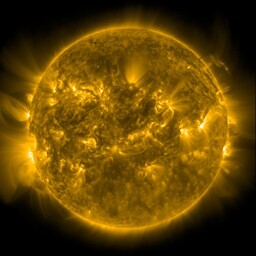
Updated Mar 19 2200 UTC

Joint USAF/NOAA Report of Solar and Geophysical Activity
SDF Number 079 Issued at 2200Z on 19 Mar 2012

IA.  Analysis of Solar Active Regions and Activity from  18/2100Z
to 19/2100Z:  Solar activity was low.  Region 1432 (N22W68) produced
a C1/Sf event at 19/1351Z while developing spots in an area that was
previously plage.

IB.  Solar Activity Forecast:  Solar activity is expected to be very
low to low for the next two days (20-21 March) until Regions 1432
and 1435 (S26W62) exit the visible disk.  Activity is expected to
decrease to very low levels with a chance for C-class activity on
day three (22 March).

IIA.  Geophysical Activity Summary 18/2100Z to 19/2100Z:
Geomagnetic field activity was at mostly quiet levels.  An isolated
period of active was observed for the 0300-0600Z synoptic period.
The enhanced activity followed what appeared to be the 15 March
transient arrival at the ACE spacecraft around 19/0315Z.  Total
field strength rose to 7nT, Bz turned southward to -7nT, wind speeds
reached up to 590 km/s, and temperature and density showed a slight
increase. The greater than 2 MeV electron flux at geosynchronous
orbit was at high levels throughout the period.

IIB.  Geophysical Activity Forecast:  Geomagnetic activity is
expected to be at quiet to unsettled levels on 20 March.  Activity
is expected to decrease to mostly quiet levels for the rest of the
period.
Latest Solar Flare Activity Causing Major Solar Storm 2012
Subscribe to:
Posts (Atom)