Showing posts with label Solar. Show all posts

Thursday, August 15, 2013

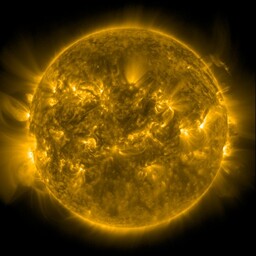
latest current solar flare storm activity august 15 2013


 latest current solar flare storm activity august 15 2013
Solar activity was at low levels. The largest event of the period, a
C2/Sf flare, erupted from Region 1818 (S07W07, Dki/beta) at 15/1756 UTC.
The region continued to exhibit a horizontal shear line and slight areal
growth over the period. The other region of interest, Region 1817
(S21W31, Ekc/beta-gamma-delta) exhibited some intermediate spot decay
but redeveloped intermixed magnetic fields including a weak delta within
the large leader spot. The region was responsible for a C1/Sf at 15/1835
UTC. Two new regions were numbered during the period; Region 1822
(S08E57, Dao/beta) rapidly evolved on the disk and Region 1823 (S07E72,
Hsx/alpha) rotated onto the disk. The remaining spot groups were either
stable or in slight decay. At about 14/2000 UTC, both SDO/AIA 304 and
GONG H-alpha imagery observed a 21 degree long filament eruption
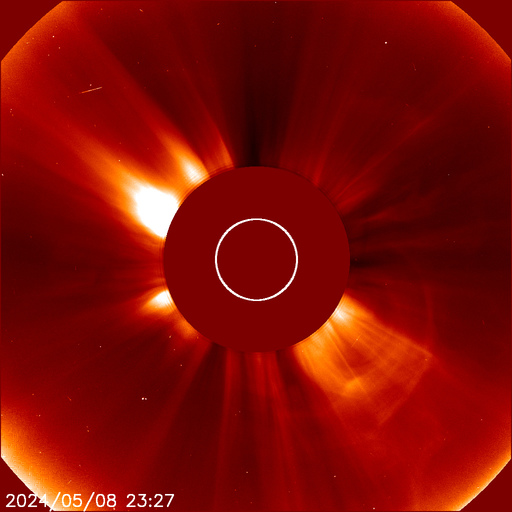
centered near S28W70. At 14/2200 UTC, SOHO/LASCO C2 imagery observed 
a slow-moving CME off the SW limb with a majority of the ejecta directed
just south of the ecliptic plane. WSA Enlil analysis indicated this CME
did not have an Earth-directed component.
.Forecast... Solar activity is expected to remain low for the next three days (16 - 18 Aug) with a chance for M-class activity (R1-R2 Radio Blackouts). Energetic Particle .24 hr Summary... The greater than 2 MeV electron flux at geosynchronous orbit was at normal levels. The greater than 10 MeV proton flux at geosynchronous orbit was at background levels. .Forecast... The greater than 2 MeV electron flux at geosynchronous orbit is expected to be at normal to moderate levels, with a chance for high levels, for the next three days (16 - 18 Aug). The greater than 10 MeV proton flux at geosynchronous orbit is expected to be at background levels for the next three days (16 - 18 Aug). Solar Wind .24 hr Summary... Solar wind measurements at the ACE spacecraft were consistent with coronal hole high speed stream (CH HSS) conditions as Earth remained under the influence of (-) CH54. Winds speeds began the period at around 475 km/s and remained steady at this speed through about 15/1130 UTC. A gradual rise was then observed to about 600 km/s through 15/1845 UTC where speeds remained steady through the end of the period. Interplanetary magnetic field (IMF) Bt varied between 4 nT and 11 nT while the Bz component of the IMF varied between +11 to -9 nT. Phi was in a predominately negative (toward) orientation through about 15/1000 UTC when it became variable between negative and positive (away). .Forecast... Solar wind conditions should continue to reflect CH HSS effects for the next two days (16 - 17 Aug). Peak speeds are forecast to be in the 550 km/s to 600 km/s range as the bulk of CH54 becomes more geoeffective. By day three (18 Aug), solar wind speeds are expected to slowly decrease as CH HSS effects began to wane. Geospace .24 hr Summary... The geomagnetic field was at quiet to active levels due to CH HSS effects. .Forecast... The geomagnetic field is expected to be at quiet to unsettled levels with isolated active periods on day one (16 Aug) as CH HSS effects persist. Quiet to unsettled conditions are expected on day two (17 Aug) becoming mostly quiet on day three (18 Aug) as CH HSS effects wane

Monday, November 19, 2012

Current Solar Flare Activity on 12/21/2012

12 21 2012, or December 21 2012 is often a date associated with the finish with the world. This date, 12 21 2012, arrives mostly from the extended count in the Mayan calendar. The Mayans for reasons unidentified were quite innovative within the study of astronomy. Their calendar is really many calendars in one. The calendar referred to as the extended count is the one which notes 12 21 2012 since the conclude in the earth as we realize it.The reason for this day is quite problematic. On December 21, 2012 or 12 21 2012, for the 1st time in 26000 a long time, the sun will conjunct the milky way, along with the elliptical plane

The Mayan Calendar has left us with a profound mystery. Academia, science and the clergy have labored long over the question as to why the calendar was extrapolated into the 21st century and why, on December 21st, 2012, it abruptly ends?


Eschatology could be the research in the stop of life on earth. There are several speculations just before 12 21 2012. One of many most recent instances for such speculation was referred to as Y2K. Though Y2K primarily was regarding computer systems, some noticed it like an indication from the end occasions. I think that a lot of folks experience that 2012 could be the conclude for any range of good reasons. Very first of all, guilt could play a part within this. Surely the human race has considerably to be ashamed of. Furthermore, many weather conditions changes and adjustments to our environment have taken spot. We've got noticed what alterations in local weather can do to our civilization in storms such as Katrina. Moreover to all of this, considerably of the world is facing horrible financial conditions

As the predicted date of the end of the world, that is the 12 21 2012 Polar Shift, draws nearer, the more we need to focus our attention on the innumerable things that could possibly happen on planet Earth. Theorists and experts alike have in fact, enumerated a number of possibilities that can take place come year 2012. Although there is no scientific proof to confirm that all such predictions will surely come true, there are countless of predictions about the possibilities that can happen in the envisaged Doomsday of 2012. Here are just a few of these possibilities that you should know regarding the December 12, 2012 Polar Shift so that you can be prepared as to what can possibly occur during such time:
1. Asteroid, Meteor And Comet
First and foremost, experts and theorists predict the possibility of experiencing an orbit which may culminate by colliding with our planet earth in the year 2012. While this may be the most predictable catastrophe come 2012, it will still be good to not doubt it and instead, equip ourselves with the appropriate survival kit to make sure that we stay alive even if the predicted phenomenon finally takes place.
2. Coronal Mass Ejection From The Sun
For those who may not know it, the CME or Coronal Mass Ejection which came from the sun and caused the year 1859's solar storm, is actually true. Such event took place during the month of September of 1859 bringing about a failure in the telegraph systems from corner to corner of North America as well as Europe. The same event is in fact, predicted to occur in the year 2012 when the end of the world is envisaged to take place. What is more, it is also forecast that there are going to be huge storms bringing such massive power blackouts at the same time, the wreckage of satellites.
3. Magnetic Pole Shift
Polar reversals such as the 12 21 2012 Polar Shift are predicted to be occurring at a time gap of 400,000 years. In fact, the most current polar shift that occurred happened about 730,000 years ago and not too many people even know about it. You see, even our scientists still lack the knowledge about polar reversals, in the same manner that they are not so sure until now, about how such magnetic fields are generated. Although they are able to predict that geomagnetic reversals such as the 12 21 2012 Polar Shift, would take about hundreds and hundreds of years to take place and that they actually cause no harm at all. But then this has been disputed as it was found out that polar shifts can actually take place in just a snap of the fingers, yes, as in anytime.
4. Explosion From The Black Hole
Another possibility that is expected to take place after a polar shift in planet Earth is the possible danger of a Galactic core explosion, or what is simply an explosion from the Black Hole at the center or middle of our galaxy. It is expected that such incident will bring about some cosmic ray super waves that would be gestured by a burst of gamma rays. These bursts are actually believed to cause the massively destructive tsunamis in our planet.

 There are many theories regarding just what will transpire on 12 21 2012. Several feel that solar flare activity will improve significantly and that a huge solar flare will strike the earth causing destruction. Other theories incorporate the earth being struck by a mystery planet or asteroid known as planet x. Nonetheless other speculations say that the earths wobble on its axis, will trigger drastic modifications while in the earths weather and environment creating mass destruction by components this kind of as tidal waves. Even though there are many diverse theories,several authorities agree that "something" will occur in 2012.Some people imagine that 2012 will mark the finish of everyday living on our planet, even though other people do not. Some see it as being a time of drastic change and survival for those that transform spiritually. So called specialists link the Mayan calendar with other prophesies these as Nostradamus, as well as the end occasions explained while in the Bible inside the guide of Revelations. Nevertheless there is certainly little or no if any connection to that actual day in both of these resources.
.
All of this could look just like the occasions preceding the end times.Considering that considerably with the info on 12 21 2012 is speculation, it is critical to have your data from a trustworthy resource. With this way you may make intelligent and educated decisions on what you feel. There are numerous authorities that sense 12 21 2012 is often a time for survival and good change. Let us hope that's true. 2012 Specifics

Friday, July 27, 2012

Report of Solar and Geophysical Activity 27 Jul 2012

IA.  Analysis of Solar Active Regions and Activity from  26/2100Z
to 27/2100Z:  Solar activity was moderate. Sympathetic activity
between Regions 1530 (S19E28) and 1532 (S20E53) produced a M2/1f
x-ray event at 1726Z on 27 July. The event was accompanied by a
Tenflare (340 sfu), type II and IV radio sweeps. The type II was
reported with an estimated speed of 2099 km/s, however a radial
speed estimate of the CME obtained from STEREO B coronagraph was
measured near 500 km/s. Initial analysis suggests that the transient
will not likely have a geoeffective trajectory. New Region 1533
(S28E18) developed today and was numbered. There were some
preliminary observations indicating a new region (not yet numbered)
rotating onto the disk in the southern hemisphere, behind Region
1532.

IB.  Solar Activity Forecast:  Solar activity is expected to be at
low levels for the next 3 days (28-30 July).

IIA.  Geophysical Activity Summary 26/2100Z to 27/2100Z:
The geomagnetic field was quiet. The greater than 2 MeV electron flux
at geosynchronous orbit reached high levels during the period.

IIB.  Geophysical Activity Forecast:  The geomagnetic field is
expected to be quiet to active on day 1 (28 July) as the onset of
coronal hole (CH) high speed stream effects are forecasted. The
field should remain mostly unsettled on day 2 (29 July) with
possible nighttime active levels from substorms. Conditions should
recover from unsettled to active levels to mostly quiet on day 3 (30
July) as CH effects wane.

Thursday, July 26, 2012

latest Solar flare activity july 26 2012

latest Solar flare activity july 26 2012

increasing chance for M-Class flare activity around Sunspot 1530. Solar activity is expected to be low with a slight chance for moderate activity depending on sunspot growth within the next several days.


Joint USAF/NOAA Report of Solar and Geophysical Activity
SDF Number 206 Issued at 2200Z on 24 Jul 2012

IA.  Analysis of Solar Active Regions and Activity from  23/2100Z
to 24/2100Z:  Solar activity was low.  New Region 1530 (S19E68) was
responsible for multiple low level C-class flares.  The largest was
a C4/Sf at 24/1905Z.  SDO and STEREO-B EUVI 195 imagery show
brightening behind the northeast and southeast limbs, suggesting the
presence of more active regions yet to rotate onto the visible disk.

IB.  Solar Activity Forecast:  Solar activity is expected to be at
low levels.

IIA.  Geophysical Activity Summary 23/2100Z to 24/2100Z:
The geomagnetic field was at quiet to unsettled levels with an
isolated minor storm period at high latitudes from 24/1200 - 1500Z. 
Solar wind measurements at the ACE spacecraft showed an increase in
solar wind speed from approximately 450 km/s to 580 km/s by 24/0830Z
before decreasing to 500 km/s by the end of the period.  This is
likely due to the influence of a geoeffective coronal hole high
speed stream.  The greater than 10 MeV proton event at
geosynchronous orbit that began at 23/1545Z, reached a maximum flux
of 12 pfu at 23/2145Z and continued to fluctuate near the 10 pfu
threshold. The greater than 2 MeV electron flux at geosynchronous
orbit reached high levels during the period.

IIB.  Geophysical Activity Forecast:  The geomagnetic field is
expected to be at quiet to unsettled levels with a slight chance for
active periods on day 1 (25 July) due to persistent effects from the
coronal hole high speed stream.  Mostly quiet conditions are
expected for days 2 - 3 (26 - 27 July).

III.  Event Probabilities 25 Jul-27 Jul
Class M    05/05/05
Class X    01/01/01
Proton     30/01/01
PCAF       yellow

Saturday, July 14, 2012

Visable aurora july 14 2012 solar flare storm

Visable aurora july 14 2012 solar flare storm
 If you’re far enough north, you might catch a glimpse of the magnificent aurora borealis. The northern lights sky show will be more intense tonight because the sun released a large solar flare on Thursday and Friday, and it’s just starting to affect Earth on Saturday morning.


The Display: Shows the intensity and location of the aurora from the solar flare as expected for the time shown at the bottom of the map. This forecast is based on current solar wind conditions and the average time for the solar wind to propagate from the ACE satellite at L1 to Earth.
The model produces an estimate of the intensity of the aurora. In this product a linear relationship between intensity and viewing probability is assumed. This relationship was validated by comparison with data from the UVI instrument on the NASA POLAR Satellite .
The sunlit side of Earth is indicated by the lighter blue of the ocean. The sub-solar point is also shown as a yellow dot but only if the sub-solar point is in the view of the choosen image. The day-night line or terminator is shown as a yellow line. Note that the aurora will not be visible during daylight hours and it may be an hour or more before sunrise or after sunset that the aurora can be seen from the ground.
____ The red line about 1000 km equatorward of the aurora indicates how far away viewers on the ground might see the aurora assuming good viewing conditions.


This is a big solar flare, classified by astronomers as “extreme,” but according to spaceweather.com, it’s barely into that extreme range. Just a few ticks less intense, and it would be ranked in the innocuous “M” (moderate) range.
Nevertheless, this latest solar flare still might be powerful enough for you to see those lovely northern lights tonight, even from latitudes as far south as New York. Will anything else be affected? No, you don’t have to worry about electronics being destroyed, even if you own an Earth-orbiting satellite.
 

latest Solar storm news and solar flare activity july 14 2012

Space Weather Message Code: WARK06
Serial Number: 199
Issue Time: 2012 Jul 14 1914 UTC

WARNING: Geomagnetic K-Index of 6 expected
Valid From: 2012 Jul 14 1915 UTC
Valid To: 2012 Jul 14 2359 UTC
Warning Condition: Onset
NOAA Scale: G2 - Moderate
Potential Impacts: Area of impact primarily poleward of 55 degrees Geomagnetic Latitude.
Induced Currents - Power grid fluctuations can occur. High-latitude power systems may experience voltage alarms.
Spacecraft - Satellite orientation irregularities may occur; increased drag on low Earth-orbit satellites is possible.
Radio - HF (high frequency) radio propagation can fade at higher latitudes.
Aurora - Aurora may be seen as low as New York to Wisconsin to Washington state.


An incoming Coronal Mass Ejection (CME) is expected this morning and could lead to Geomagnetic Storming at high latitudes. The plasma cloud was generated by an X1.4 Solar Flare on Thursday around Sunspot 1520. Continue to monitor the ACE Spacecraft Data for detection of the expected interplanetary shock. In the graph below, you will be looking for a sharp increase in solar wind speed (yellow line).
UPDATE: As of 13:30 UTC (9:30 EST), ACE has yet to detect a sharp increase in solar wind speed. The Proton Levels streaming past Earth are showing some signs of fluctuation however, and this is known to happen in advance of an incoming CME cloud.

 CME Update: The WSA-Enlil Solar Wind Prediction has been updated and is calling for the CME Plasma Cloud to sweep past Earth by 12:00 UTC (8:00am EST) early Saturday morning (July 14). The Goddard Space Center prediction has it forecast for 3 hours earlier. The latest model shows a Solar Wind increase to near 700 km/s.
 

Friday, July 13, 2012

latest Solar storm news and solar flare activity july 13 2012


Joint USAF/NOAA Report of Solar and Geophysical Activity
SDF Number 195 Issued at 2200Z on 13 Jul 2012

IA.  Analysis of Solar Active Regions and Activity from  12/2100Z
to 13/2100Z:  Solar activity has been at low levels for the past 24
hours. Region 1521 (S21W34) has been the most active region,
producing multiple low-level C-class events. Region 1520 (S16W23)
has decayed in area but remains the most magnetically complex region
on the disk, still classified as a beta-gamma-delta. The other four
numbered active sunspot regions have remained quiet and rather
stable. A CME was observed in LASCO C2 imagery at 13/0224Z. After
analysis, the CME was determined to not be geoeffective.

IB.  Solar Activity Forecast:  Solar activity is expected to be at
low to moderate levels for the next three days (14-16 July), as
Regions 1520 and 1521 continue to evolve and rotate toward the west
limb.

IIA.  Geophysical Activity Summary 12/2100Z to 13/2100Z:
The geomagnetic field has been at quiet levels for the past 24 hours.
The greater than 2 MeV electron flux at geosynchronous orbit reached
high levels during the period.

IIB.  Geophysical Activity Forecast:  The geomagnetic field is
expected to be at quiet to minor storm levels with a slight chance
for isolated periods at major storm levels on day one (14 July), due
the arrival of the 12 July CME. Unsettled to active levels with a
chance for minor storm periods are expected on day two (15 July), as
effects of the CME continue. A return to predominantly quiet levels
is expected on day three (16 July).

Wednesday, July 11, 2012

latest Solar storm news and solar flare activity july 11 2012

Joint USAF/NOAA Report of Solar and Geophysical Activity
SDF Number 193 Issued at 2200Z on 11 Jul 2012

IA.  Analysis of Solar Active Regions and Activity from  10/2100Z
to 11/2100Z:  Solar activity was low.  Regions 1519 (S15W18), 1520
(S17E06) and 1521 (S22W07) all produced C-class flares during the
period.  The largest event was a C9/1n at 11/0831Z from Region 1521.
Region 1520 indicated consolidation and rotation in its trailer
spots while developing additional sheer.  The region remained a
complex beta-gamma-delta magnetic configuration.  During the past 24
hours, Region 1521 elongated along its E/W axis and developed a
gamma configuration in its trailer spots.  The region is now
classified as an E-type beta-gamma group.  A 20 degree long filament
erupted in the NE quadrant of the disk at about 11/0930Z.  The
eruption occurred along a channel centered near N22E22.  Limited
LASCO imagery hinted at a possible CME that lifted off the NNE limb
likely associated with the filament eruption.  Further analysis of
this CME is ongoing.

IB.  Solar Activity Forecast:  Solar activity is expected to be
moderate with a slight chance for X-class events for the next three
days (12 - 14 July).

IIA.  Geophysical Activity Summary 10/2100Z to 11/2100Z:
The geomagnetic field was at predominately quiet to unsettled levels
with isolated high latitude minor to major storm intervals from
11/0600 - 1200Z.  ACE solar data indicated wind velocities remained
steady at about 500 km/s while the Bz component of the
interplanetary magnetic field did not vary much beyond +/- 5 nT. The
greater than 2 MeV electron flux at geosynchronous orbit reached
high levels during the period.

IIB.  Geophysical Activity Forecast:  The geomagnetic field is
expected to be at mostly quiet to unsettled levels for the next
three days (12 - 14 July).

Saturday, June 23, 2012

Latest Solar Storm News and Solar Flare Activity June 23 2012


An eruption took place early Saturday morning off the northwest limb resulting in a bright Coronal Mass Ejection (CME). Because of the location, the plasma cloud will be directed away from Earth.

Solar Update
Solar activity on the Earth facing side of the Sun should continue at very low levels this weekend. New sunspot 1511 was numbered on Friday, but so far remains a small and magnetically simple region.

Monday, June 18, 2012

latest Solar storm news and solar flare activity june 18 2012

Joint USAF/NOAA Report of Solar and Geophysical Activity
SDF Number 170 Issued at 2200Z on 18 Jun 2012

IA.  Analysis of Solar Active Regions and Activity from  17/2100Z
to 18/2100Z:  Solar activity was low.  Region 1504 (S15W53) produced
a few low level C-flares, the largest of which was a C1/Sf at
17/2139Z.  Region 1504 decreased in total area and ended the day at
690 millionths.  Regions 1505 (S13W53) and Region 1506 (N08W42)
showed signs of decay.  There were no Earth-directed CMEs observed
during the period.

IB.  Solar Activity Forecast:  Solar activity is expected to remain
low with a chance of isolated M-class activity from Region 1504.

IIA.  Geophysical Activity Summary 17/2100Z to 18/2100Z:
The geomagnetic field ranged from quiet to minor storm levels. 
Active levels were reached at the beginning of the period from
17/2100Z to 18/0300Z.  Minor storm levels were reached from 18/0300Z
to 18/0600Z.  This elevated activity was due to persistent effects
from the 13 and 14 June CMEs.   The remainder of the period showed a
steady decline to mostly quiet levels. The greater than 2 MeV
electron flux at geosynchronous orbit reached high levels during the
period.

IIB.  Geophysical Activity Forecast:  Geomagnetic activity is
expected to be quiet to unsettled on day 1 (19 June). Quiet levels
are expected on 20 - 21 June.

III.  Event Probabilities 19 Jun-21 Jun
Class M    25/25/25
Class X    05/05/05
Proton     05/05/05
PCAF       Green

IV.  Penticton 10.7 cm Flux
Observed           18 Jun 118
Predicted   19 Jun-21 Jun  115/110/095
90 Day Mean        18 Jun 119

V.  Geomagnetic A Indices
Observed Afr/Ap 17 Jun  036/055
Estimated Afr/Ap 18 Jun  013/016
Predicted Afr/Ap 19 Jun-21 Jun  008/010-006/006-006/005

VI.  Geomagnetic Activity Probabilities 19 Jun-21 Jun
A.  Middle Latitudes
Active                20/05/05
Minor storm           05/01/01
Major-severe storm    01/01/01
B.  High Latitudes
Active                20/15/15
Minor storm           30/15/10
Major-severe storm    25/05/05

Thursday, April 05, 2012

Solar flare and Geophysical Activity update April 2012

Solar Update
Solar activity remains very low with only B-Class X-Ray activity detected mostly around Sunspot 1450 and region 1451. The leader spot located within 1450 did show some growth over the past 24 hours. There will be a chance for C-Class flares.


Prepared jointly by the U.S. Dept. of Commerce, NOAA,
Space Weather Prediction Center and the U.S. Air Force.

Joint USAF/NOAA Report of Solar and Geophysical Activity
SDF Number 094 Issued at 2200Z on 03 Apr 2012

IA. Analysis of Solar Active Regions and Activity from 02/2100Z
to 03/2100Z: Solar activity has been very low for the past 24 hours.
Region 1450 (N16W04) produced two B4 flare events, one at 02/2220Z
and the other at 03/1228Z. A weak CME associated with a filament
eruption near N30E11, became visible on LASCO C2 imagery at
02/2348Z. This CME has a northerly trajectory and is not expected
to be geoeffective.

IB. Solar Activity Forecast: Solar activity is expected to be very
low with a chance for C-class flares for the next three days (04-06
April).

IIA. Geophysical Activity Summary 02/2100Z to 03/2100Z:
The geomagnetic field was at quiet levels for the past 24 hours.

IIB. Geophysical Activity Forecast: The geomagnetic field is
expected to be quiet to unsettled on days one and two (04-05 April)
due to a coronal hole high speed stream becoming geoeffective on 04
April, followed by the anticipated arrival of a weak CME associated
with the filament eruption that occurred at 02/0224Z. Day three (06
April) is expected to return to quiet levels.


III. Event Probabilities 04 Apr-06 Apr
Class M 01/01/01
Class X 01/01/01
Proton 01/01/01
PCAF green

Tuesday, April 03, 2012

Report of Solar and Geophysical Activity

Joint USAF/NOAA Report of Solar and Geophysical Activity
SDF Number 093 Issued at 2200Z on 02 Apr 2012

IA. Analysis of Solar Active Regions and Activity from 01/2100Z
to 02/2100Z: Solar activity has been very low for the past 24 hours.
Region 1451 (N17E25) produced a B7 event at 02/0234Z. New Regions
1452 (N18E47) and 1453 (S17E01) were numbered today. A weak
Earth-directed CME, associated with a filament eruption near N26E14,
became visible on LASCO C2 imagery at 02/0224Z.

IB. Solar Activity Forecast: Solar activity is expected to be very
low with a chance for C-class activity for the next three days
(03-05 April).

IIA. Geophysical Activity Summary 01/2100Z to 02/2100Z:
The geomagnetic field was quiet to unsettled during the past 24
hours.

IIB. Geophysical Activity Forecast: The geomagnetic field is
expected to be mostly quiet on day one (03 April). Quiet to
unsettled conditions are expected on days two and three (04-05
April) due to a coronal hole high speed stream becoming geoeffective
early on 04 April followed the next day by the arrival of the weak
CME associated with this mornings filament eruption.

Friday, March 23, 2012

Report of Solar flare Activity march 2012

Joint USAF/NOAA Report of Solar and Geophysical Activity
SDF Number 083 Issued at 2200Z on 23 Mar 2012

IA.  Analysis of Solar Active Regions and Activity from  22/2100Z
to 23/2100Z:  Solar activity was moderate.  Newly numbered Region
1445 (S24E76) rotated onto the solar disk and produced an M1 flare
at 23/1940Z as well as a C6 flare at 23/1639Z.  Region 1444 (N21E37)
was numbered overnight, but is small and stable.

IB.  Solar Activity Forecast:  Solar activity is expected to be low
to moderate, mainly due to additional activity from Region 1445.

IIA.  Geophysical Activity Summary 22/2100Z to 23/2100Z:
The geomagnetic field was initially unsettled, but decreased to quiet
levels after 23/0300Z.  The elevated activity was caused by a solar
sector boundary crossing. The greater than 2 MeV electron flux at
geosynchronous orbit reached high levels during the period.

IIB.  Geophysical Activity Forecast:  The geomagnetic field is
expected to be quiet for the next three days (24-26 March).

Tuesday, March 06, 2012

Report of Solar and Geophysical Activity 05 Mar 2012

Joint USAF/NOAA Report of Solar and Geophysical Activity
SDF Number 065 Issued at 2200Z on 05 Mar 2012

IA.  Analysis of Solar Active Regions and Activity from  04/2100Z
to 05/2100Z:  Solar activity has been high.  An X1/2b flare occurred
at 05/0409Z from Region 1429 (N17E41).  This flare was associated
with a full halo CME with a LASCO C3 plane of sky speed of about
1340 km/sec.  Region 1429 has a beta-delta magnetic class with an
area of approximately 810 millionths, and appears to be growing. The
region produced additional M-class flares during the period.  New
Region 1431 (S27W36) was numbered today and is a small B-type
sunspot group.

IB.  Solar Activity Forecast:  Solar activity is expected to be
moderate, but there is a chance for additional major flare activity
and/or a greater than 10 MeV proton event from Region 1429.

IIA.  Geophysical Activity Summary 04/2100Z to 05/2100Z:
The geomagnetic field has been mostly quiet to unsettled with the
exception of some active to minor storm periods at high latitudes. A
greater than 10 MeV proton flux enhancement began at about 05/0030Z.
Flux levels remained elevated throughout the day and reached a peak
of 3.9 pfu at 05/1630Z. The initial increase was associated with the
long duration M2 flare of 04 March, but additional particles were
also contributed by todays X1/CME event. The greater than 2 MeV
electron flux at geosynchronous orbit reached high levels during the
period.

IIB.  Geophysical Activity Forecast:  The geomagnetic field is
expected to be unsettled to active for day 1 (06 Mar) due to
combined effects from the M4/CME event observed on 04 March and a
favorably positioned coronal hole high speed stream.  Active
conditions with a chance for minor storm periods are forecast for
the second day (07 Mar) due to a expected glancing blow from todays
X1/full halo CME.  Predominantly unsettled levels are expected for
the third day (08 Mar).

III.  Event Probabilities 06 Mar-08 Mar
Class M    75/75/75
Class X    30/30/30
Proton     30/30/30
PCAF       green

Monday, March 05, 2012

Solar Flare Activity March 05 2012

Major X Class Solar Flare
A long duration and major X1.1 solar flare peaked at 04:09 UTC Monday morning around Sunspot 1429. A strong R3 Level Radio Blackout resulted. A bright Coronal Mass Ejection (CME) is now seen in the latest STEREO Behind and Lasco images. The expanding plasma cloud is mostly heading towards the north and east, however a small portion looks to be Earth directed. This is the 10th largest solar flare of the current Sunspot Cycle and it also happens to be the 10th X-Class flare as well. Stay Tuned for the latest updates.

Sunday, March 04, 2012

Recent Solar Flare Activity March 04 2012

Joint USAF/NOAA Report of Solar and Geophysical Activity
SDF Number 064 Issued at 2200Z on 04 Mar 2012

IA.  Analysis of Solar Active Regions and Activity from  03/2100Z
to 04/2100Z:  Solar activity was moderate.  A long duration M2/1N
flare was observed at 04/1052Z from Region 1429 (N18E55). 
Associated with the event was a 750 sfu Tenflare, Type IV Radio
Sweep, and a CME first visible in STEREO B COR 2 Imagery at 04/1210Z
(estimated speed of 840 km/s).  This region is classified as a Dkc
spot group with a Beta-Gamma-Delta magnetic configuration.  Further
analysis of the CME will be necessary as imagery becomes available,
however there appears to be a partial Earth-directed component.  A
glancing blow is possible from this event.

IB.  Solar Activity Forecast:  Solar activity is expected to be at
low to moderate levels with a slight chance for an X-class flare
from Region 1429.

IIA.  Geophysical Activity Summary 03/2100Z to 04/2100Z:
The geomagnetic field was at quiet to active conditions with an
isolated major storm period observed at high latitudes between
04/0900 - 1200Z.  Activity was due to extended periods of the
negative Bz component of the interplanetary magnetic field near -5
nT.   The solar wind speed at the ACE spacecraft was relatively
steady near 380 km/s. The greater than 2 MeV electron flux at
geosynchronous orbit reached high levels during the period.

IIB.  Geophysical Activity Forecast:  The geomagnetic field is
expected to be mostly quiet on day 1 (05 March).  Activity levels
are expected to increase on day 2 (06 March) due to a possible
glancing blow from todays CME associated with the M2/1N flare. 
Unsettled to active conditions are expected with isolated minor
storm periods possible.  Conditions are expected to settle down to
mostly quiet to unsettled conditions by day 3 (07 March) as the
effects of the CME wane.  There is a slight chance for a greater
than 10 MeV proton event from Region 1429 for the forecast period.

III.  Event Probabilities 05 Mar-07 Mar
Class M    60/60/60
Class X    15/15/15
Proton     15/15/15
PCAF       green

Long Duration M-Class Flare + CME
A long duration M2.0 Solar Flare peaked this morning at 10:45 UTC. The latest blast was again centered around Sunspot 1429 located in the northeast quadrant. A 46 minute long 10cm Radio Burst, also known as a TenFlare, was recorded as well and measured 750 pfu. A type IV Sweep Frequency Event resulted. Sometimes Long Duration flares can produce bright Coronal Mass Ejections. Stay Tuned to SolarHam.com for the latest information. UPDATE: The latest Solar Flare did generate a Coronal Mass Ejection. The blast is most likely directed to the east, but a portion of the cloud may be Earth directed. 


Sunspot 1429 now a BGD group
A large and active Sunspot rotated into view off the northeast limb. This sunspot group was numbered 1429 on Saturday, and was responsible for several C-Class flares and now two moderate solar flares. Sunspot 1429 continues to expand and now has a Beta-Gamma-Delta magnetic configuration, the most powerful kind of classification. There will be an increasing chance for an X-Class event.


Solar Update
Solar activity continues at moderate levels. A long duration M2.0 Solar Flare peaked at 10:45 UTC this morning and was centered around large Sunspot 1429. This region continues to rotate into a more geo effective position, and the chances for Earth directed Coronal Mass Ejections will increase. There will remain a chance for further M-Class flares on Sunday and a smaller risk of an isolated X-Class flare. Another sunspot, now numbered 1430, is forming just to the west of 1429. Elsewhere, new Sunspot 1428 in the southern hemisphere is currently stable.